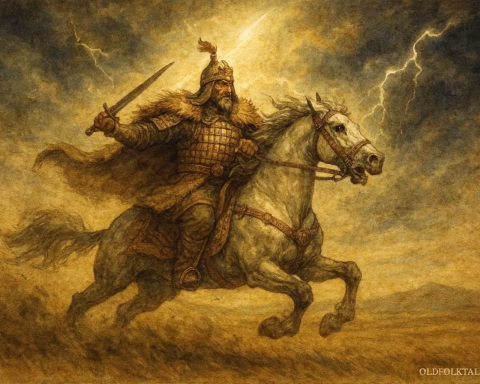
In the age when the sky still breathed upon the sea and the old gods walked at the edge of human sight, Rata the Voyager sought wisdom from the forest spirits of Tahiti and Aotearoa. From his union with the enchanted winds of Tāwhirimātea was born a son, Whakatau, a child whose cradle was the woven basket of a sacred net, whose first lullabies were the rustle of leaves whispering of destiny. It was said that the boy glowed faintly with the hue of dawn, a promise that he would someday shape light from darkness.
Raised in the village of his father’s people, Whakatau grew swiftly in strength and craft. Though slight of build, he possessed hands guided by divine intuition, hands that could coax a canoe from the heart of a tree as though the wood longed to sail the ocean. Elders spoke of how he listened to the living forest before his blade touched bark, offering prayer, song, and breath. Each stroke of his adze was an invocation. Each curl of wood was a future wave parted.
Yet even as the youth learned the arts of balance, between sea and land, mortal and god, the forest itself trembled with unrest. Deep in its labyrinthine shadows stirred the Nui Atua Rakau, monstrous spirits who despised humankind’s shaping of trees. They were wrath embodied: towering forms of knotted bark, eyes shining with sap-fire, limbs splitting into branches tipped with claws. For decades they had slept, soothed by ancient rites. But as the memory of those rites weakened among mortals, the creatures stirred, hungry to reclaim the world for the wild and the dark.
Their first strike fell upon villages bordering the sacred groves, where trees were found uprooted, houses shattered, and chiefs left trembling at the sight of footprints that sank deep as burial pits. The people pleaded with their gods, and the gods whispered one name: Whakatau.
On the morning he came of age, a cloak of red feathers shimmering across his shoulders, Whakatau stepped forward. “If the forest is wounded, I will speak to it,” he declared. “If darkness rises, then light must shape a path.”
He went alone into the woods, carrying only his carving tools and a small ceremonial paddle, symbol of his promise to bring peace. But the shadows thickened as he walked, and the forest grew silent, too silent. Then came the groan of bending trunks, the hiss of leaves, and the Nui Atua Rakau emerged from the gloom.
They towered above him, their wooden flesh creaking with malice.
“Child of Rata,” one rumbled, “you carve the bones of our kin. You steal what we guard.”
Whakatau bowed his head. “I carve only with consent. The trees speak to me. I honor them with voyage and story.”
But the spirits were not swayed. Weakened rituals had turned them to hatred; they saw all humans as thieves. With a sound like thunder cracking through roots, they attacked.
Whakatau leapt aside as a branch-claw tore through the earth. His mortal tools seemed small against the monstrous forms, yet he remembered his father’s lessons: the canoe is not merely wood, but the spirit of movement; to shape is to transform; to transform is to balance. With a cry to the gods, he struck his ceremonial paddle against the ground. Light rippled outward, forming a circle around him.
The battle that followed shook the groves. Whakatau dodged blows that splintered stone, answered each strike with one of his own, using not brute strength, but the artistry of a carver who understood the weakness and grain of living wood. He chipped, cleaved, and sliced without hatred, each blow precise as prayer. One spirit fell, its body collapsing into harmless driftwood. Another staggered under the glow of his divine aura. Yet the greatest of them remained: Te Rākau Nui, a titan whose barked shoulders held centuries of fury.
The giant seized Whakatau in vines that constricted like steel. “You will join the forest in silence,” it snarled.
Whakatau’s heart wavered. Was he truly honoring the trees, or had all his crafting been a slow theft? In that moment of doubt, the vines tightened, and from within the pain, revelation rose. Creation is not theft; creation is covenant. With a shout born of courage and sorrow, he drove his adze downward, cutting the vines while singing the ancient song his father had forgotten.
The spirit froze. The song flowed through the forest like returning wind, calming old wounds. The titan wavered, weakened by memory, and Whakatau struck its heartwood, ending its rage.
When the final monster fell, the forest sighed in relief. A path cleared before him. At its center stood a massive fallen tree, the last gift of Te Rākau Nui. Whakatau understood immediately. This was no spoil of battle but an offering: the tree wished to sail.
He spent seven days carving the greatest canoe his people would ever know. Its prow was shaped like a rising dawn, its hull engraved with the story of balance restored. When he launched it, the sea glimmered, and the wind carried the scent of renewed harmony.
Whakatau returned to his people a hero, not because he had slain monsters, but because he had listened, understood, and rebuilt the sacred bond between humans and the living world.
Author’s Note
Whakatau’s legacy endures as a model of balance: a hero who fought not for conquest but for harmony. His tale teaches that creation demands respect, courage, and moral clarity, and that every act of shaping the world must honor the spirits within it.
Knowledge Check (6 Questions)
-
What divine influence contributed to Whakatau’s birth?
-
How did Whakatau communicate with the forest before carving canoes?
-
Who were the Nui Atua Rakau?
-
What symbolic role did the ceremonial paddle play in the story?
-
What moral struggle did Whakatau face during the battle?
-
What was the significance of the tree offered after the final monster fell?
Cultural Origin: Tahitian and Māori mythological traditions, particularly the epic cycles surrounding Rata and his descendants.
Source: Teuira Henry, Ancient Tahiti (1928).