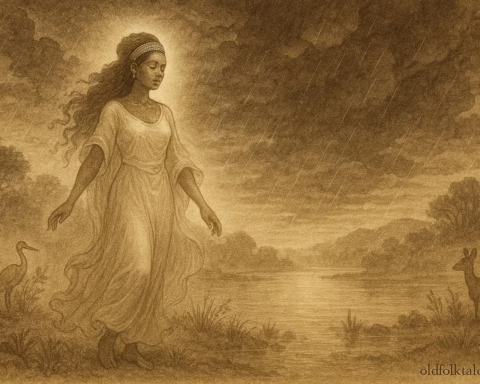
Before the first snows ever touched the edges of the northern forests, before rivers learned their winding paths, and before humankind found its breath, the Spirit-Makers shaped the great expanse of all things. From their council fire rose Wisakedjak, child of dawn, walker between realms, the one ordained to renew creation when darkness rose against it.
He was not yet the playful wanderer some later tales remembered. In the age of first struggles, he bore the mantle of cosmic restorer, with responsibility heavier than stone, older than time.
For many seasons the world knew harmony. Animals roamed freely. Humans, newly made, listened to the pulse of the land. But as cycles turned, a shadow deepened across the continent. A great corruption, born of ancient disobedience, seeped into rivers, hardened in the hearts of monsters, and stirred chaos among the storms above.
Soon the waters themselves rose, first as creeping tides, then as an unending deluge. The flood swept across the earth with a roar like a sky-splitting drum. Valleys drowned. Mountains shuddered. Entire forests vanished beneath the churning waves. Humans clung to drifting debris, crying to the spirits for salvation.
In the storm’s heart, Wisakedjak stood upon a lone piece of floating cedar, robes heavy with rain, the wind striking him like whips of ice. He raised his voice toward the unseen heavens.
“Let the world not perish in blindness,” he called. “Grant me strength to rebuild what is lost.”
Thunder answered. The waters surged higher. Wisakedjak felt the weight of failure pressing upon him. In his heart, he wondered whether humankind deserved saving, for he had seen their quarrels, their forgetting of sacred duties, their careless wounding of the earth. Was it right to restore a world already stained by disobedience?
This hesitation, this flicker of doubt, was his great moral trial. The Spirit-Makers had given him power, but not certainty. Renewal required more than strength; it required compassion deeper than the wounded earth itself.
At last he steadied his breath and declared:
“Even the flawed must be guided. Even the lost must have a path.”
With that vow, his purpose renewed like fire catching dry bark.
Through storm and darkness he traveled across the endless flood, seeking any creature that had survived. At last he came upon Otter, exhausted but swimming with grim determination.
“Brother,” Wisakedjak said, “I seek the earth beneath these waters. Will you dive to its bottom and bring a handful of soil, that creation might begin anew?”
Otter nodded with weary courage and plunged beneath the waves. Wisakedjak waited. The storm raged. The waters churned. But Otter did not return. Only his body rose, lifeless upon the roiling surface, paws still curled as though clutching hope itself.
Wisakedjak bowed his head. “Brave one, your strength will not be forgotten.”
Beaver came next, proud and sturdy. Without hesitation, he dove. He, too, did not return alive. Wisakedjak’s sorrow deepened, for he understood now: restoring the world required sacrifice, not only his own but that of all creation.
At last, Little Muskrat paddled forward on trembling limbs.
“I am small,” Muskrat squeaked, “and my lungs burn easily. But I will try.”
Wisakedjak tried to dissuade him. “No, little one, you are too fragile.”
Muskrat shook his whiskered head. “Even the smallest may carry the world on their back.”
Then he dove. The waters swallowed him, swirling with the remains of drowned forests and shattered mountains. Muskrat swam deeper than any creature before him. Darkness closed around his small body, crushing, freezing. Yet he pressed onward.
At last, when his breath had nearly fled his body, he reached the bottom, the silent cradle where the old world slept. He scooped a single handful of earth into his paws and pushed upward toward the light.
When his body surfaced, Wisakedjak caught him and let out a cry of grief, for the tiny hero no longer breathed. But in Muskrat’s limp paw lay the miracle needed: damp soil, shining faintly with the memory of land.
From the depths of sorrow and sacrifice, Wisakedjak rose to his full divine stature. He placed the earth upon the shell of Turtle, who had waited patiently through storm and despair.
“Turtle, bearer of worlds,” he said, “carry this seed of land, and let it grow.”
The soil spread, forming mountains, forests, plains, and rivers. The waters receded. Light returned.
Wisakedjak breathed life into the renewed land. Then he knelt by the spirits of the fallen animals.
“Your courage restored creation,” he whispered. “Your names will echo long after suns have burned out.”
At the rebirth of the world, he called the surviving humans and spoke a final teaching:
“Walk in balance. Honor the beings who shaped your home. Forget not the price of your survival. And know that when darkness rises again, creation endures, not through might, but through sacrifice shared.”
Thus Wisakedjak became not only restorer of earth but guide of humankind, the one who taught that the world’s renewal is everyone’s sacred responsibility.
Author’s Note
Wisakedjak’s legacy as cosmic restorer shows that heroism is not merely triumph over danger but the courage to choose compassion in moments of doubt. His story reminds generations that the world survives through cooperation, humility, and shared sacrifice.
Knowledge Check
-
What disaster forces Wisakedjak to act as a cosmic restorer?
-
What moral struggle does Wisakedjak face before choosing to save humanity?
-
Which three animals attempt to dive for earth beneath the flood?
-
Which creature succeeds in bringing soil to Wisakedjak?
-
What symbolic role does Turtle play in the restoration of the world?
-
What core teaching does Wisakedjak give to humans after the world is renewed?
Cultural Origin: Algonquian (primarily Cree, Ojibwe, and related nations)
Source: Henry Rowe Schoolcraft, Algic Researches (1840s), documenting Algonquian cosmological cycles.