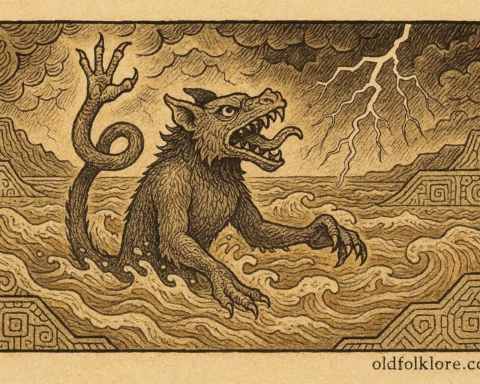
Xólotl is a profound and enigmatic figure in Aztec cosmology, often depicted as a dog-headed deity and the twin of Quetzalcoatl, the feathered serpent. His domains encompass fire, lightning, death, and transformation. Xólotl acts as a psychopomp, guiding souls through Mictlan, the Aztec underworld, ensuring their safe passage and the continuity of cosmic cycles.
He embodies paradox: terrifying in appearance yet necessary, destructive yet regenerative. Xólotl is associated with the evening sun, eclipses, and twilight, reflecting the transitions between life and death. Rituals invoked him during dangerous journeys, eclipses, or fires, and sacred dogs were often buried with their owners to serve as companions for Xólotl’s underworld guidance. Codices depict him as both canine and human in form, symbolizing his liminality and ability to traverse worlds. Through sacrifice, vigilance, and guidance, he ensures transformation and the ongoing rhythm of existence.
Mythic Story
In the heart of the Aztec cosmos, where fire danced in the sky and death awaited all mortals, Xólotl moved silently, a shadow at the edge of light. His twin, Quetzalcoatl, illuminated the heavens as the morning star, but Xólotl belonged to dusk and darkness, carrying the weight of endings and transitions. Though feared, his role was sacred: without him, life could not endure, for death is the crucible of transformation.
The story begins with the sun’s peril. The world had already endured the failures of prior suns, each destroyed by chaos and calamity. The current sun, Tonatiuh, required motion, a journey across the sky to sustain life. The gods determined that one must sacrifice to ensure the sun’s movement. Xólotl, understanding the cosmic necessity, volunteered his own form. Disguised as a monstrous dog, he descended to Mictlan, confronting the labyrinthine underworld to retrieve the bones of previous generations of humans.
The underworld was treacherous: rivers of darkness, jagged rocks, and spirits who tested courage and will. Xólotl’s form as a dog allowed him to navigate the caverns, slip past the fierce guardians, and carry bones back to the earthly plane. Each step he took was a negotiation with death itself, a careful balance between the pull of life and the inevitability of mortality. With his twin Quetzalcoatl, he ground the bones into dust and sprinkled them across the earth, from which humanity would be reborn. Through this act, Xólotl demonstrated the paradox of his domain: destruction that sustains, darkness that nourishes life.
But his tasks were not complete. In another myth, Xólotl must accompany the sun through the underworld each night, a journey as vital as the rising sun itself. He becomes the evening star, the twin in the sky, leading Tonatiuh’s descent while fending off chaotic forces. During eclipses, it is said that Xólotl wrestles with the monstrous darkness that would devour the sun. His dog-headed form, both frightening and protective, symbolizes his liminal power, at once close to death and intimately connected to life’s continuity.
Xólotl’s guidance was not limited to cosmic duties. The Aztec people believed that he walked with the dead, especially those who passed without ceremony. Dogs, as earthly companions, were sacrificed to accompany humans into Mictlan, reflecting the enduring bond between Xólotl and his charges. In this way, he becomes not only a guardian of the universe but also a caretaker of souls, a necessary guide through darkness, reminding all that transformation, whether cosmic or personal, requires courage, surrender, and trust in the cycles of life.
Even in his terrifying form, Xólotl is a teacher. He demonstrates that fire can both destroy and illuminate; that lightning can strike fear yet inspire awe; that death, though inevitable, is a passage toward renewal. Aztec rituals, festivals, and codices preserve his image, showing him leading the dead, the bones, the sun, and the evening stars across the skies and earth. He is a deity of paradox and transition, embodying the truth that all life flows through cycles of death, sacrifice, and transformation.
Through these stories, Xólotl’s presence reminds mortals that endings are necessary, that light depends on darkness, and that transformation, though often terrifying, is the foundation of existence. He is the shadow twin, the companion to the bright, the guide who teaches that true courage is facing what others fear and leading it toward renewal.
Discover the gods, goddesses, and divine spirits who ruled the heavens and shaped human fate
Author’s Note
Xólotl’s myth imparts lessons on the inevitability and necessity of transformation. He embodies the courage to confront darkness, the wisdom to guide others through transitions, and the understanding that destruction often precedes creation. In human terms, he teaches that fear and mortality are not ends, but pathways to growth, insight, and renewal.
Knowledge Check
Q1: Who is Xólotl’s twin?
A: Quetzalcoatl, the feathered serpent.
Q2: What are Xólotl’s primary domains?
A: Fire, lightning, death, and transformation.
Q3: What role does Xólotl play in the Aztec underworld?
A: He guides souls through Mictlan and retrieves human bones for renewal.
Q4: Why is Xólotl depicted as dog-headed?
A: His canine form allows him to traverse the underworld and symbolizes liminality.
Q5: How does Xólotl demonstrate the paradox of life and death?
A: Through acts that are both terrifying and necessary, such as guiding souls and aiding cosmic cycles.
Q6: What moral lesson does Xólotl convey?
A: Courage and transformation are essential; death and darkness are integral to life’s cycles.
Source: Codex Borgia and Codex Telleriano-Remensis, Aztec Civilization.
Source Origin: Aztec, Central Mexico