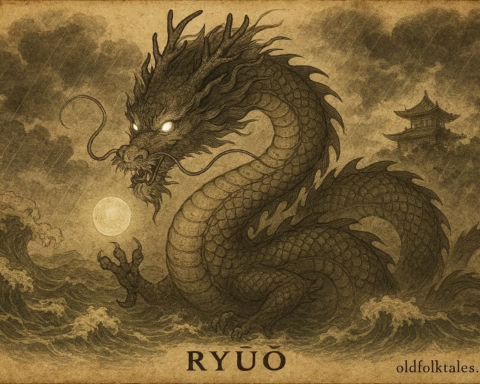
The Yamata-no-Orochi is one of the most fearsome beings in Japanese mythology: a gigantic serpent or dragon possessing eight heads, eight tails, and a body so vast it sprawls across eight valleys and eight hills. Its eyes are said to glow like burning embers; moss and trees grow upon its scales; and its belly is perpetually red, stained with the blood of its victims.
When the storm-god Susanoo-no-Mikoto was cast out of Heaven for mischief, he descended to the River Hi in Izumo, where he met an old couple, Ashinazuchi and Tenazuchi, weeping by the water. They explained that every year the monstrous Orochi came to devour one of their eight daughters; seven were already gone, and only Kushinada-hime remained.
Moved to pity (and attracted by her beauty), Susanoo devised a plan. He transformed Kushinada into a comb, placed her in his hair for safekeeping, and instructed the couple to prepare eight vats of potent sake. When the Orochi arrived, each of its eight heads drank deeply and fell into drunken sleep. Seizing his moment, Susanoo drew his sword and sliced the monster apart, blood flooding the valley. In the serpent’s final convulsions, his blade struck something hard inside its tail, a gleaming divine sword later named Ama-no-Murakumo-no-Tsurugi, “Sword of the Gathering Clouds of Heaven.”
This weapon was presented to Amaterasu, the sun-goddess, and ultimately became the revered Kusanagi-no-Tsurugi, one of the Three Imperial Regalia of Japan, symbols of imperial authority and divine descent.
Cultural Role and Symbolism
The Yamata-no-Orochi legend functions on multiple levels, mythic, ritual, natural, and political, forming a nexus of Shinto cosmology and Japanese cultural identity.
1. Mythic and Theological Significance
The battle between Susanoo and Orochi dramatizes the taming of chaotic nature by divine order. As a storm deity, Susanoo embodies uncontrollable weather and wildness, yet through heroic action he channels destructive power toward protection and renewal. The slain serpent’s body literally yields a sacred sword, transformation of chaos into divine instrument.
2. Imperial Symbolism
The discovery of the sword within Orochi’s tail forges a link between mythic heroism and imperial lineage. The Kusanagi sword, together with the mirror and jewel, became the symbols of the Japanese throne, integrating local Izumo myth into national mythology. In ritual context, the story legitimized the emperor’s divine ancestry and the unity of Heaven and Earth through sacred regalia.
3. Environmental and Natural Imagery
Orochi’s eight-headed form may symbolize branching river systems or floodwaters of the Izumo plain. Many scholars interpret the myth as an etiological explanation of flood control or a metaphor for agriculture, Susanoo, the storm-bringer, subduing destructive waters to render them fertile. The multiple heads and valleys correspond to the tributaries of the River Hi, suggesting the serpent as personified natural disaster.
4. Moral and Spiritual Themes
The tale celebrates courage, cleverness, and devotion. Susanoo’s redemption arc, from exile to hero, reflects a Shinto moral: divine power must harmonize with compassion. The sake that lulls Orochi signifies the use of human ingenuity rather than brute force. The myth teaches that chaos can be subdued not by suppression but by transformation into sacred order.
5. Ritual and Local Worship
In some regions of Japan, especially Izumo and the Ibuki mountains, Orochi is not purely demonized. Certain shrines venerate the serpent as a kami (spirit) representing fertility or rainfall. Ritual dramas (kagura) reenact Susanoo’s battle annually, accompanied by music and dance, ensuring agricultural prosperity. Thus, the myth oscillates between destruction and blessing, a duality central to Shinto worldview.
Historical Context and Variants
The Kojiki (712 CE) and Nihon Shoki (720 CE) both record the Orochi episode, though with differing details. The Nihon Shoki preserves several variant versions, shifting the setting, the couple’s genealogy, and even the outcome, a hallmark of early oral mythography being canonized in writing. Later commentaries, such as those by Motoori Norinaga in the Edo period, interpreted Orochi as a symbol of unruly nature or foreign threat, reflecting political readings over time.
Artistic depictions from the Heian through Edo periods portray Orochi as a multi-headed dragon coiling around mountains, sometimes breathing fire, sometimes enshrined as guardian deity. Modern media, from kabuki to anime, continue to adapt the legend, often emphasizing its romantic or heroic aspects. Yet the core message endures order emerging from chaos, divine virtue forged in trial.
Explore the mysterious creatures of legend, from guardians of the sacred to bringers of chaos
Author’s Note
As a folklorist, I am struck by how the Yamata-no-Orochi story binds myth, geography, and governance into a single mythopoetic thread. The serpent is not merely a monster; it is the embodiment of untamed nature, the floodwaters that both nourish and destroy. Susanoo’s act of slaying is an act of balance restoration, mirroring the Shinto principle that harmony arises when human and natural forces are aligned. The survival of this myth from the 8th-century chronicles to modern cultural imagination attests to Japan’s enduring reverence for the interplay between destruction and creation.
Knowledge Check (Q & A)
- Q: What does “Yamata-no-Orochi” literally mean?
A: “Eight-Forked (or Eight-Branched) Great Serpent.” - Q: Who defeats Yamata-no-Orochi in the myth?
A: The storm-god Susanoo-no-Mikoto, brother of the sun-goddess Amaterasu. - Q: What weapon is found inside Orochi’s tail?
A: The divine sword Ama-no-Murakumo-no-Tsurugi, later called Kusanagi-no-Tsurugi. - Q: What does Orochi symbolize in Japanese cosmology?
A: Chaotic natural forces, especially floods or uncontrolled waters, that must be harmonized. - Q: How does Susanoo defeat the serpent?
A: By intoxicating its eight heads with sake and cutting it apart while it sleeps. - Q: What modern cultural significance does the tale hold?
A: It remains central to Shinto ritual drama, imperial mythology, and Japanese art as a symbol of bravery and renewal.
Source:
Primary: Kojiki: Records of Ancient Matters (trans. Basil Hall Chamberlain, 1882, Public Domain).
Secondary: Kokugakuin University Encyclopedia of Shinto, entry “Yamata-no-Orochi.”
Additional comparative notes: Nihon Shoki (720 CE) variant accounts.
Origin:
Japan, early Nara-period texts (compiled 712–720 CE). Mythic setting: the “Age of the Gods,” particularly the Izumo region.