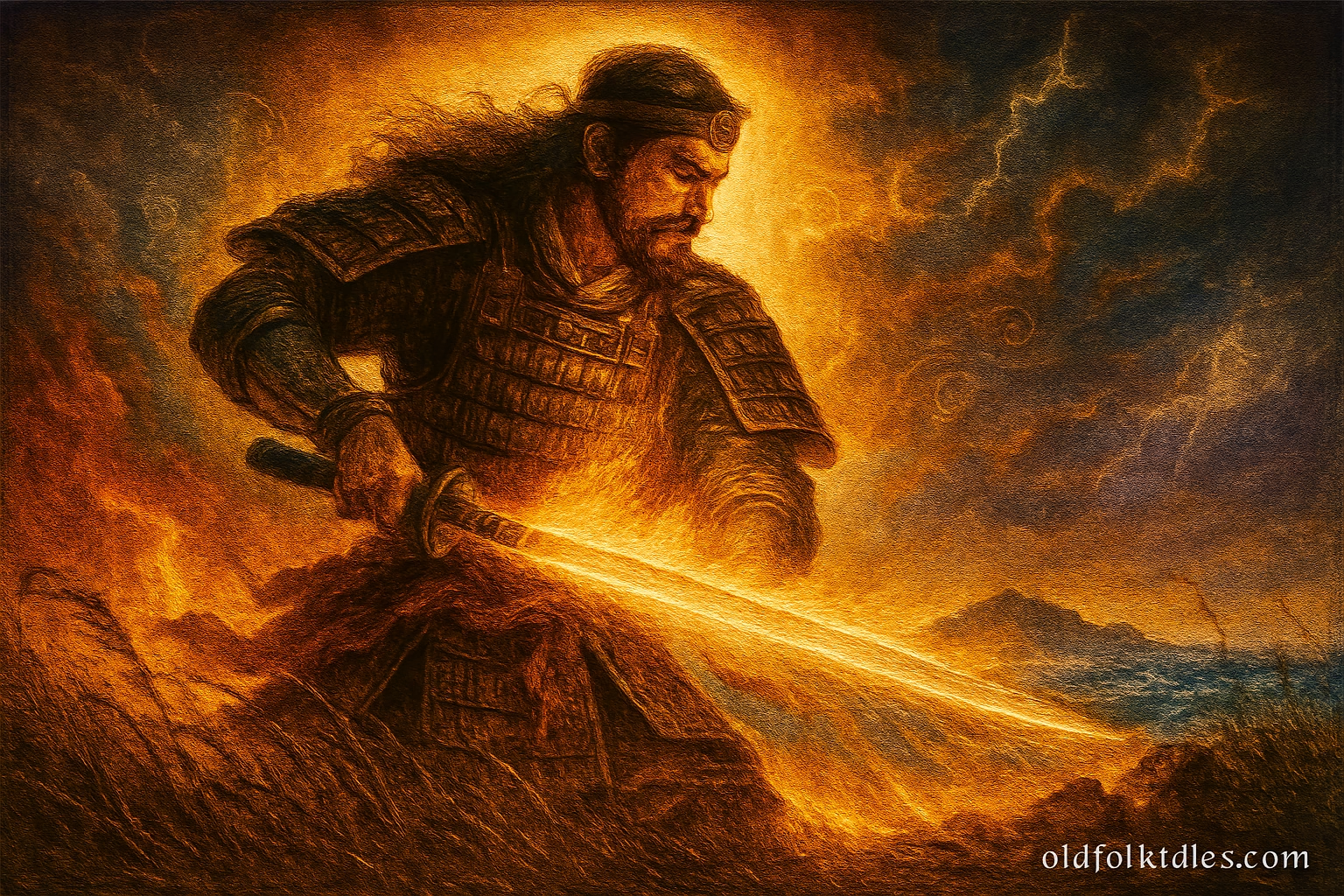
Before memory settled upon the islands of Japan, before shrines rose to honor gods and emperors, the land trembled under the weight of spirits, some benevolent, others fierce and hungry for disorder. In this early age stood a prince whose destiny was woven from divine lineage and human sorrow: Yamato Takeru, son of Emperor Keikō, warrior of flame-hearted courage, and bearer of the sacred blade Kusanagi-no-Tsurugi, one of the Three Imperial Regalia.
From his youth, Yamato Takeru walked with a presence that made mortals bow and spirits pause. His divine origin showed in the sharpness of his gaze, luminous as steel touched by dawn. Yet divinity did not shield him from hardship. His elder brother, consumed by envy and shadowed pride, provoked him into a deadly confrontation. Pressed to defend himself, Yamato Takeru struck down his brother, sealing his early years with tragedy. The Emperor, grieving yet bound by duty, saw in his youngest son both brilliance and danger. Thus, he sent the prince far from the court, first to the wild lands to subdue unruly tribes, then to confront the monstrous spirits that threatened imperial order.
It was exile disguised as duty. But Yamato Takeru accepted his father’s commands with unwavering obedience, believing that honor lay not in comfort but in action.
His first trial brought him to the Kumaso brothers, warriors feared across the south. Disguised as a maiden during a feasting ceremony, Yamato Takeru approached them with calculated grace. At the opportune moment, he cast aside the guise, revealing the fire of his true nature, and struck down both men. As one brother died, he gasped a name that would echo through the centuries: “Takeru… the Brave One.” Thus the prince received the name by which future generations would remember him.
Yet triumph did not soothe the heaviness in his spirit. “Why must the sword take what the heart wishes to spare?” he wondered. But no answer came, only the next command.
His father then sent him eastward, toward the lands of the Emishi, whose rebellion threatened imperial rule. Before he departed, his aunt, Princess Yamato-hime, high priestess of Ise, perceived the storms gathering around the young prince’s fate. With solemn care, she bestowed upon him the sacred Kusanagi-no-Tsurugi, a sword originally drawn by the storm god Susanoo from the tail of the slain serpent Yamata-no-Orochi. With it, she gave him a fire-striking kit, whispering: “May the gods shield your heart as well as your body.”
Her blessing would save him sooner than she knew.
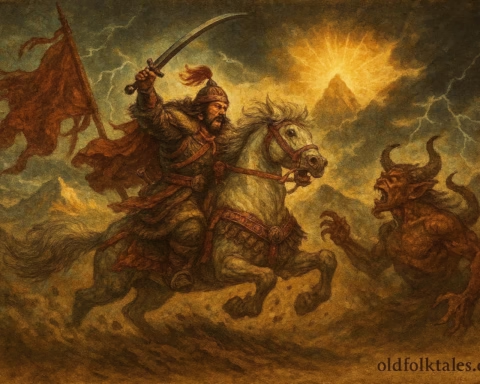
In the eastern wilds, treachery awaited. A local chieftain, pretending to honor Yamato Takeru, lured him into a vast grassland. With a flick of malice, the chieftain set the field ablaze. Flames surged in every direction, devouring the plain and curling toward the prince. But Yamato Takeru, recalling the gift from Ise, knelt and struck fire against fire. Using Kusanagi, he sliced through the burning grass, controlling the wind itself; the sacred blade bent the flames to his will. A ring of fire swirled outward, consuming the enemy and carving his name deeper into legend.
From that trial onward, Kusanagi became not merely a weapon but a companion, whispering divine guidance when his own courage faltered.
But the more Yamato Takeru triumphed, the more the weight of bloodshed pressed upon him. Each victory added glory to his name but carved sorrow into his heart. He fought not for conquest but for duty, and duty rarely granted peace.
At last, after quelling the eastern rebellions, he journeyed westward to confront the mountain god of Ibuki, a spirit of storms who despised mortals. Yamato Takeru, weary from his many campaigns and forgetting the sacred sword in a moment of uncharacteristic haste, climbed the mountain alone. The god appeared before him as a colossal white boar. With reckless pride, the prince underestimated the creature, striking it with a mere wooden blade he carried at his side. At once, the boar vanished like mist, revealing it had been an illusion meant to mock him.
The true god’s wrath struck him unseen. A tempest swept over the mountain, and Yamato Takeru was struck by a curse that weakened his limbs and drained his divine strength. Stumbling down the slopes, coughing and fevered, he realized too late the folly of leaving Kusanagi behind.
Though he struggled on, hoping to return home, his body succumbed near the plains of Nobono. Gazing across the open sky, he whispered a final prayer, that Japan might know peace beyond the trials of one warrior’s path. In that last moment, his spirit transformed into a great white bird, soaring upward into the heavens. The people who later found his fallen body raised a shrine in his honor, naming him the White Bird Prince, forever ascending, forever watching.
Thus ended the mortal journey of Yamato Takeru, the tragic hero whose divine destiny carried both brilliance and sorrow, and whose blade shaped the order of Japan.
Author’s Note
Yamato Takeru remains one of Japan’s most iconic mythic heroes, half divine, half human, and wholly bound by duty. His story in the Kojiki and Nihon Shoki reflects the early Japanese ideal of the warrior whose strength is matched only by his capacity for sacrifice. His association with the Kusanagi-no-Tsurugi symbolizes imperial legitimacy and divine protection. Shrines dedicated to him across Japan preserve his legacy as both conqueror and guardian spirit.
Knowledge Check
-
What divine or semi-divine lineage does Yamato Takeru descend from?
-
How did Yamato Takeru receive his name “Takeru”?
-
What sacred object did Princess Yamato-hime give him, and why was it important?
-
How did Yamato Takeru escape the burning grassland?
-
What mistake led to his downfall on Mount Ibuki?
-
In what form did Yamato Takeru’s spirit ascend after his death?
Cultural Origin: Japan, Kojiki and Nihon Shoki (8th century CE)
Source: Kojiki, trans. Donald L. Philippi (Princeton University Press, 1968). Cultural Origin: Japan.