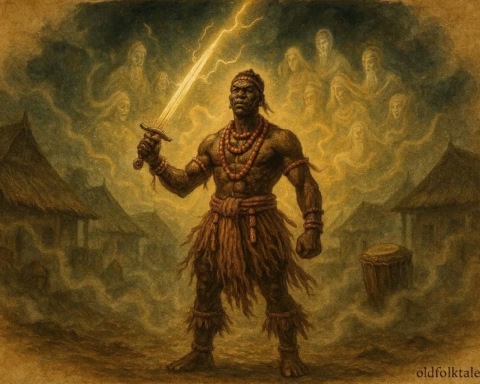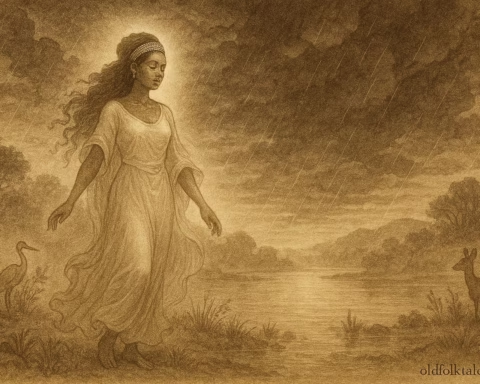
Before the rivers of the Pacific rainlands carved their winding paths toward the endless sea, before the ceiba roots bound sky to earth, a cry of thunder split the night. From that crack in the firmament descended Yurumangui, born of a jaguar-star and a river-spirit mother, his spirit half flame and half flowing water. In the heavens he had been a streak of gold, hunting the shadows that sought to swallow the constellations. On earth, he arrived as a protector of the living, tasked to guard the Chibchan clans and the Afro-Colombian families who dwelled along the rain-drenched rivers.
As a child of two realms, Yurumangui bore eyes that glowed amber in darkness, and markings like molten stripes rolled across his skin whenever danger approached. The elders knew he was no mortal boy, for storms moved differently when he walked, winds pausing to listen, rivers bending with respect. Under the tutelage of the forest spirits, he learned how every creature possessed a law, every root held a lesson, every current sang a warning. From the ancestors he learned a deeper truth: the world survives only when its laws of balance are honored.
Yet balance was already breaking.
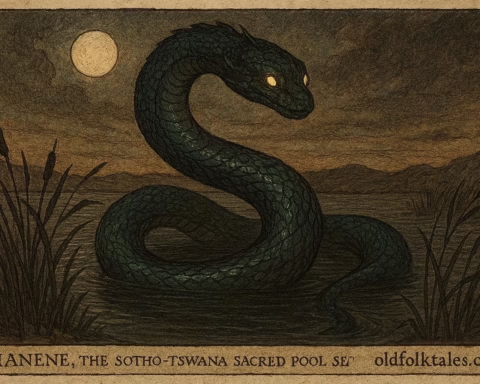
For in the depths of the Atrato and the San Juan rivers slithered ancient beings born before memory, the N’gola, monstrous river serpents with armored scales black as drowned moons. They gorged on fish, swallowed canoes whole, and churned the water into whirlpools that devoured entire villages. The people prayed at night, their songs trembling on the wind:
“Let the jaguar-star descend. Let the water-son come.”
Yurumangui heard.
He journeyed along the riverbanks, where the air smelled of wet earth and mangrove sap, and soon found the trail of the N’gola, a path of broken trees, overturned boats, and silence where birds once sang. When he reached a village drenched in fear, the survivors whispered of a monstrous serpent whose breath boiled water and whose coils could crush a ceiba in one tightening.
Yurumangui knelt by the trembling families. “I will face it,” he said. His voice was calm, like the stillness before a storm. Yet beneath that calm lived a growing weight, a dawning moral struggle. The N’gola, though monstrous, were ancient river guardians created when the first mountains split. If he destroyed them, would he unbalance the rivers further? But if he left them free, the people would perish.
The hero sought guidance.
He entered the sacred rainforest, where the trees rose like pillars in a cosmic temple. There he found Hua-Mbé, the grandmother spirit of the forest, who wore leaves for hair and glowed with the soft green of new shoots.
“You cannot defeat the N’gola by strength alone,” Hua-Mbé warned. “Strike blindly, and the river laws will collapse. Destroy without knowledge, and your own soul will fracture.”
“What must I learn?” Yurumangui asked.
“That guardians who forget their duty become tyrants. The N’gola turned monstrous because humans broke the river laws, overfishing, poisoning waters, ignoring sacred rhythms. Punish the serpents alone, and you punish only half the crime.”
The words struck him like a spear. He saw the deeper struggle: his mission was not simply to slay monsters, it was to restore the order between humanity, spirit, and water.
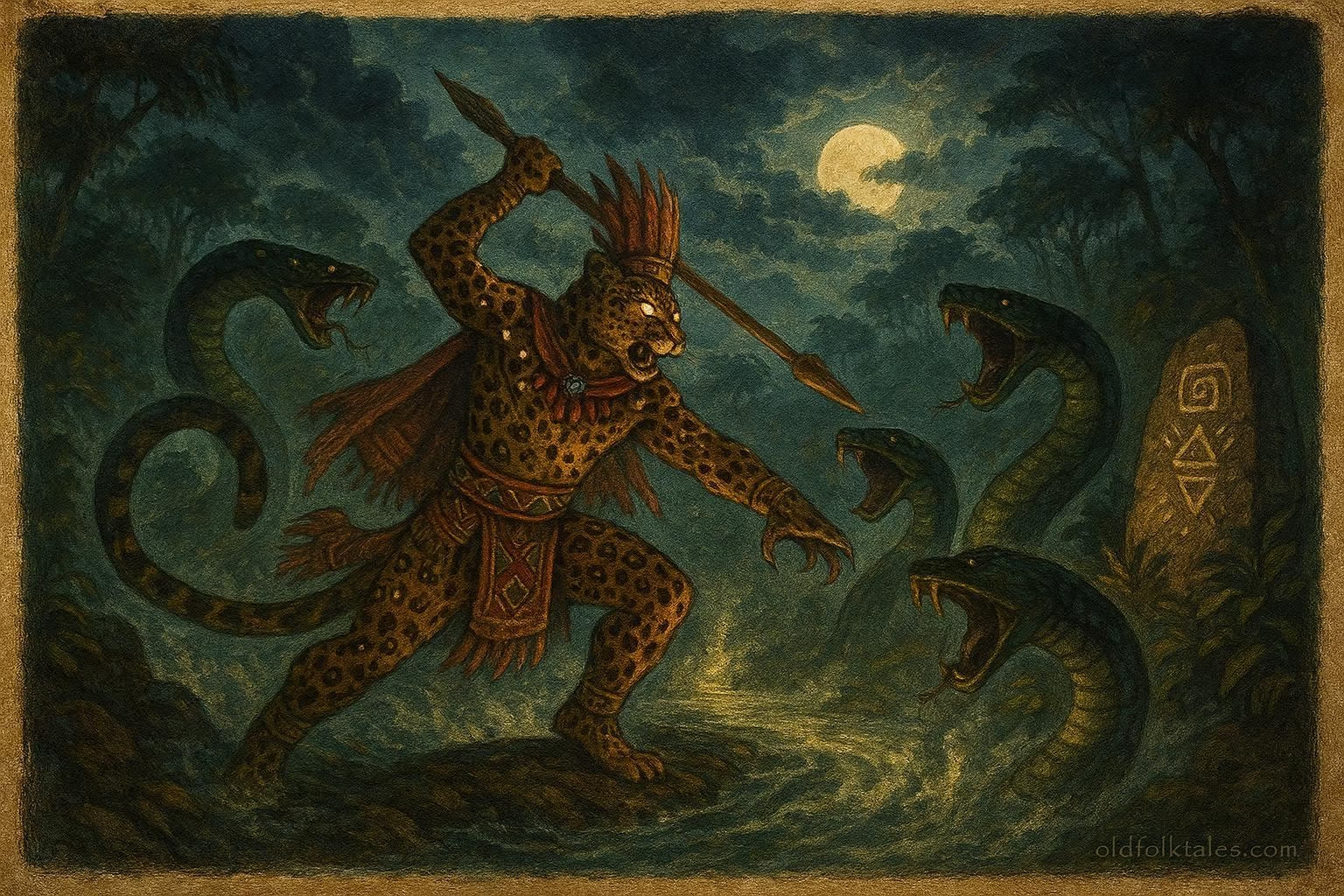
With new resolve, Yurumangui followed the currents to the N’gola’s lair, a cavern where the river plunged into thunderous darkness. He entered without fear. The water turned boiling hot, then icy cold, testing his divine body. When he reached the core chamber, three colossal serpents rose, their eyes glowing like drowned embers.
“Star-jaguar,” hissed the first.
“Child of forbidden rivers,” snarled the second.
“You seek to unmake us,” roared the third.
Yurumangui did not answer with hatred. Instead, he declared, “You were guardians once. You lost your sacred way. I have come to restore the laws. Surrender, and I will bind your rage. Resist, and I will end your corruption.”
But the serpents had grown drunk on power; they lunged.
The battle shook the cavern. Yurumangui shifted into his jaguar form, muscles blazing with celestial fire, claws shimmering like obsidian moons. The N’gola struck with coils like falling trees and fangs like stone daggers. Water exploded into steam; rocks shattered.
One serpent he subdued by forcing it beneath a sacred glyph of the ancestors, binding its fury into the stone. Another he purified by channeling river-light through its scales until its corruption melted away like black tar. But the last serpent, the oldest, swollen with rage, fought until the river itself screamed.
At the height of their struggle, Yurumangui faced his deepest test. He could kill the creature, but in doing so, he would sever the ancient chain of water guardianship. Instead, he chose the harder path. He pierced the serpent’s forehead with a single jaguar-mark and whispered the oldest law:
“Flow with purpose. Guard without devouring.”
The serpent collapsed, its monstrous form shrinking into the shape of a great shimmering eel, no longer a tyrant, but a keeper of depths.
The rivers calmed. The whirlpools stilled. Fish returned in silver schools that glittered like rainfall. Yurumangui emerged from the cavern not as conqueror, but as teacher. He gathered the clans and proclaimed the Sacred Survival Laws, how to fish with moderation, how to respect spawning seasons, how to read the river’s moods, how to walk the rainforest without breaking its breath.
And thus the people flourished.
Some say Yurumangui still roams the rivers in jaguar form, his amber eyes flickering on moonless nights. Others claim he returned to the sky, joining the jaguar-star that watches over the Pacific rainlands. But all agree that the rivers flow more wisely because he once walked their edges and taught humanity to do the same.
AUTHOR’S NOTE
Yurumangui stands as a symbol of ecological guardianship and cultural resilience for the Afro-Colombian and Chibchan peoples of the Pacific littoral. His myth teaches that heroism includes restraint, compassion, and respect for interconnected worlds, human, animal, and spiritual alike.
KNOWLEDGE CHECK
-
What divine beings were Yurumangui’s parents?
-
What threat was terrorizing the river communities?
-
Why did Yurumangui struggle morally before fighting the N’gola?
-
How did he defeat the serpents without destroying the river’s balance?
-
What teachings did he give to the people afterward?
-
What does Yurumangui symbolize in regional mythic tradition?
CULTURAL ORIGIN: Afro-Colombian and Chibchan-Pacific (Northwestern Colombia), drawing from regional river-spirit and jaguar-guardian traditions tied to rainforest cosmology.
SOURCE: 19th-century Afro-Colombian/Chibchan oral traditions documented in regional ethnographic collections and Pacific rainland myth cycles.