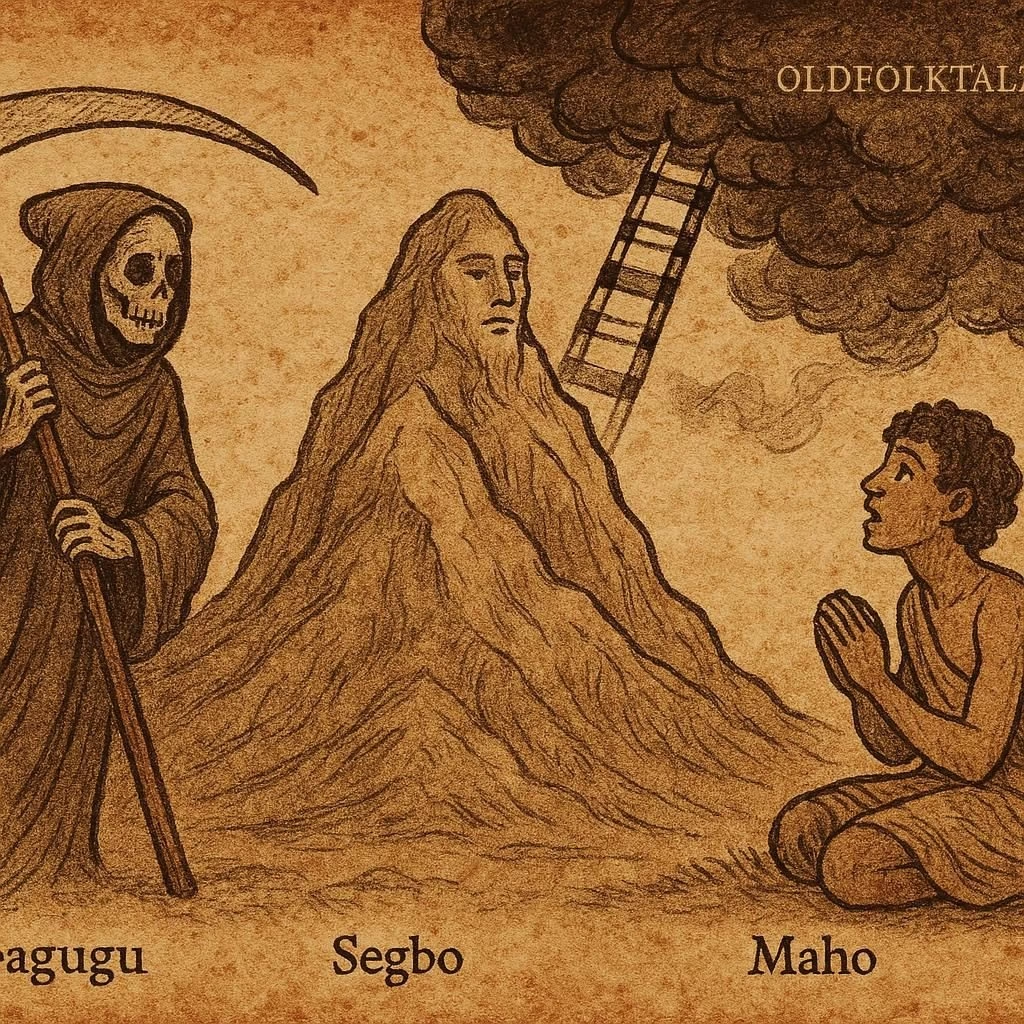
In a time when the gods still walked among the people, Lisa gave his daughter Maho a name that carried a powerful promise. He called her Gbemende, meaning that she would overcome all obstacles.
The name soon became a challenge to Segbo, a powerful figure who believed that no one could surpass him. After taking Maho as his wife, Segbo subjected her to a series of seemingly impossible tests. Each time, he expected her to fail, but Lisa continued to protect his daughter.
When Maho gave birth to a remarkable son named Agbagugu, Segbo’s jealousy grew. He devised increasingly dangerous challenges to prove his superiority over the child. Yet Agbagugu repeatedly overcame them, fulfilling the promise contained in his name.
The story explains how the boy eventually surpassed his father, rose into the heavens and became Hevioso, the powerful deity associated with thunder.
Lisa Gives Maho a New Name
Long ago, Lisa, the great creator, had a daughter named Maho. He recognised something remarkable about her and decided to give her a new name.
He called her Gbemende, meaning that she would overcome all obstacles.
Segbo, a powerful figure with many wives, heard the name and became curious. He wondered whether Maho could truly live up to such a remarkable promise.
Determined to test her, he demanded that Lisa give her daughter to him as a wife. Lisa agreed, and Maho became part of Segbo’s household.
Explore more stories from our Beninese Folktales Collections archive.
Segbo already had twelve wives, and he soon made it clear that Maho would face the same demanding expectations as the others.
The Challenge of the Millet Beer
One day, Segbo gathered his wives and gave each of his twelve wives some millet. He instructed them to prepare millet beer, warning that any woman whose drink failed would face death.
However, when he came to Maho, he gave her okra instead of millet.
Maho immediately understood the danger. She could not prepare the same drink as the other women with the ingredients Segbo had given her. Afraid that she would be punished, she began to cry.
Her cries reached Lisa, who asked what had happened. Maho explained that Segbo had given her okra instead of millet and that she feared she would die because she could not complete the task.
Lisa comforted her and told her not to worry.
That night, a powerful wind swept across the land. It moved through the household and transformed the situation completely.
By morning, Maho’s okra had become excellent beer, while the other wives’ millet preparations had turned into bowls of okra.
Segbo was displeased when he discovered what had happened. He suspected that Lisa had intervened, but he did not give up.
He simply remarked that Lisa had helped his daughter again and that there would be another opportunity to test her.
Maho’s Son Is Born
Some time later, Segbo’s twelve wives became pregnant. According to the custom followed in his household, they were expected to give birth on the same day.
Segbo announced that the children would arrive in two days.
Maho, however, was not pregnant. She realised that she would be unable to produce a child alongside the other wives and feared that Segbo would punish her.
Once again, she cried until Lisa heard her.
When Maho explained her situation, Lisa reassured her. He instructed her to sleep and wait until the other women began giving birth. He then told her that when the time came, she should strike the ground three times with her foot if she wanted a son, or three times with her head if she wanted a daughter.
Maho followed his instructions.
When the cries of childbirth began, she struck the ground three times with her foot. Immediately, a son appeared.
The child was handsome, strong and radiant. Segbo examined him and recognised that he was finer than the other children.
He suspected that Lisa had once again intervened, but he could do little to prevent the boy’s arrival.
The child was named Agbagugu, a name associated with surpassing his father.
Segbo Tests the Children’s Strength
Segbo was not satisfied. He wanted to prove that Agbagugu could not become greater than his own children.
He possessed a special medicine that could make infants walk and speak when they were only ten days old. He gave it to the other boys but deliberately withheld it from Agbagugu.
He then announced another test. In twelve days, every boy would have to walk and speak. Any child who failed would be killed along with his mother.
Maho was terrified. She knew that her son had not received the medicine and would therefore appear unable to meet Segbo’s demand.
She cried until Lisa came to her aid.
Lisa instructed her to wait until the other children began walking and speaking. At that moment, she should tap Agbagugu’s head seven times.
Maho obeyed.
On the eleventh day, the other children began to walk and speak. Maho then tapped her son’s head as Lisa had instructed.
Immediately, Agbagugu rose. He became taller, stronger and livelier than the other boys.
Segbo could not conceal his anger. Once again, the child had passed a test that was meant to destroy him.
Agbagugu Wins the Race
Segbo decided to test the children’s abilities in another way.
He arranged a race and gave twelve horses to his other sons. To Agbagugu, he gave only a sheep.
He instructed the children to take corn to the field and warned that whoever arrived last would be killed.
Maho became distressed when she saw the unequal treatment. Her son had been given a sheep while the others had horses. She feared that he could not possibly win.
Lisa comforted her and provided a white powder for the sheep.
When the animal inhaled the powder, it transformed into a magnificent horse.
Agbagugu mounted it and raced ahead of the other children. His horse carried him swiftly to the field, allowing him to arrive first.
Segbo was furious. The boy had once again defeated the challenge he had carefully arranged against him.
The Journey to Obtain Death’s Scythe
After several failed attempts, Segbo decided to give Agbagugu a task that appeared impossible.
He ordered the boy to bring him Death’s scythe.
Everyone understood the danger. Death guarded his weapon, and approaching him was considered a journey from which no one could safely return.
Maho feared for her son’s life. However, Lisa gave Agbagugu seven peppers and explained how to use them during the journey.
He instructed the boy to break a pepper at each stage as he travelled towards Death’s dwelling.
Agbagugu set out with the seven peppers.
Along the way, he encountered several obstacles. A crowd stood in his path, but one of the peppers helped him clear the way. He then reached a guarded entrance where dogs watched over the door. Another pepper caused the dogs to fall asleep.
Further along, bees surrounded the place where Death lived. Agbagugu used another pepper, and the bees disappeared into a tree.
He continued until he reached Death himself. With the help of the remaining peppers, he overcame the final danger and caused Death to fall asleep.
Agbagugu then took the scythe and returned home safely.
When Death awoke and discovered that his weapon was missing, he became furious. His anger shook the world.
Segbo saw that Agbagugu had returned with the scythe. He recognised that Lisa had helped the boy once again, but he was not finished with his test.
He ordered Agbagugu to return the weapon to Death.
Returning the Scythe
Lisa gave Agbagugu another seven peppers and instructed him to retrace his journey.
The boy followed the same route, using the peppers to overcome the obstacles that had threatened him earlier.
He passed the places where the crowd, the dogs and the bees had once stood. Eventually, he reached Death and returned the scythe to its rightful owner.
Agbagugu then made his way home safely.
When Segbo saw him return, he finally accepted that the boy could not be defeated through the challenges he had devised.
He acknowledged that Lisa had named the child well. Agbagugu had indeed surpassed his father.
Segbo’s Final Betrayal
After recognising Agbagugu’s strength, Segbo promised Maho and her son great possessions. He even declared that he would turn himself into sand so that his body could provide the material from which humankind would be formed.
However, his words concealed another intention.
When night came, Segbo secretly planned to kill Agbagugu. He had accepted the boy’s superiority outwardly but could not bear the thought of being surpassed.
Lisa discovered the plot and struck Segbo down with a single finger.
Segbo was transformed into a mountain.
With Segbo defeated, Agbagugu inherited his father’s possessions. He then twisted white and black threads together to form a ladder.
Using this ladder, he climbed towards the heavens with his mother, his brothers and his father’s wives.
Agbagugu Becomes Hevioso
In the heavens, Agbagugu became Sogbo, also known as Hevioso, the powerful deity associated with thunder.
His voice became the loud thunder that breaks across the sky. The sound is fierce and commanding, reflecting the strength he demonstrated throughout his struggles with Segbo.
However, the thunder does not always end with a loud crash. A softer rumble often follows it.
In the story, this quieter sound represents Maho’s voice as she gently reminds her son to be careful. Although Agbagugu has become powerful, she still speaks to him with the concern of a mother.
Lisa eventually gave him authority over the whole domain, which he shared with his twelve brothers.
The story thus explains the relationship between thunder, its quieter rumble and the figures associated with them. It also celebrates the boy who overcame every challenge and fulfilled the promise of his name.
Explore our complete Africa Folktales collection.
Moral of the Story
The tale highlights perseverance, wisdom and the importance of guidance. Agbagugu succeeds because he receives help from Lisa and follows the instructions that protect him from danger. His story also shows how jealousy and pride can lead to destructive actions.
Knowledge Check
- What new name did Lisa give Maho, and what did it mean?
Lisa named her Gbemende, meaning that she would overcome all obstacles. - Why did Segbo give Maho okra instead of millet?
He wanted to make it impossible for her to prepare the millet beer and expected her to fail the test. - How did Agbagugu become stronger than the other children?
Lisa instructed Maho to tap his head seven times, after which he became taller, stronger and livelier than the other boys. - What task did Segbo give Agbagugu to test his courage?
He ordered him to obtain Death’s scythe and later return it. - What does the loud thunder represent in the story?
It represents the powerful voice of Agbagugu, who became the thunder deity Hevioso. - What does the faint rumble after thunder represent?
It represents Maho’s gentle voice reminding her son to be careful.
Source
Source: Adapted from “The Son Who Surpassed His Father: Why a Faint Rumble Succeeds Loud Thunder,” a Dahomean narrative recorded in Melville J. Herskovits and Frances S. Herskovits, Dahomean Narrative: A Cross-Cultural Analysis (1958), Narrative 16, p. 155.
Explore More Beninese Folktales
- The Princess and the Dangerous Lion
- The Orphan Girl and Her Stepmother
- The Truth Behind the King’s First Wife
- Turtle’s Revenge on the Lion
- The King and the Magic Stone
- Why Death Came to the World
- The Talking Drum’s Warning