Objects inherited from previous generations often carry memories that cannot be measured by their material value. A mirror may seem like an ordinary household possession, yet it can represent family history, affection and the lives of those who once owned it. In this Japanese tale recorded by Lafcadio Hearn, a farmer’s wife donates an inherited bronze mirror to help a temple cast a great bell. Although she initially gives it willingly, she soon regrets surrendering something so closely connected to her family. Her private attachment produces an extraordinary occurrence at the foundry, and the consequences give rise to a legend that continues long after her death.
The Temple’s Need for a Great Bell
Eight centuries ago, the Buddhist priests of Mugenyama, in the province of Tōtōmi, wanted a large bell for their temple. A temple bell served an important religious purpose, and the priests needed bronze to make one.
They therefore appealed to the women of their parish. Each woman was asked to contribute an old bronze mirror that could be melted down and used as bell-metal.
The request offered the women an opportunity to support the temple. Their old mirrors could become part of an object intended for religious use, and the priests hoped that enough contributions would provide the metal required for the casting.
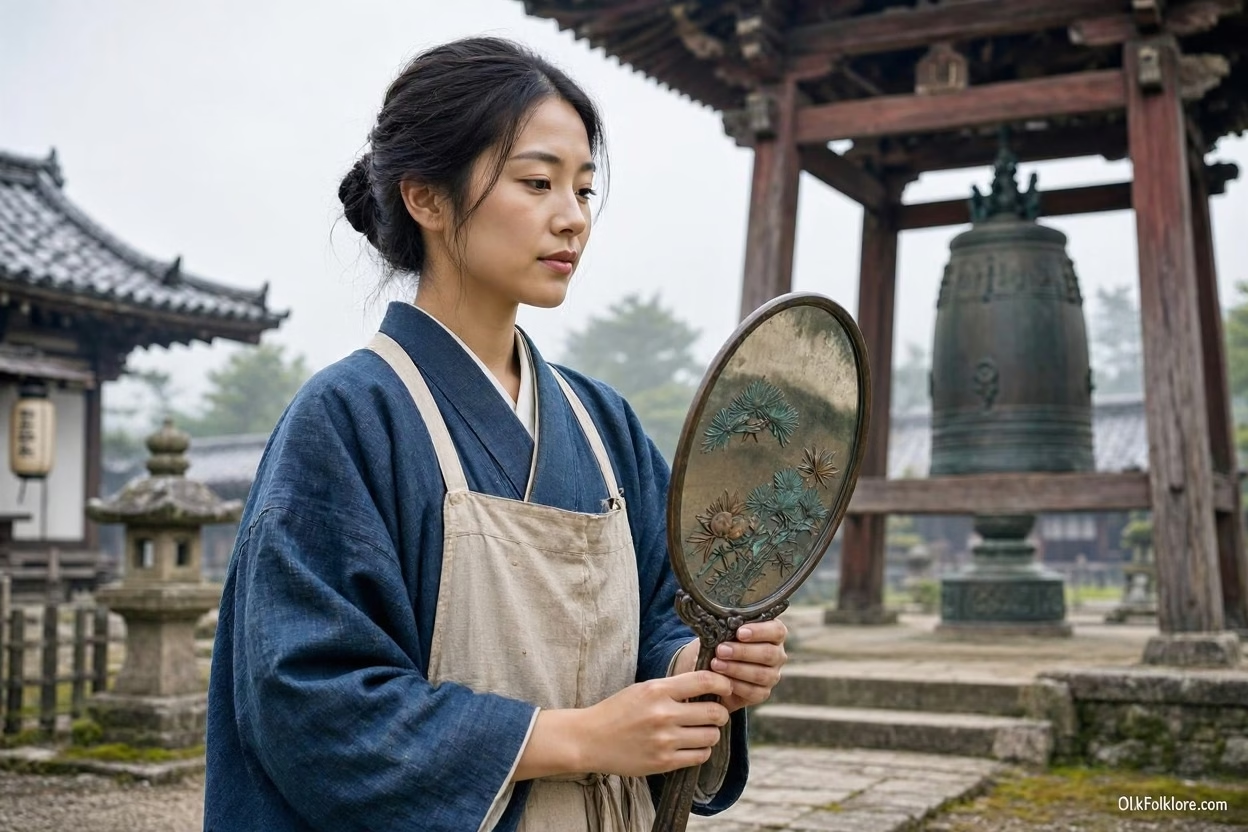
Among those who responded was a young farmer’s wife. She owned a bronze mirror that had belonged to her mother and had passed through earlier generations of her family. Remembering the temple’s request, she presented it as her contribution.
At first, she appeared to have made a generous decision. She had given something valuable towards a communal religious undertaking. Yet the mirror carried memories that made it difficult for her to part with it permanently.
The Woman Regrets Her Gift
After donating the mirror, the farmer’s wife began to regret her decision.
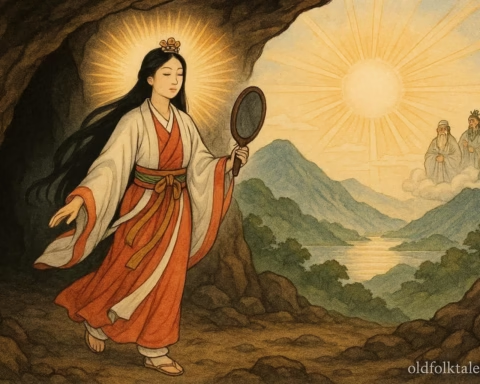
She remembered what her mother had told her about the object. It had belonged not only to her mother but also to her grandmother and great-grandmother. Its history reached back through several generations of women in her family.
She also remembered the happy faces and smiles that the mirror had reflected. As a little girl, she had admired the three fortunate emblems on its back: the pine, bamboo and plum blossom. These designs, known as Shō-Chiku-Bai, had delighted her when her mother first showed her the heirloom.
The mirror therefore represented more than its bronze material. It connected the young woman to her childhood, her mother and the generations that had preceded her.
Whenever she visited the temple, she saw the mirror lying in the courtyard behind a railing. Hundreds of other donated mirrors had been placed there, but she could still recognise her own by the familiar designs on its back.
She longed to retrieve it. If she could have offered the priests enough money in exchange, she might have persuaded them to return the heirloom. Unfortunately, she did not possess the necessary funds.
She even wished for an opportunity to steal the mirror and hide it somewhere safe, where she could keep it for the rest of her life. However, no opportunity presented itself.
Her regret deepened until she felt that she had foolishly surrendered a part of her own life. She could not bring herself to explain this private sorrow to anyone.
The Mirror Refuses to Melt
Eventually, the priests sent all the donated mirrors to the foundry. The bell-founders began the work of melting the bronze contributions so that they could cast the great temple bell.
However, something unusual happened.
Among the many mirrors, one refused to melt. The workers tried repeatedly, but the bronze remained hard and cold despite the heat of the furnace.
The mirror resisted every attempt to reduce it to molten metal.
Explore more stories from our Lafcadio Hearn’s Kwaidan collection
The bell-founders could not understand why this particular object behaved differently from the others. News of the strange occurrence spread, and people began to wonder which woman had contributed the mirror.
Before long, the community discovered that the unyielding mirror belonged to the farmer’s wife.
According to the belief presented in Hearn’s account, the woman’s regret explained the mystery. She had offered the mirror without giving it wholeheartedly. Although she had physically surrendered it, her feelings remained attached to the heirloom.
Her selfish soul, still connected to the mirror, was believed to have kept it hard and cold within the furnace.
The discovery exposed a private feeling that the woman had tried to conceal. What she had considered a personal struggle had become public knowledge.
The Woman’s Death and the Farewell Letter
The farmer’s wife became overwhelmed by shame and anger when the community learned that her mirror was the one that refused to melt.
She could not bear the public exposure of her regret. In her distress, she drowned herself.
Before her death, however, she wrote a farewell letter containing a strange promise. She declared that once she was dead, the mirror would no longer resist the furnace and the bell could be cast successfully.
She then promised that whoever managed to break the bell by ringing it would receive great wealth from her ghost.
Her final words connected her death with the fate of the mirror. She had been unable to surrender the heirloom while alive, but she believed that her spirit could reward anyone who succeeded in breaking the bell made from it.
Hearn explains that Japanese belief regarded the final wish or promise of someone who died in anger, including someone who died by suicide in anger, as possessing supernatural power.
The woman’s letter therefore became central to the legend of the bell.
The Bell of Mugen
After the woman’s death, the mirror finally melted. The bell-founders succeeded in casting the great bell, and it was eventually suspended in the temple courtyard.
However, the community had not forgotten the promise in the woman’s letter.
People believed that her spirit would grant wealth to whoever broke the bell by ringing it. Once the bell was installed, crowds gathered to test the promise.
They swung the ringing-beam with all their strength, hoping to damage the bell and claim the reward. Yet the bell proved strong and resisted their attempts.
The people did not give up. They returned day after day and continued ringing it furiously. Their efforts became a serious disturbance, and the priests could no longer tolerate the constant noise.
Eventually, they decided to remove the bell. They rolled it down the hill, and it disappeared into a deep swamp.
The swamp swallowed the great bronze object, ending the repeated attempts to break it. The priests were rid of the disturbance, but the story survived.
The bell became known as the Mugen-Kané, or the Bell of Mugen. Although the physical bell had disappeared, its legend remained.
The Meaning of Nazoraëru
After recounting the story of the bell, Hearn moves beyond the events at Mugenyama to discuss a Japanese belief associated with the word nazoraëru.
He explains that the word has no exact English equivalent. Dictionaries commonly translate it as imitate, compare or liken. However, Hearn describes a deeper meaning involving the mental substitution of one object or action for another in the hope of producing a magical or religious result.
The idea involves treating one thing as though it represents another. Through imagination and sincere intention, an individual may perform a symbolic action in place of something that is difficult or impossible to accomplish directly.
Hearn gives a religious example. Someone who cannot afford to build a Buddhist temple may place a small pebble before an image of the Buddha with the same devotion that would inspire the construction of a temple. The symbolic offering may then carry spiritual merit similar to the larger act.
He also describes a revolving library containing thousands of Buddhist volumes. A person who cannot read every book may turn the library while sincerely wishing to gain the merit of reading the sacred texts.
These examples illustrate the religious meaning Hearn associates with nazoraëru. He then turns to its magical applications, where an object or action symbolically represents another person or event.
One example involves a small figure made from straw. If someone represents an enemy through that figure and performs a ritual upon it, the intended magical effect is directed towards the person represented.
Another example concerns a robber. If the victim discovers the robber’s footprints and burns large pieces of moxa upon them, the ritual is believed to cause pain in the robber’s feet until the thief returns.
Hearn uses these examples to explain the thinking behind the later legends of the Mugen-Kané.
Umégaë and the Broken Bronze Basin
Once the bell had disappeared into the swamp, people could no longer attempt to break it directly. However, those who still hoped to obtain the wealth promised by the dead woman’s spirit found another way.
They began breaking other objects while imagining that those objects represented the lost bell. In their minds, destroying a substitute could produce the same result as breaking the original.
One of the people associated with this practice was a woman named Umégaë. Japanese legend remembered her through her connection with Kajiwara Kagesue, a warrior of the Heiké clan.
During their travels together, Kajiwara once found himself in serious financial difficulty. Umégaë remembered the legend of the Bell of Mugen and decided to imitate the action that was believed to bring wealth.
She took a bronze basin and treated it as though it were the temple bell. She struck it repeatedly until it broke, crying out for three hundred pieces of gold.
A guest staying at the inn where the pair were lodging heard the noise and asked what was happening. After learning about their financial difficulty and Umégaë’s actions, he gave her three hundred ryō in gold.
Her attempt appeared to have succeeded. She had broken a bronze object in place of the missing bell, and someone had rewarded her with the exact amount she requested.
A song was later composed about Umégaë’s bronze basin. Hearn records that dancing girls continued to sing it, with lyrics expressing the hope that money might come from striking the basin and that the proceeds could secure the freedom of their companions.
The incident strengthened the fame of the Mugen-Kané. Other people began copying Umégaë, hoping to enjoy similar good fortune.
The Farmer and the Mysterious Jar
Among those who followed the example was a dissolute farmer who lived near Mugenyama, beside the Ōïgawa River.
The farmer had wasted his wealth through reckless living and eventually found himself in need of money. Remembering the stories about the Bell of Mugen, he decided to perform his own symbolic imitation.
He made a small model of the famous bell from mud taken from his garden. Treating the clay object as though it were the original bronze bell, he struck it until it broke.
As he carried out the act, he called out for great wealth, hoping that the spirit associated with the old mirror would answer his request.
Something extraordinary followed.
A white-robed woman appeared from the ground before him. Her long hair flowed loosely around her, and she carried a covered jar.
She told the farmer that she had come to answer his fervent prayer as it deserved to be answered. She then placed the jar in his hands and disappeared.
The farmer was delighted. He hurried home to tell his wife about the unexpected gift.
He placed the covered jar before her. It was heavy, and the couple opened it together, eager to discover what the mysterious woman had given them.
The jar was filled to the brim with something.
But Hearn refuses to reveal what they found inside.
He ends the account by telling his readers that he cannot say what the jar contained. The mystery remains deliberately unanswered, leaving the reader to imagine the strange conclusion for themselves.
Explore our complete Historic Folklore & Fairy-Tale Collections archive.
Moral Lesson
The story explores the emotional value of family possessions and the consequences of actions driven by regret, shame and desperation. The farmer’s wife discovers that an inherited object can carry memories far beyond its material worth. Her inability to reconcile her generous intention with her private attachment leads to tragedy.
The later accounts also reveal how legends can influence human behaviour. People imitate actions that they believe will bring wealth or good fortune, even when the original circumstances are unusual or impossible to reproduce.
Hearn’s discussion of nazoraëru further invites readers to consider the relationship between imagination, symbolism and belief. The tale shows how an ordinary object can acquire extraordinary meaning through the stories and hopes attached to it.
Knowledge Check
1. Why did the priests of Mugenyama ask women to donate their bronze mirrors?
They needed bronze to cast a large bell for their temple.
2. Why did the farmer’s wife regret donating her mirror?
It had belonged to several generations of her family and reminded her of her mother, grandmother and childhood memories.
3. What happened when the bell-founders tried to melt the woman’s mirror?
The mirror refused to melt despite repeated attempts in the furnace.
4. What promise did the woman make in her farewell letter?
She promised that whoever broke the bell by ringing it would receive great wealth from her ghost.
5. What does Hearn mean by the Japanese concept of nazoraëru?
It involves symbolically substituting one object or action for another through imagination, often to produce a magical or religious result.
6. What happened when the farmer broke his clay model of the bell?
A mysterious white-robed woman appeared and gave him a covered jar, but Hearn deliberately leaves its contents undisclosed.
Source
Adapted from “Of a Mirror and a Bell” in Kwaidan: Stories and Studies of Strange Things by Lafcadio Hearn, published in 1904.
Explore More On Lafcadio Hearn’s Kwaidan