Once upon a time, Anansi lived in a poor little hut beside a magnificent palace. The palace belonged to a wealthy man named Nothing, who had everything Anansi wished he possessed.
One day, the two neighbours decided to travel to a nearby town to find wives. Before they left, Nothing dressed himself in a fine velvet cloth, while Anansi wore an old, ragged cotton garment.
As they travelled, Anansi began to admire his neighbour’s clothing. He persuaded Nothing to exchange garments with him for a short while, promising to return the velvet cloth before they arrived at the town.
Explore more stories from our West African Folk-Tales collection.
Nothing agreed, trusting his companion. But Anansi had no intention of keeping his promise. He invented one excuse after another until they reached their destination, still wearing each other’s clothes.
Dressed in the fine velvet, Anansi immediately attracted attention. Women admired his appearance, and he had little difficulty finding as many wives as he wanted.
Nothing, meanwhile, was mistaken for a poor beggar because of the shabby garment he wore. No woman wanted to marry him. Eventually, a kind woman felt sorry for him and offered him her daughter in marriage.
The young bride had to endure the laughter of Anansi’s new wives, who could not understand why she would marry a man who appeared to have nothing. She ignored their mockery and went with her husband.
When the wedding parties began their journey home, the women expected to discover where their new husbands lived. What they saw at the crossroads astonished them.
The path leading to Anansi’s hut was narrow and only partly cleared. There were no servants waiting to welcome him. The road to Nothing’s palace, however, was broad and beautifully prepared. Fine skins and carpets had been spread along it, and servants stood ready with elegant clothes for Nothing and his bride.
The women soon discovered that appearances had deceived them. Nothing was not a beggar at all. He was a wealthy man whose palace, servants and possessions reflected his status. His wife became the most honoured woman in the district and enjoyed every comfort she could desire.
Anansi’s wives received a very different welcome. His hut offered them little, and even their food was miserable. Instead of the fine living they had imagined, they had to survive on unripe bananas and peppers.
When Nothing’s wife heard about their hardship, she invited the women to a grand feast at her palace. They arrived expecting a simple meal but found themselves surrounded by comfort and plenty. Delighted by what they saw, they decided to remain there rather than return to Anansi’s poor home.
When Anansi discovered that his wives had abandoned him, his jealousy turned into hatred. He blamed Nothing for his humiliation and tried repeatedly to kill him. Every attempt failed.
At last, Anansi devised a more dangerous plan. He persuaded some rats to dig a deep pit in front of Nothing’s doorway. Once the hole was ready, he placed sharp knives and broken bottles inside it. Then he smeared the palace steps with okro, making them dangerously slippery.
Satisfied with his work, Anansi waited nearby.
That night, when he believed Nothing’s household had gone to sleep, he called out to his wealthy neighbour, urging him to come outside and see something wonderful.
Nothing’s wife immediately grew suspicious. She warned her husband not to listen to Anansi and urged him to remain indoors. Anansi called again, but she continued to discourage him.
Nothing eventually became too curious to resist. He decided to step outside and discover what his neighbour wanted to show him.
The moment he placed his foot on the slippery steps, he lost his balance and fell straight into the concealed pit.
The crash startled the household. Servants rushed to fetch lights and hurried outside to investigate. When they found Nothing in the pit, they discovered that the knives and broken bottles had wounded him terribly. His injuries proved fatal, and he soon died.
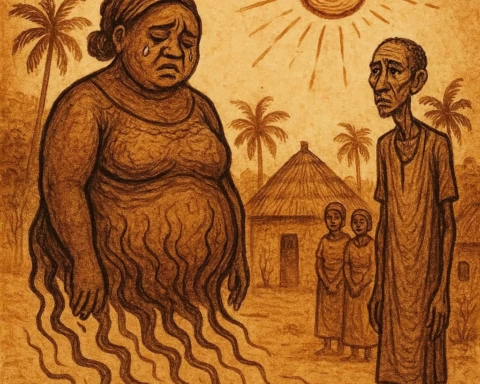
His wife was devastated by the sudden loss of her husband. In her grief, she boiled a large quantity of yams, mashed them and carried a great dishful around the district. Whenever she encountered a child, she offered the child some yam so that the child could join in mourning her husband.
The custom became the explanation for a familiar expression. According to the tale, whenever someone sees a child crying and asks why, the answer may be that the child is “crying for nothing.”
Explore our complete Historic Folklore & Fairy-Tale Collections archive.
Moral
Deception may bring temporary advantages, but greed and jealousy can lead to destructive consequences. Anansi manipulates others to gain what he wants, yet his dishonesty leaves him isolated and consumed by resentment. The story warns against judging people by appearances and against allowing envy to govern our actions.
Knowledge Check
1. Why did Anansi exchange clothes with Nothing?
Answer: He wanted to wear Nothing’s fine velvet cloth so that women would mistake him for a wealthy man.
2. Why did Nothing struggle to find a wife?
Answer: His ragged clothing made him appear poor, so women rejected him until one woman took pity on him.
3. Why did Anansi’s wives leave him?
Answer: They discovered that Nothing lived in a magnificent palace and enjoyed wealth and comfort, while Anansi could offer them very little.
4. How did Anansi cause Nothing’s death?
Answer: He arranged a pit filled with knives and broken bottles, made the palace steps slippery with okro, and lured Nothing outside until he fell into the trap.
5. What expression does the story explain?
Answer: It explains the expression “crying for nothing,” through the grieving wife’s practice of giving mashed yam to children so they would join in mourning her husband.
Source
Barker, W. H., and Cecilia Sinclair, compilers and arrangers. West African Folk-Tales. London: George G. Harrap & Company, 1917. “Anansi and Nothing,” Chapter III of Part I, “Anansi, or Spider, Tales,” printed pages 35–37.
Explore More West African Folk-Tales
- Thunder and Anansi: A West African Folktale
- Tom Tit Tot: The Girl Who Outwitted a Terrifying Imp by Guessing His Name
- Why the Sun and the Moon Live in the Sky: A Southern Nigerian Folktale
- Igiri and the Mushroom Baby: An Ikom Folktale
- The Envier and the Envied: A Powerful Arabian Nights Tale
- The Old Man and the River Spirit
- The Enchanted Date Palm of the Oasis