In the animal kingdom, the hare was famous for his cleverness. He could think his way out of difficult situations, but there was one thing he wanted more than anything else: meat. Unfortunately, he was not good at hunting, so he began searching for a way to fill his stomach without doing any work.
One day, he called all the animals together and suggested that they choose a king to govern them. The animals agreed, and after discussing their options, they appointed the elephant as their ruler.
The hare then proposed another rule. A piece of land beside the road should be reserved for the king’s private use, he said. Anyone caught making a mess on that land would be killed, and their body would be eaten.
Explore more stories from our Ikom Folk Stories collection.
The animals accepted the law, unaware that the hare already had a plan to take advantage of it.
That night, the hare sneaked onto the king’s reserved land and deliberately dirtied it. The following morning, he hid in the nearby bushes, waiting for another animal to pass. He wanted an innocent victim he could accuse of breaking the law.
Before long, a bush cat came along on his way to the farm.
“Have you visited the king’s land this morning?” the hare asked.
“No,” replied the bush cat.
“Then go and see it for yourself,” the hare insisted.
The bush cat went to inspect the place and returned, confirming that it was dirty. The hare immediately pretended to be shocked.
“That cannot be right! I went there earlier, and it was perfectly clean. You must have done it yourself. I shall report you to the king.”
Before the bush cat could defend himself properly, the hare rushed into town and spread the accusation. The great wooden drum was beaten to summon the animals to a meeting.
The bush cat explained that he had done nothing wrong. But the hare stood before the gathering as the accuser, and the animals believed his lies. The elephant ordered that the bush cat be killed and that his meat be dried and delivered to the king the following morning.
The hare had secured his first meal.
The Hare’s Scheme
The king assigned the task of drying and guarding the bush cat’s meat to Keroho, a fruit-eating animal known for being lazy and sleepy. The hare had recommended him for the job, pretending that someone who ate fruit would have no reason to steal meat.
But the hare had a different motive. Keroho was fat, and the hare knew he would be too sleepy to guard the food properly.
That evening, Keroho prepared a fire, cut up the bush cat’s body, and laid the meat out to dry. Once everything was in place, he settled down to sleep.
The hare waited until the animals had gone to bed. Then he slipped out through the back of his house, entered Keroho’s yard, and stole all the dried meat. He took it home, ate as much as he wanted, and buried the leftovers.
At dawn, the hare beat the great drum to summon the animals to the king’s house.
When Keroho heard the drum, he hurried to check the meat. To his horror, it had disappeared. Trembling with fear, he went to the gathering and explained that he had left the meat beside the fire before going to sleep.
The hare immediately accused him.
“Do not believe him,” he told the others. “Perhaps he sold the meat for money. I propose that Keroho be killed so that we do not lose our meat.”
The animals accepted his accusation, and the elephant ordered Keroho’s death. His meat was then handed to the bush cow to dry and guard.
The hare had escaped suspicion once again.
That evening, he visited the bush cow carrying a large calabash of strong tombo, an alcoholic drink. He drank only a little himself, encouraging his host to finish the rest.
The bush cow soon fell into a deep sleep. At midnight, while the night was quiet except for the calls of owls and frogs, the hare crept into the yard and stole the meat from beside the fire.
The next morning, the drum sounded again. The bush cow could not produce the missing meat, and the king ordered him killed.
The same trick continued. Each night, the hare stole the meat, and each morning, the animal responsible for guarding it was accused and killed. The animals kept appointing new guardians, but none could escape the hare’s deception.
Eventually, only seven animals remained.
The Tortoise Sets a Trap
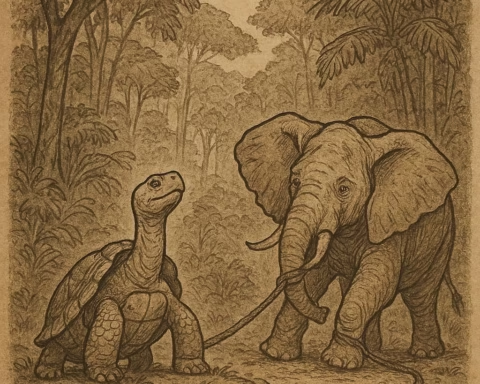
When it was time to assign the latest batch of meat to a guardian, the task fell to the tortoise. Unlike the other animals, he had begun to notice a troubling pattern. Every night the meat vanished, and every morning another animal died.
The tortoise was regarded as one of the wisest animals, and he had no intention of becoming the next victim. He decided that if the hare came again, he would catch him.
He instructed his wife to watch the meat carefully before leaving for the bush to collect rubber. When he returned in the evening, he cut up the meat and prepared a large fire.
As he worked, he thought aloud about the animal who would die next.
“It will not be my turn tomorrow if I can prevent it,” he said.
He placed the meat over the fire and covered it with the rubber he had collected. The sticky material would make it difficult for anyone to take the meat without getting trapped.
Afterwards, the tortoise told his wife he was tired and went to bed. But he only pretended to sleep. He kept one eye open, watching the meat and waiting for the thief.
Late that night, when the surroundings were quiet, the hare crept around the back of the tortoise’s house. Confident that everyone was asleep, he reached out his right hand to seize the meat.
His hand stuck fast to the rubber.
He pulled and struggled, but the sticky material would not release him. Afraid of waking the tortoise, he whispered, “Let me go! Let me go!”
The rubber did not answer.
Growing angry, the hare threatened to strike it with his left hand if it did not release his right. When he received no response, he hit the rubber with all his strength.
His left hand became stuck too.
Somewhere nearby, he thought he heard laughter. Then he heard the tortoise murmuring in his sleep about discovering the thief who had been stealing the king’s meat.
The hare panicked. He kicked at the rubber with one foot, hoping to free himself, but that foot became trapped as well. When he tried the other foot, it too stuck fast.
By the time he stopped struggling, all four limbs were held securely in the sticky rubber.
The hare had finally been caught.
The Hare Is Punished
When morning arrived, the tortoise called his wife to help him. Together, they placed the meat, the rubber, and the trapped hare into a basket and carried everything to the king’s house.
As usual, the great drum summoned the animals. They gathered to discuss who should receive the tortoise’s meat when he was killed, for they expected another disappearance.
Instead, the tortoise arrived carrying the missing meat and the hare caught on top of it.
He explained how he had covered the meat with rubber and caught the thief in the act. The animals finally saw the truth. The hare, who had accused innocent creatures to hide his own crimes, was found guilty.
The king ordered him to pay a large number of brass rods as punishment. If he failed to provide them, he would be killed, and his mother and sister would also die because his deception had caused the deaths of so many animals.
The hare begged for more time to gather the payment. The request was granted.
But he had no intention of facing the punishment.
He rushed home and summoned his mother and sister. Together, they went to a large cotton tree. The hare tied a rope around a low branch and climbed high into the tree, where he built a small shelter for his family.
He then returned to the lower branch and pulled his mother and sister up the rope. Once they were safely in the shelter, he sat beside the rope with a sharp knife.
When the agreed time passed and the hare failed to pay, the animals went to his house. Finding him gone, they soon discovered his hiding place in the cotton tree.
They saw the rope hanging down and began climbing it together. The tortoise stayed on the ground as the others climbed higher.
When the animals had reached about halfway up, the hare cut the rope with one stroke of his knife.
The rope gave way, and the climbing animals tumbled down onto the tortoise. Their combined weight smashed his once-smooth shell into pieces. The animals hurt themselves badly, but none died.
They picked themselves up and limped away, leaving the tortoise injured on the ground.
On their way home, they passed the tortoise’s house and told his wife what had happened. They explained that the animals had fallen from a great height onto her husband, breaking his shell into pieces.
The tortoise’s wife immediately took a basket and hurried to the cotton tree. She gathered every piece of her husband’s broken shell, lifted him carefully, and carried them both home.
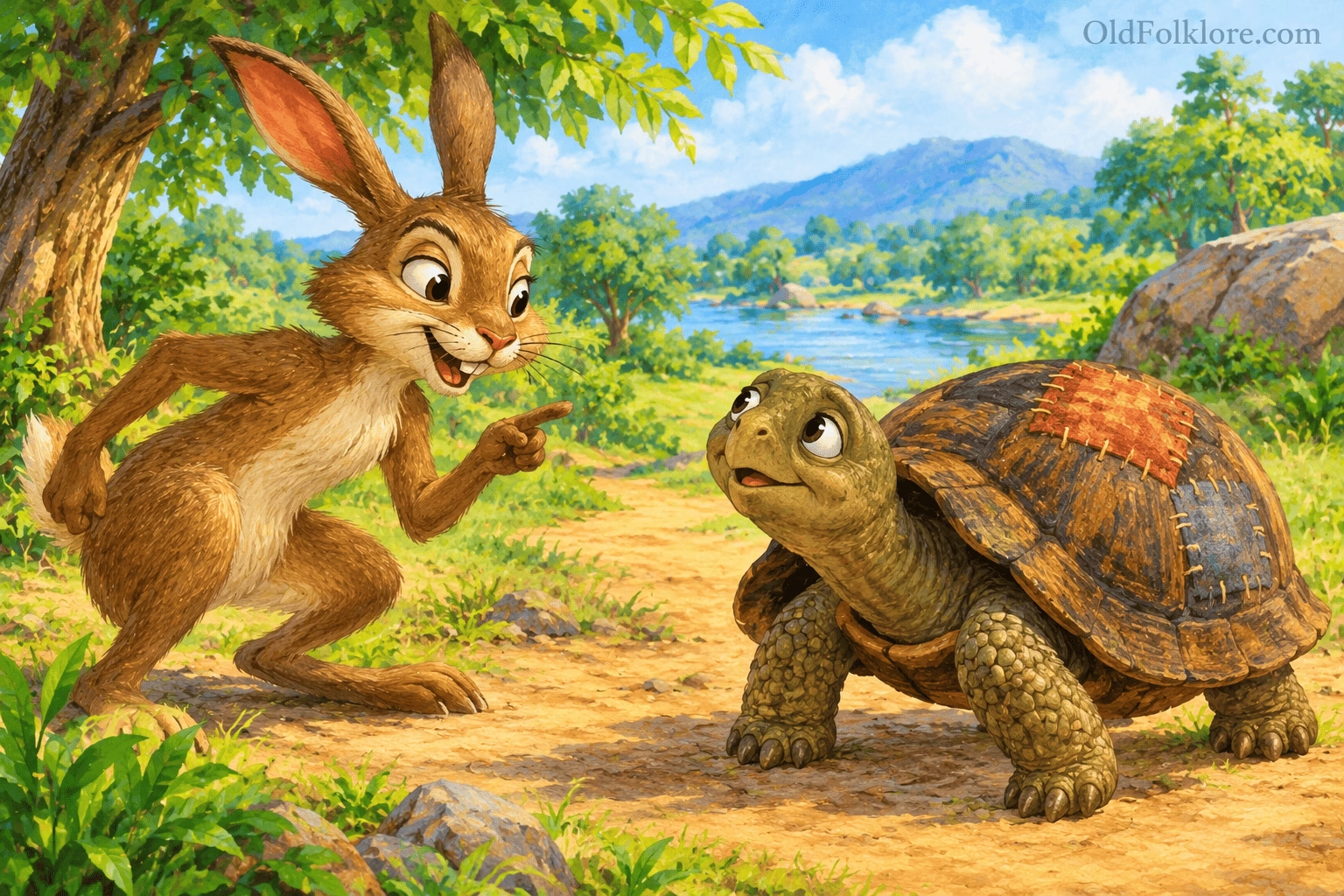
There, she fitted the pieces together and placed them back on his body. The shell healed and grew firmly in place, but the marks where the pieces had joined remained.
And that, the story explains, is why the tortoise’s shell is covered with patches instead of being smooth.
Explore our complete Historic Folklore & Fairy-Tale Collections archive.
Moral
Cleverness without honesty becomes cruelty. The hare uses his intelligence to deceive others, but his scheme is eventually exposed. The story also warns against punishing people based on accusations without first examining the evidence.
Knowledge Check
1. Why did the hare create the law about the king’s private land?
He wanted to frame another animal, have it killed, and obtain meat without hunting.
2. Why did the hare choose Keroho to guard the meat?
He knew Keroho was lazy and sleepy and expected him to be an easy target for theft and false accusations.
3. How did the tortoise catch the hare?
He covered the meat with sticky rubber. When the hare tried to steal it, all four of his limbs became trapped.
4. Why did the animals fall onto the tortoise?
The hare cut the rope they were climbing, causing them to fall onto the tortoise and break his shell.
5. What does the story explain about the tortoise?
It offers a traditional explanation for why the tortoise’s shell has patches where the broken pieces were joined together.
Source
Dayrell, Elphinstone. Ikom Folk Stories from Southern Nigeria. Royal Anthropological Institute of Great Britain and Ireland, Occasional Papers No. 3, 1913. “The Cunning Hare; or, Why the Tortoise has a Patched Shell.
Explore More West African Folk-Tales
- Thunder and Anansi: A West African Folktale
- Tom Tit Tot: The Girl Who Outwitted a Terrifying Imp by Guessing His Name
- Why the Sun and the Moon Live in the Sky: A Southern Nigerian Folktale
- Igiri and the Mushroom Baby: An Ikom Folktale
- The Envier and the Envied: A Powerful Arabian Nights Tale
- The Old Man and the River Spirit
- The Enchanted Date Palm of the Oasis