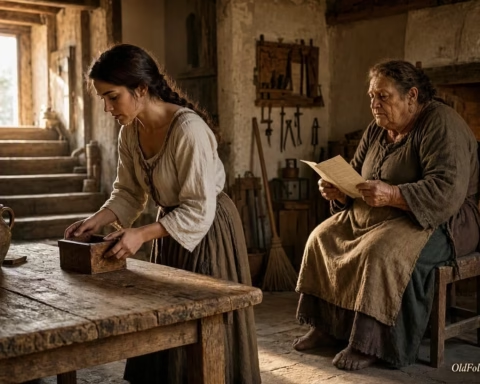
In the village of Miano, a childless couple longs for a baby. Their wish is granted in an unexpected form when the wife gives birth to a sprig of myrtle. The plant eventually comes into the possession of Prince Cola Marchione, who discovers that it conceals a beautiful fairy. Their growing love attracts the attention of jealous women, whose cruelty threatens to destroy the happiness they have found.
The Myrtle Born from a Wish
In the village of Miano, a man and his wife lived without children. They longed for an heir, and the wife often prayed that Heaven would grant her even the smallest child.
She repeated her wish so frequently that, after nine months, her prayers appeared to be answered. Yet instead of giving birth to a boy or girl, she received a fine sprig of myrtle.
The couple treated the plant as their child. The woman placed it in a beautifully decorated pot and set it in the window, tending it carefully every morning and evening. She cherished it as much as another mother might cherish a daughter.
One day, the king’s son passed the house while riding out to hunt. He noticed the lovely myrtle and immediately wanted to possess it. He sent a messenger to ask the woman whether she would sell the plant, offering a great deal in exchange.
At first, she refused. The myrtle meant too much to her, and she could not bear the thought of parting with it. The prince persisted with promises, requests and offers until she finally agreed.
Before surrendering the pot, she begged him to care for it as she had done. The prince promised to treat it well and carried it into his own chamber, placing it on a balcony where he could tend and water it himself.
The little plant now stood in a royal chamber, far from the home where it had been cherished since birth.
A Visitor in the Prince’s Chamber
One evening, after the prince had gone to bed and extinguished his candles, he heard someone moving quietly through the room.
He remained still, wondering whether a servant had entered to steal from him or whether some mischievous spirit had come to disturb his sleep. Rather than calling for help, he waited to discover the visitor’s purpose.
Explore more stories from our Basile’s Pentamerone collection.
Soon, he felt something soft and delicate near his bed. It was unlike anything he had expected to encounter in the darkness.
The prince suspected that the visitor might be a fairy. Instead of being frightened, he felt an immediate affection for the mysterious creature.
At dawn, the stranger disappeared before he could discover her identity. The prince awoke filled with curiosity and spent the following days wondering about his visitor.
For seven nights, the same mystery continued. Each evening, the fairy came to his chamber, and each morning she vanished before sunrise.
The prince became increasingly determined to see her clearly. One night, while she slept, he gently tied a strand of her hair to his arm so that she could not leave unnoticed. He then called for a servant to bring a light.
When the room brightened, he saw a beautiful young woman whose appearance astonished him.
The Fairy Reveals Herself
The prince had never seen anyone so beautiful. He gazed at the sleeping maiden in wonder, comparing her loveliness with the finest treasures of the world.
His admiration woke her. When she opened her eyes, he greeted her with declarations of love and begged her to accept his devotion.
The fairy blushed at his praise. She explained that she was willing to serve him and felt fortunate to have become more than a spirit dwelling in a plant.
The prince’s affection deepened. He embraced her and promised that she would become his wife and share his royal position. He offered her his faith and declared that she would hold the key to his heart.
The fairy accepted his devotion, and the two began to live together in happiness.
For several days, their lives continued peacefully. The prince tended the myrtle and kept the fairy close to him, while she returned his affection.
Their happiness, however, soon faced a test.
The Prince’s Departure
The king summoned his son to hunt a great wild boar that had been ravaging the countryside. The prince could not refuse his father’s command, so he prepared to leave the palace for two or three days.
Although he was accustomed to hunting, he now dreaded being separated from the fairy. His love had grown so strong that it gave rise to a troubling jealousy. He worried about what might happen while he was away.
Before departing, he asked the fairy to return to the myrtle plant and remain inside the pot until he came back. He believed that keeping her hidden would protect her from anyone who might seek to harm her.
The fairy agreed because she did not wish to deny him anything. She asked him to leave a silk thread with a small bell attached to the top of the myrtle. When he returned, he could pull the thread and ring the bell, and she would emerge immediately.
The prince arranged everything carefully. He instructed his chamberlain to make his bed each evening, water the myrtle regularly and ensure that not a single leaf was lost.
Then he mounted his horse and left for the hunt, anxious about the days he would spend away from the woman he loved.
The Jealous Women’s Plot
Seven women who knew the prince became jealous of the mysterious affection he had shown someone else. Curious to discover the secret, they paid a mason to build an underground passage connecting their house with the prince’s chamber.
Once the passage was complete, they entered his room while he was away.
At first, they found nothing unusual. Then they noticed the myrtle standing on the balcony.
Each woman plucked a leaf from the plant. The youngest among them went further and removed the entire top, including the part where the little bell was attached.
The bell rang, and the fairy emerged, believing that the prince had returned.
The women immediately attacked her. They accused her of stealing the prince’s affection and declared that she would no longer escape their revenge.
They tore the fairy apart, and each woman took a portion of her body. The youngest sister refused to participate fully in the cruelty and took only a lock of the fairy’s golden hair.
When they had finished, the women left through the underground passage, believing that they had destroyed their rival.
Soon afterwards, the chamberlain arrived to carry out his master’s instructions. He discovered the terrible scene and was overcome with horror.
Fearing that he would be blamed, he gathered the remains of the fairy, placed them in the flowerpot and watered the myrtle. He then locked the chamber, left the key beneath the door and fled the town.
The Prince Returns to an Empty Chamber
When the prince returned from hunting, he hurried to his chamber and pulled the silk thread to ring the bell.
He waited for the fairy to appear, but nothing happened.
He rang again and again. Still, there was no answer.
Growing impatient, he went directly to the chamber door. Rather than wait for the chamberlain to bring the key, he forced the lock and entered.
The sight before him filled him with despair. The myrtle had lost its leaves, and the fairy was nowhere to be seen.
He cried out in grief, lamenting the loss of his beloved and the destruction of the plant that had brought them together. He blamed the hunt for taking him away from her and wondered who could have committed such a cruel act.
The prince refused to eat or sleep. His sorrow became so intense that his face lost its healthy colour, and his strength began to fade.
He believed that he had lost the woman he loved forever.
Yet the fairy’s story had not ended.
The Fairy Returns
The remains in the flowerpot began to give rise to new life. The fairy had miraculously sprouted again from what the chamberlain had placed in the soil.
She saw the prince’s terrible grief and felt compassion for him. Unable to bear his suffering, she emerged from the pot and stood before him.
The prince could hardly believe his eyes. The woman he had mourned was alive and beautiful once more.
She comforted him and explained that the jealous women had attacked her, but their cruelty had not destroyed her permanently.
Relief returned to the prince. The colour came back to his face, his strength recovered, and his despair gave way to joy.
He embraced the fairy and asked her to explain everything that had happened. Once he understood the truth, he realised that the chamberlain had not been responsible for the attack.
The prince ordered that the chamberlain be found and brought back. He then arranged a great banquet, inviting the important people of the kingdom, including the seven women who had attacked the fairy.
Justice at the Royal Feast
During the banquet, the prince asked the guests what punishment should be given to anyone who had harmed such a beautiful and innocent woman.
One guest suggested one punishment, another proposed something harsher, and the discussion continued around the table.
Eventually, the seven women were asked to give their opinions. Although they knew what they had done, they declared that anyone who attacked a woman so lovely deserved to be imprisoned for life.
The prince seized upon their answer. They had condemned themselves through their own judgement.
He revealed that they were responsible for the fairy’s suffering and ordered them to be confined in a dungeon, where they would spend the remainder of their lives.
The sentence was carried out.
The prince then arranged a marriage between the youngest of the seven women and the chamberlain, providing her with a generous dowry. He also ensured that the fairy’s parents would have enough money to live comfortably.
Finally, he married the fairy with the full consent of his father. They spent the rest of their lives happily together, while the women who had plotted against them suffered for their cruelty.
The tale closes with a proverb about a lame goat that can still hop when nothing stands in its way, reflecting the unexpected turns that lead to the fairy’s survival and the jealous women’s downfall.
Explore our complete Historic Folklore & Fairy-Tale Collections archive.
Moral Lesson
Jealousy can lead people to commit terrible acts, while kindness and loyalty can survive even the cruelest trials. The fairy’s return brings the prince happiness, but the ending also warns that those who condemn others for wrongdoing may expose their own guilt.
Knowledge Check
1. What did the childless couple receive after the wife’s repeated prayers?
They received a sprig of myrtle instead of a human child.
2. How did the prince discover the fairy?
He noticed a mysterious visitor in his chamber at night and eventually used a light to see her clearly while she slept.
3. Why did the prince ask the fairy to return to the myrtle plant?
He was leaving to hunt a wild boar and wanted her to remain safely hidden until he returned.
4. How did the seven jealous women enter the prince’s chamber?
They paid a mason to construct an underground passage from their house to his room.
5. How did the fairy survive the attack?
She miraculously grew again from the remains that the chamberlain placed in the flowerpot.
6. What punishment did the prince give the women who attacked the fairy?
He ordered them to be imprisoned in a dungeon for the rest of their lives.
Source
“The Myrtle” is the second tale in the First Day of Giambattista Basile’s The Pentamerone, or The Story of Stories, translated from Neapolitan by John Edward Taylor in the 1850 second edition
Explore More Basile’s Pentamerone Tales
- The Flea: Basile’s Italian Fairy Tale
- The Enchanted Doe
- Peruonto: The Foolish Woodcutter Who Won a Princess Through Kindness