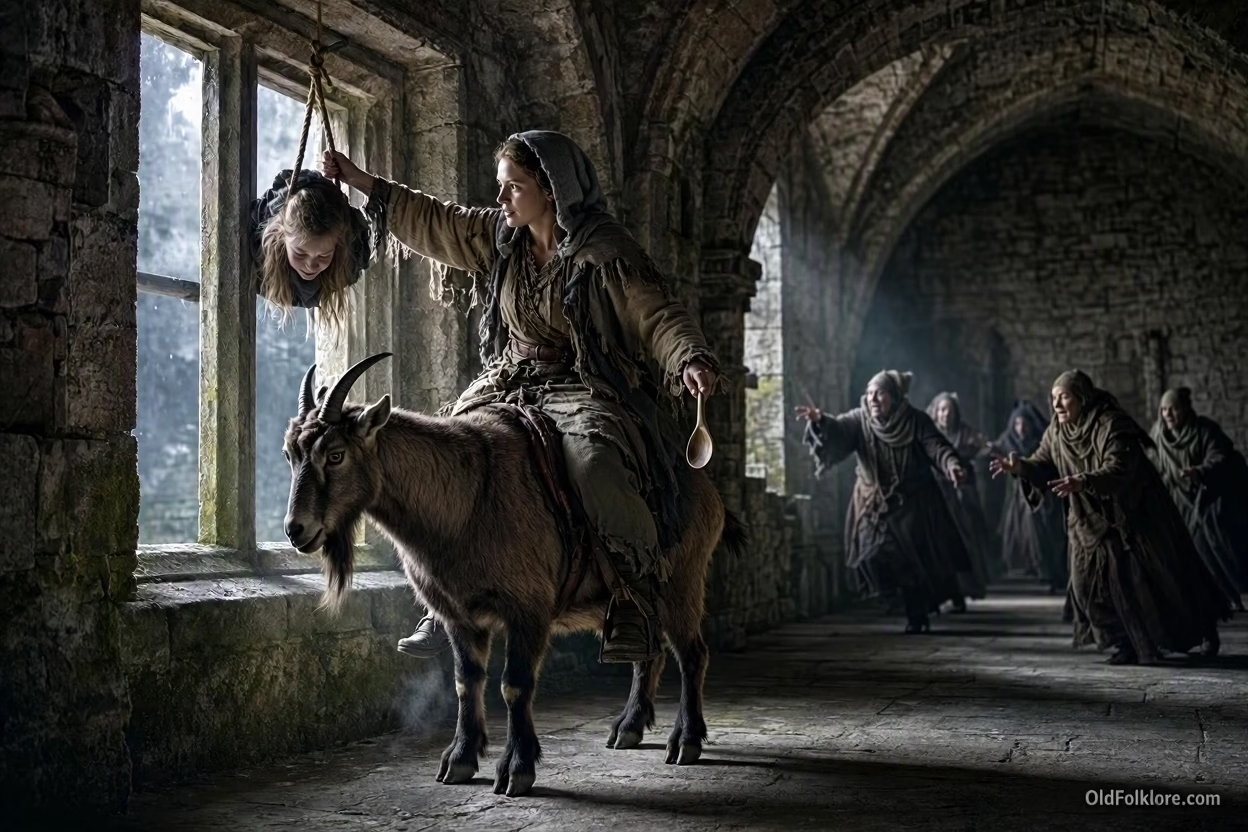
A king and queen long for children and eventually welcome two daughters into their family. The elder, Tatterhood, is born looking unusual and rides a goat while carrying a wooden spoon. Her younger sister is beautiful, but a Christmas Eve encounter with witches leaves her with a calf’s head. Determined to rescue her sister, Tatterhood sets out on a dangerous journey that reveals the strength hidden beneath her ragged appearance.
The Queen’s Wish for Children
Once upon a time, a king and queen lived in a grand palace, but they had no children. The queen felt deeply unhappy. Wherever she travelled throughout the kingdom, she saw children bringing life and noise to even the humblest homes. She longed to experience the same happiness.
At last, the royal couple took a young girl into their palace to raise as their own. They hoped to love and care for her as they would a daughter, teaching her good behaviour and correcting her when necessary.
One day, their foster daughter was playing in the palace courtyard with a golden apple. An old beggar woman passed by with her own little girl, and the two children soon became friends. They tossed the golden apple between them and played happily together.
The queen watched from a window. She called her foster daughter inside and asked why she had been playing with the beggar woman’s child.
The girl replied that the old woman possessed a power that could help the queen have children of her own. The queen doubted the claim, but the girl insisted that it was true.
Eventually, the queen summoned the beggar woman and asked whether she could help her become a mother. The woman initially dismissed the suggestion, saying that queens should not believe the foolish tales of children.
However, after the queen offered her wine and mead, the old woman began to speak more freely. She described a strange method involving two pails of water. The queen was to wash herself in both pails and pour the water beneath her bed. By morning, two flowers would appear. She must eat the beautiful flower but leave the ugly one untouched.
The queen followed the instructions. The next morning, she found two flowers beneath her bed. One was bright and lovely, while the other was dark and unpleasant. The beautiful flower tasted so sweet that she ate it immediately. Then, believing the second flower could do little harm, she ate that one too.
Before long, the queen discovered that she was expecting a child.
The Birth of Tatterhood
The queen first gave birth to a girl who arrived holding a wooden spoon and riding a goat. The child looked rough and unusual, and she immediately called out to her mother.
The queen was startled by the sight. The child reassured her, however, saying that a more beautiful sister would soon follow.
In time, the queen gave birth to a second daughter. This child was remarkably beautiful, with a gentle appearance that delighted everyone who saw her.
Explore more stories from our Asbjørnsen & Moe’s Norwegian Folk Tales collection.
The elder girl became known as Tatterhood because she wore a ragged hood that hung in tatters around her ears. She rode her goat and carried her wooden spoon wherever she went.
The queen struggled to accept Tatterhood’s appearance. The nurses tried to keep the elder girl apart from her younger sister, but their efforts failed. Wherever the beautiful princess went, Tatterhood followed.
Although the sisters looked very different, Tatterhood remained devoted to her sibling. No one could keep them apart for long.
Witches in the Palace
One Christmas Eve, a terrible commotion erupted in the gallery outside the queen’s rooms. There was such a crashing and clattering that the palace seemed ready to shake apart.
Tatterhood asked what was happening. At first, the queen told her not to concern herself with it, but the girl refused to be dismissed.
Eventually, the queen explained that a company of trolls and witches had arrived to celebrate Christmas inside the palace.
Tatterhood immediately decided to drive them away. Her family tried to stop her, warning her about the danger, but she would not change her mind.
Before leaving, she gave the queen one important instruction. Every door had to remain firmly shut so that none of the witches could enter the rooms where the royal family was staying.
Armed with her wooden spoon, Tatterhood went into the gallery to confront the intruders. A tremendous struggle followed. The palace creaked and groaned as though its beams and walls were being pulled apart.
The queen and the others waited anxiously, hoping Tatterhood would defeat the witches and return safely.
The Princess with a Calf’s Head
During the commotion, one of the doors was left slightly open. Tatterhood’s younger sister could not resist peeping outside to see what was happening.
The moment she put her head through the opening, an old witch appeared and snatched it away. The witch placed a calf’s head on the princess’s shoulders instead.
The younger princess stumbled back into the room on all fours, making the sounds of a calf.
When Tatterhood returned, she immediately noticed what had happened. She was furious that the others had failed to keep the doors shut as she had instructed.
Yet she did not waste time blaming her sister. She announced that she would find a way to restore her.
Tatterhood went to the king and demanded a properly equipped ship stocked with everything needed for a long voyage. She refused to take a captain or sailors, insisting that she would travel with her sister alone.
The king eventually agreed. Tatterhood prepared the ship, helped her sister aboard and set sail towards the land where the witches lived.
The Journey to the Witches’ Castle
When the ship reached the witches’ land, Tatterhood told her sister to remain aboard and keep still. She then mounted her goat and rode towards the witches’ castle.
At the castle, she discovered an open window in the gallery. Through it, she could see her sister’s missing head hanging from the window frame.
Without hesitation, Tatterhood urged her goat through the window, seized the head and turned to escape.
The witches soon realised what she had done. They rushed after her in a furious crowd, surrounding her as thickly as bees around a hive.
But Tatterhood was not easily frightened. Her goat snorted, puffed and charged at the witches with its horns. Tatterhood swung her wooden spoon, striking at the attackers and forcing them back.
The witches could not overcome the determined princess and her powerful mount. At last, they abandoned their pursuit.
Tatterhood returned to the ship carrying her sister’s own head. She removed the calf’s head and restored the princess’s original one. The younger girl immediately became herself again, beautiful and gentle as before.
With her sister safe, Tatterhood had completed the rescue that had brought them across the sea.
Two Sisters and a New Kingdom
After leaving the witches’ land, Tatterhood sailed a long way until she reached the kingdom of another king. This ruler was a widower with an only son.
When the royal household heard that a strange ship had arrived, the king sent messengers to discover who owned it and where it had come from.
The messengers found Tatterhood alone on deck, riding her goat at great speed. They were astonished by the sight and asked whether anyone else had travelled with her.
Tatterhood confirmed that she had brought her sister, but she refused to show the younger princess to anyone except the king himself.
When the messengers reported what they had seen, the king went to the shore in person. Tatterhood then brought her sister out of the ship.
The younger princess was so beautiful that the king immediately fell in love with her. He invited both sisters to his palace and wished to marry the younger one.
Tatterhood refused to agree unless the king’s son married her in return.
The prince was unhappy with the arrangement. He considered Tatterhood ugly and was reluctant to take her as his bride. Nevertheless, the king and others persuaded him to give his word.
Preparations began for the two weddings. The king would marry the beautiful younger sister, while the prince would marry Tatterhood.
The Bride’s Hidden Beauty
On the wedding day, the king travelled ahead with his beautiful bride. People stopped along the road to admire her, and the procession continued towards the church.
Behind them rode the prince beside Tatterhood. She sat on her goat, holding her wooden spoon and wearing her ragged grey hood.
The prince remained miserable. He thought his wedding was the saddest occasion of his life and could hardly bring himself to speak.
Tatterhood finally asked why he was so silent. When he replied that he had nothing to say, she suggested that he ask why she rode such an ugly goat.
The prince repeated the question.
Tatterhood answered that the goat was not ugly at all but the finest horse a bride could ride. At once, the goat changed into a magnificent horse.
They continued towards the church, but the prince remained gloomy. Again, Tatterhood encouraged him to ask about something that troubled him. This time, she suggested that he ask why she carried an ugly wooden spoon.
When the prince asked, Tatterhood declared that it was a beautiful silver wand, the finest a bride could carry. The wooden spoon instantly became a shining silver wand.
Still the prince remained unhappy. Tatterhood then asked him to question her about her ragged grey hood.
He did so, and she answered that it was the brightest golden crown a bride could wear. Immediately, the hood transformed into a brilliant crown.
Finally, she urged the prince to ask why her face looked so ugly and grey.
When he asked, Tatterhood declared that she was not ugly at all. In fact, she was ten times more beautiful than her sister.
The prince looked at her again. Before his eyes, Tatterhood became a woman of extraordinary beauty. He could scarcely believe that the bride beside him was the same girl he had considered so unattractive moments earlier.
His sorrow vanished, and he found himself able to speak freely.
The two weddings were celebrated with great feasting and drinking. Afterwards, the king and the prince travelled with their brides to the sisters’ father’s palace, where another wedding feast was held.
There was rejoicing throughout the celebration, and the story ends with the promise that the festivities continued long afterwards.
Explore our complete Historic Folklore & Fairy-Tale Collections archive.
Moral Lesson
Tatterhood’s courage and determination prove more valuable than conventional beauty. She acts when others hesitate, rescues her sister from danger and refuses to let appearances determine her worth. The tale also challenges the assumption that a person’s outward appearance reveals their true character or potential.
Knowledge Check
1. Why was the queen unhappy at the beginning of the tale?
She had no children and longed to experience the happiness she saw in other families.
2. What unusual things accompanied Tatterhood at birth?
She arrived holding a wooden spoon and riding a goat.
3. What happened to Tatterhood’s younger sister on Christmas Eve?
A witch took away her head and replaced it with the head of a calf.
4. How did Tatterhood rescue her sister?
She sailed to the witches’ land, rode her goat into their castle, recovered her sister’s head and restored it.
5. What conditions did Tatterhood set before the king could marry her sister?
She insisted that the king’s son must marry her.
6. How did Tatterhood’s appearance change during the wedding journey?
Her goat became a fine horse, her wooden spoon became a silver wand, her ragged hood became a golden crown, and her face transformed into extraordinary beauty.
Source
“Tatterhood” appears as Tale XLVIII in Popular Tales from the Norse, a collection compiled by Peter Christen Asbjørnsen and Jørgen Moe and translated into English by Sir George Webbe Dasent.
Explore More Asbjørnsen & Moe’s Norwegian Folk Tales