Once upon a time, in a quiet village, there lived a beautiful little girl who was dearly loved by her mother and grandmother. Her grandmother was especially fond of her and had made her a lovely red hood to wear. The garment suited the child so perfectly that everyone began calling her Little Red Riding Hood.
One day, her mother prepared some custard and a small pot of butter for the grandmother, who was unwell and living in another village.
“My dear,” her mother said, handing her the food, “I want you to visit your grandmother. I have heard that she has been very ill. Take her this custard and a little pot of butter, and see how she is getting along.”
Little Red Riding Hood was delighted to help. She collected the provisions and immediately set out through the forest.
As she walked among the trees, she encountered a wolf. The animal was hungry and immediately thought of eating the little girl. However, some woodcutters were working nearby, so he knew he could not attack her without attracting attention.
Instead, he approached her and asked where she was going.
Explore more stories from our Charles Perrault Tales collection.
The child, who had no idea how dangerous it was to speak freely with a wolf, answered innocently.
“I am going to visit my grandmother. She is not feeling well, and I am taking her some custard and a little pot of butter from my mother.”
“Does your grandmother live far away?” the wolf asked.
“Oh, yes,” she replied. “She lives beyond the mill you can see over there. Hers is the first house you come to when you reach the village.”
The wolf listened carefully, already forming a plan.
“How fortunate!” he exclaimed. “I should like to visit your grandmother, too. Let us see who can get there first. You take one path, and I shall take another.”
The wolf chose the shortest route and hurried away as quickly as his legs could carry him. Little Red Riding Hood, however, took the longer path. She stopped along the way to collect nuts, chase butterflies and gather little flowers into a beautiful bouquet.
While the child enjoyed herself in the forest, the wolf raced towards the grandmother’s house.
He arrived long before her and knocked on the door.
“Tap, tap, tap!”
“Who is there?” the grandmother called from her bed.
“It is your granddaughter, Little Red Riding Hood,” the wolf answered, carefully imitating the girl’s voice. “I have brought you some custard and a little pot of butter from my mother.”
The grandmother, who was resting because of her illness, believed the visitor was her granddaughter.
“Pull the bobbin,” she called, “and the latch will go up.”
The wolf pulled the bobbin, and the door opened. He rushed inside, attacked the helpless old woman and swallowed her whole. He had not eaten for more than three days, and he wasted no time satisfying his hunger.
Afterwards, he shut the door, climbed into the grandmother’s bed, covered himself with her bedclothes and waited for the little girl.
Some time later, Little Red Riding Hood finally arrived. She knocked on the door.
“Tap, tap, tap!”
“Who is there?” the wolf called.
His voice sounded much deeper than her grandmother’s. The girl felt a little frightened, but she thought her grandmother might have caught a cold.
“It is your granddaughter, Little Red Riding Hood,” she answered. “I have brought you some custard and a little pot of butter from my mother.”
The wolf softened his voice as much as he could.
“Pull the bobbin, and the latch will go up.”
The girl did as she was told, and the door opened.
She entered the house, placed the custard and butter on a stool and approached the bed. The wolf remained hidden beneath the blankets.
“Put your things down,” he told her, “and come and lie beside me.”
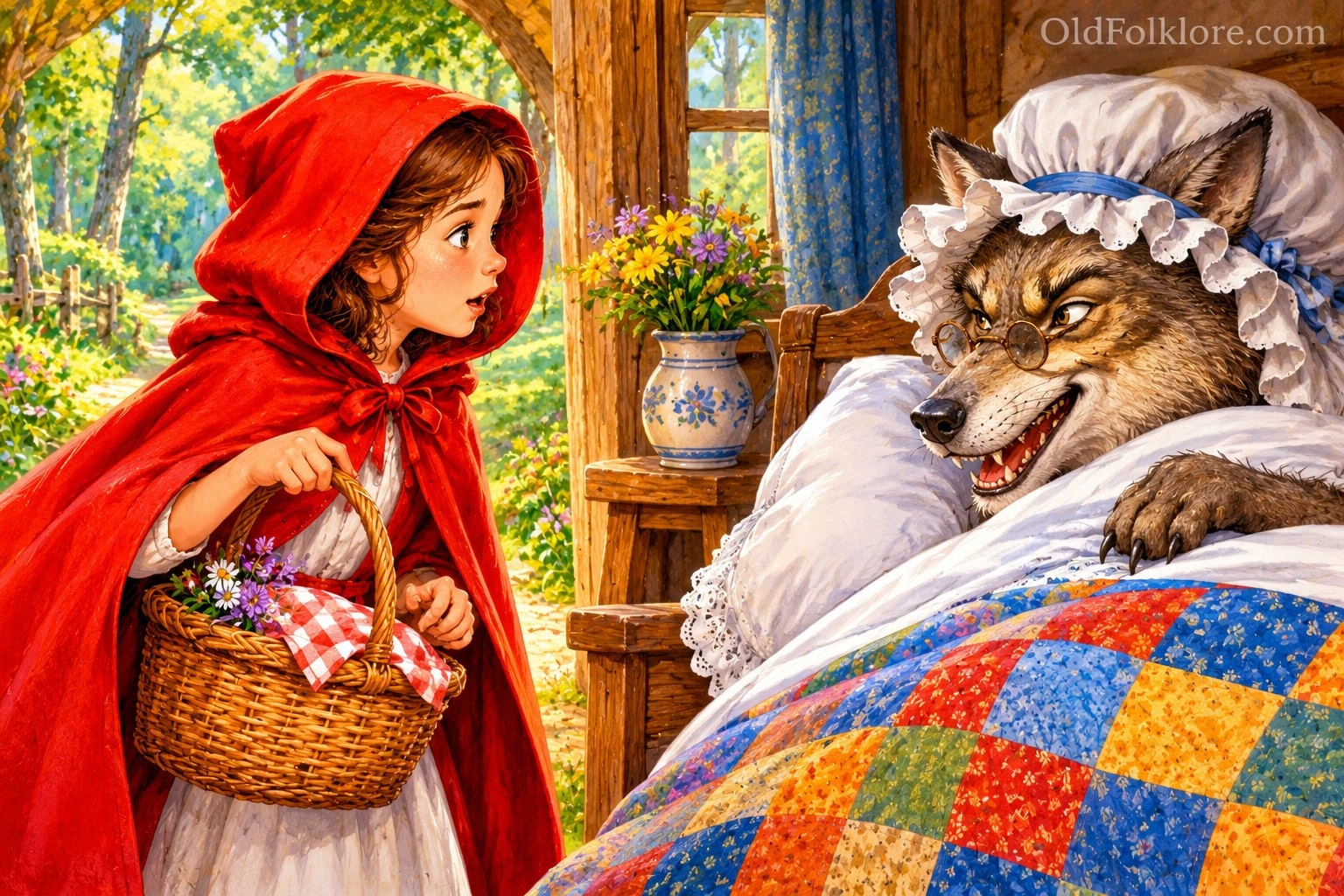
Little Red Riding Hood undressed and climbed into bed. But as she settled beside the figure she believed was her grandmother, she began noticing some very unusual things.
“Grandmamma,” she said, “what enormous arms you have!”
“They are to hug you better, my dear,” the wolf replied.
“Grandmamma, what enormous legs you have!”
“They are to run faster, my child.”
“Grandmamma, what enormous ears you have!”
“They are to hear you better, my child.”
“Grandmamma, what enormous eyes you have!”
“They are to see you better, my child.”
Little Red Riding Hood was increasingly puzzled. Then she noticed the creature’s enormous teeth.
“Grandmamma, what enormous teeth you have!”
“That is to eat you up!”
Before the little girl could escape, the wicked wolf sprang upon her and swallowed her whole.
And so, in this version of the tale, both Little Red Riding Hood and her grandmother met a terrible end.
Explore our complete Historic Folklore & Fairy-Tale Collections archive.
Moral
Little Red Riding Hood teaches that innocence without caution can expose a person to danger. It reminds readers to be careful about trusting strangers, revealing personal information and following the instructions of people whose intentions they do not understand.
Knowledge Check
1. Why was the little girl called Little Red Riding Hood?
Her grandmother had made her a beautiful red hood, which suited her so well that everyone began calling her by that name.
2. Why did the wolf not attack the girl when they first met?
Some woodcutters were working nearby, and he feared they might interrupt his attack.
3. How did the wolf reach the grandmother’s house before the girl?
He took the shorter route while Little Red Riding Hood followed the longer path, stopping to collect nuts and flowers and chase butterflies.
4. How did the wolf deceive the grandmother?
He imitated Little Red Riding Hood’s voice and pretended to be bringing food from her mother.
5. What happened to the grandmother and Little Red Riding Hood?
The wolf ate the grandmother before the girl arrived. Later, after disguising himself as the grandmother, he also ate Little Red Riding Hood.
6. What makes Perrault’s ending distinctive?
Neither character is rescued. The wolf succeeds in eating both of them, making this version a particularly dark cautionary tale.
Source
Charles Perrault, The Tales of Mother Goose, as first collected by Charles Perrault in 1696, translated into English by Charles Welsh, with an introduction by M. V. O’Shea and illustrations by D. J. Munro after drawings by Gustave Doré.
Explore More Charles Perrault Folktales
- Puss in Boots Perrault: A Classic French Folktale
- Riquet with the Tuft: A Fairy Tale About Love, Beauty and Intelligence