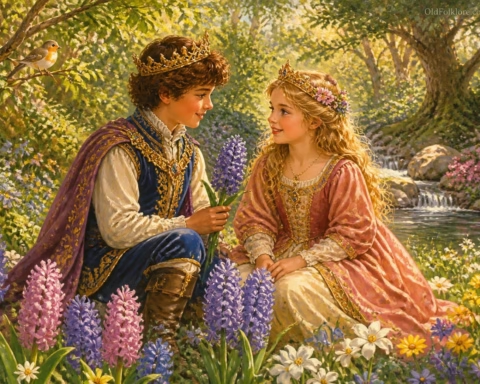
Once upon a time, in a distant kingdom, a queen gave birth to a son whose appearance was so unusual that people wondered whether he could truly be human. His head bore a small tuft of hair, and his family name was Riquet, so he became known as Riquet with the Tuft.
The queen was deeply troubled by her son’s appearance, but a fairy who had attended his birth offered her comfort. Although the prince might not possess physical beauty, the fairy promised that he would grow into a remarkably intelligent and agreeable person. She also gave him a special gift: he would be able to share as much intelligence as he wished with the person he loved most.
The queen took heart from this promise. As Riquet grew, his quick understanding, charming conversation and thoughtful behaviour won the admiration of everyone around him. Before long, his intelligence became far more remarkable to those who knew him than his unusual appearance.
Explore more stories from our Charles Perrault Tales collection.
Seven or eight years later, a queen in a neighbouring kingdom gave birth to twin daughters. The first princess was extraordinarily beautiful, and her mother’s delight was so overwhelming that the people around her feared for her health.
The same fairy appeared at the birth. Seeing the queen’s excessive happiness over her eldest daughter’s beauty, she declared that the child would possess no intelligence at all. She would be as foolish as she was beautiful.
The queen was distressed by this pronouncement. Her sorrow deepened when she discovered that her second daughter was exceedingly unattractive.
The fairy, however, offered a different kind of consolation. The younger princess would possess such remarkable intelligence that her lack of beauty would scarcely matter. The queen, hoping for a better future for her elder daughter, asked whether the fairy could grant her some intelligence too.
The fairy explained that she could not change the elder princess’s intellectual gifts, but she could give her the power to make the person she loved most extraordinarily beautiful.
With time, the two princesses grew into very different young women. The elder became more beautiful with every passing year, but her foolishness also became increasingly apparent. She struggled to answer ordinary questions sensibly and often said things that made little sense. Even simple tasks proved difficult. She could hardly arrange a few pieces of china without breaking one, and drinking a glass of water without spilling it became a challenge.
Her younger sister, meanwhile, became increasingly unattractive in appearance but possessed a lively and penetrating mind. She could speak entertainingly, offer thoughtful opinions and hold the attention of an entire gathering.
Whenever the sisters appeared in society, people first approached the elder to admire her beauty. Yet they soon drifted towards the younger one, whose intelligence and conversation gave them greater pleasure. Before long, the beautiful princess would find herself alone while her sister entertained everyone around her.
Although the elder princess was foolish, she understood enough to recognise her misfortune. She would gladly have surrendered all her beauty for even half of her sister’s intelligence. Her mother, too, sometimes reproached her for her lack of sense, leaving the poor princess miserable about the one quality she could not seem to acquire.
One day, overwhelmed by these feelings, the princess withdrew into a wood to weep in solitude.
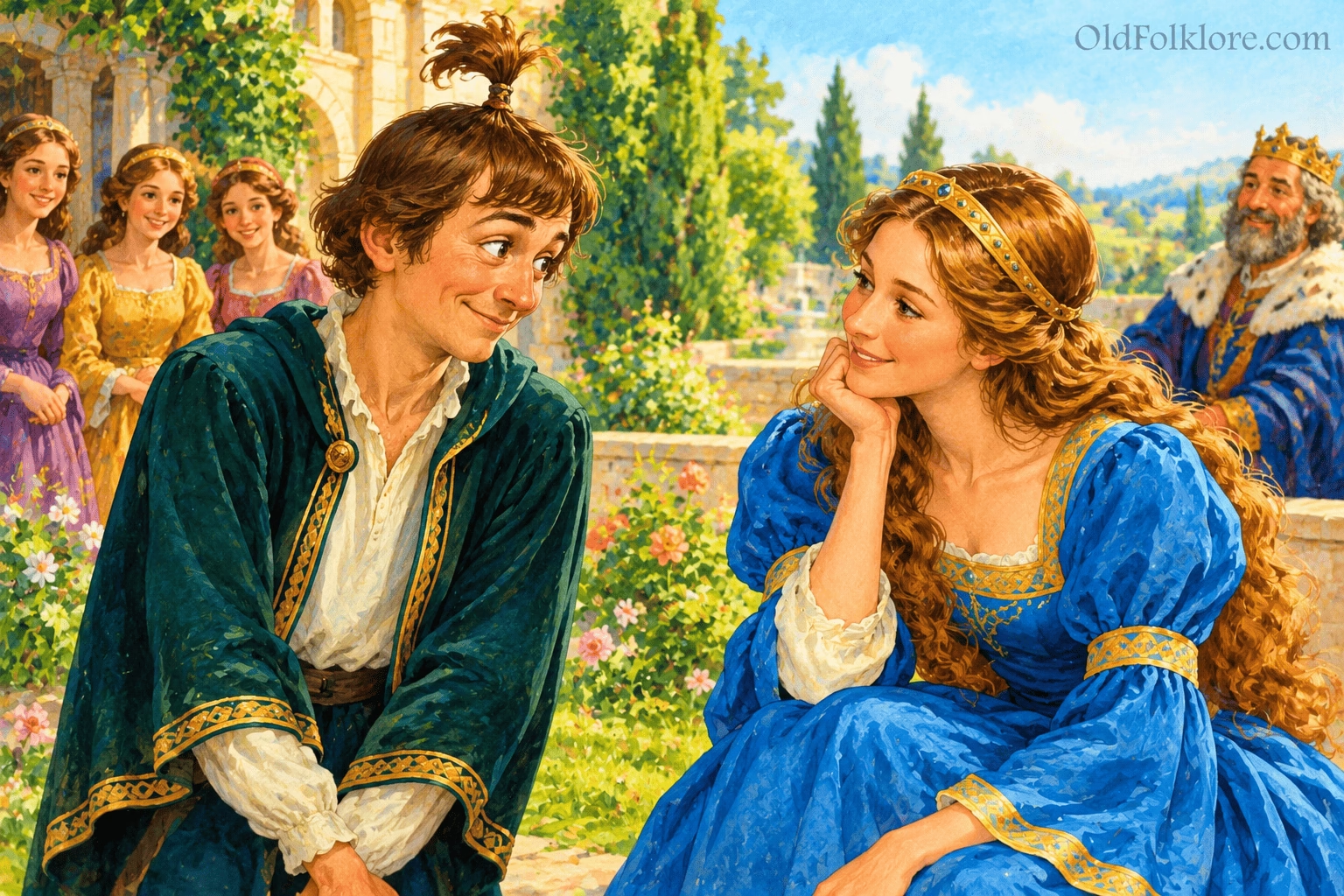
There, she encountered a small, unusually dressed young man whose appearance was far from handsome. Yet he approached her with great courtesy and spoke to her respectfully. He was none other than Prince Riquet with the Tuft.
Riquet had fallen in love with the princess after seeing portraits of her that had been distributed throughout the world. He had travelled from his father’s kingdom in the hope of meeting her, and he was delighted to discover her alone.
After exchanging the usual courtesies, he noticed her sadness and asked why someone so beautiful could be so unhappy.
The princess replied that she would rather be as unattractive as he was, provided she possessed intelligence, than remain beautiful and foolish.
Riquet gently observed that recognising one’s own lack of wisdom was itself a sign of some understanding. Nevertheless, the princess insisted that she knew how foolish she was and that the knowledge caused her great distress.
Riquet told her that he could put an end to her unhappiness. The fairy who had blessed him at birth had given him the power to bestow as much intelligence as he wished upon the person he loved most.
Since the princess was that person, he could make her as intelligent as anyone in the world. There was only one condition: she must agree to marry him.
The princess was startled. She could hardly imagine marrying someone whose appearance she found so unpleasant. Yet her desire for intelligence was so powerful that she could scarcely bear the thought of waiting another year without it.
Riquet understood her hesitation and offered her a full year to consider his proposal. The princess, overwhelmed by the prospect of finally possessing the quality she desired above everything else, accepted.
She had scarcely made her promise to marry him in a year’s time when a remarkable change came over her. Suddenly, she could express her thoughts clearly and gracefully. Words came naturally to her, and she discovered that she could hold a conversation with ease, wit and understanding.
When she returned to the palace, everyone was astonished. The princess who had once struggled to say anything sensible now spoke with such intelligence and charm that the entire court marvelled at her transformation.
Her father was delighted. He began consulting her about important matters, sometimes holding council in her own apartments. News of her new abilities spread to neighbouring kingdoms, and princes soon arrived, hoping to win her hand in marriage.
But the princess was no longer easily impressed. She listened to her suitors and considered their qualities carefully, yet none seemed intelligent enough to satisfy her.
At last, a prince arrived who was handsome, wealthy, powerful and witty. The princess felt a strong attraction to him, and her father assured her that she was free to choose her own husband. She thanked him but asked for time to consider the decision.
To think in peace, she returned to the very wood where she had first met Riquet.
As she walked, deep in thought, she heard strange sounds coming from beneath the ground. Voices called for pots, kettles and firewood, while the noise of hurried activity grew louder. Suddenly, the earth seemed to open before her, revealing a magnificent kitchen filled with cooks and attendants preparing an elaborate feast.
The princess stopped in astonishment and asked whom they were serving.
The chief cook informed her that the preparations were for Prince Riquet with the Tuft, who was to be married the following day.
At once, she remembered her promise. The day she had agreed to marry Riquet a year later had arrived, but in the excitement of gaining intelligence, she had forgotten the foolish girl she once was and the commitment she had made.
Before she could recover from her surprise, Riquet appeared before her, dressed magnificently for his wedding.
He reminded her that he had kept his word and expected her to keep hers.
The princess admitted that she had not decided to marry him. She reasoned that an unreasonable man might insist that a princess must honour her promise, but Riquet was a man of exceptional intelligence and should understand her position.
She pointed out that, even when she had been foolish, she had struggled to accept the idea of marrying him. Now that she possessed greater understanding, she found herself even less willing to make that choice. If he had truly wished to become her husband, she argued, he should not have given her the intelligence that made her reconsider the agreement.
Riquet listened carefully. He reminded her that a person of intelligence should not be treated less fairly than someone without it. If keeping a promise was reasonable for an ordinary person, why should he be denied the same consideration simply because he was clever enough to argue his case?
He then asked her a more personal question. Apart from his physical appearance, was there anything else about him that displeased her? Was she dissatisfied with his birth, intelligence, temperament or manners?
The princess admitted that she respected and admired all those qualities. His character, she acknowledged, was worthy of esteem.
Riquet explained that if she truly cared for him, she possessed the power to make him the most lovable man in the world. The same fairy who had given him the ability to make the person he loved intelligent had granted the princess a corresponding gift: she could make the person she loved extraordinarily handsome.
The princess had never understood the full extent of her own gift. Now, faced with Riquet’s devotion, intelligence and good character, she considered what she truly wanted.
She wished with all her heart that he might become the most lovable prince in the world and used her gift on him.
Immediately, Riquet appeared to her as the most handsome and agreeable man she had ever seen.
Whether magic had changed his appearance or love had changed her perception, the result was the same. The features that had once seemed unpleasant to her now appeared attractive. His posture seemed distinguished, his movements charming, and his eyes bright and expressive. Even the features she had previously disliked became, in her eyes, signs of his individuality and character.
The princess now saw the man she had come to admire for his intelligence, patience, courtesy and devotion, rather than judging him by his appearance alone.
She agreed to marry him, provided her father gave his consent. The king, who already respected Riquet’s wisdom and good judgement, gladly approved the union.
The following morning, the wedding took place, just as Riquet had arranged. The prince and princess were married, and the tale leaves us with its central question still lingering: had magic transformed Riquet, or had love simply taught the princess to see him differently?
Love and the way we see others
The ending leaves room for two interpretations. The princess’s gift may literally transform Riquet, but the narrator also suggests that love itself can alter how someone sees another person. When the princess reflects on Riquet’s patience, intelligence and devotion, the features she once disliked no longer seem repulsive.
This ambiguity is central to the tale. Rather than insisting that magic alone explains the transformation, Perrault invites readers to consider how affection influences attraction.
Intelligence, choice and promises
The princess’s sudden acquisition of intelligence changes more than her speech. It transforms her judgement, her ambitions and her expectations of a husband. Yet her new understanding also leads her to question the promise she made when she was foolish.
Riquet’s response introduces a moral complication. He expects her to honour her word, while she argues that her improved judgement gives her reason to reconsider. Their disagreement asks readers to think about responsibility, personal choice and whether a promise should remain binding when the person who made it has fundamentally changed.
Explore our complete Historic Folklore & Fairy-Tale Collections archive.
Moral
True worth extends beyond physical appearance. Intelligence, kindness, patience and good character can inspire admiration and affection, while love may change the way we perceive another person. The tale also reminds readers to think carefully about promises, personal responsibility and the choices they make.
Knowledge Check
1. What special gift did Riquet receive from the fairy?
He could give as much intelligence as he wished to the person he loved most.
2. Why was the elder princess unhappy despite her beauty?
She lacked intelligence and struggled to communicate sensibly, while her younger sister attracted people through her wit and conversation.
3. What gift did the fairy give the elder princess?
She could make the person she loved most extraordinarily handsome.
4. Why did the princess initially promise to marry Riquet?
She desperately wanted the intelligence he could give her and accepted his proposal in exchange for that gift.
5. Why did the princess reconsider her promise a year later?
After gaining intelligence, she reconsidered her earlier decision and felt reluctant to marry someone whose appearance she disliked.
6. What ultimately changed the princess’s view of Riquet?
She recognised his good character and devotion and used her own magical gift to make him handsome. The story also suggests that love itself may have changed how she perceived him.
Source
Perrault, Charles. “Riquet with the Tuft.” In The Tales of Mother Goose, translated by Charles Welsh, introduction by M. V. O’Shea, illustrated by D. J. Munro after Gustave Doré. Boston, New York and Chicago: D. C. Heath & Co., 1901.