The First Kalandar’s Tale is a story of friendship, loyalty, betrayal and the unpredictable turns of fortune. It follows a young prince whose life changes after he agrees to help his beloved cousin with a mysterious undertaking. Although he believes he is protecting a trusted relative, his involvement brings sorrow and lasting regret.
Before long, political enemies destroy his royal family, and he loses one of his eyes. He escapes execution through the kindness of a former servant, only to encounter another family tragedy in his uncle’s kingdom. When war reaches that city, he loses his remaining protection and must disguise himself to survive.
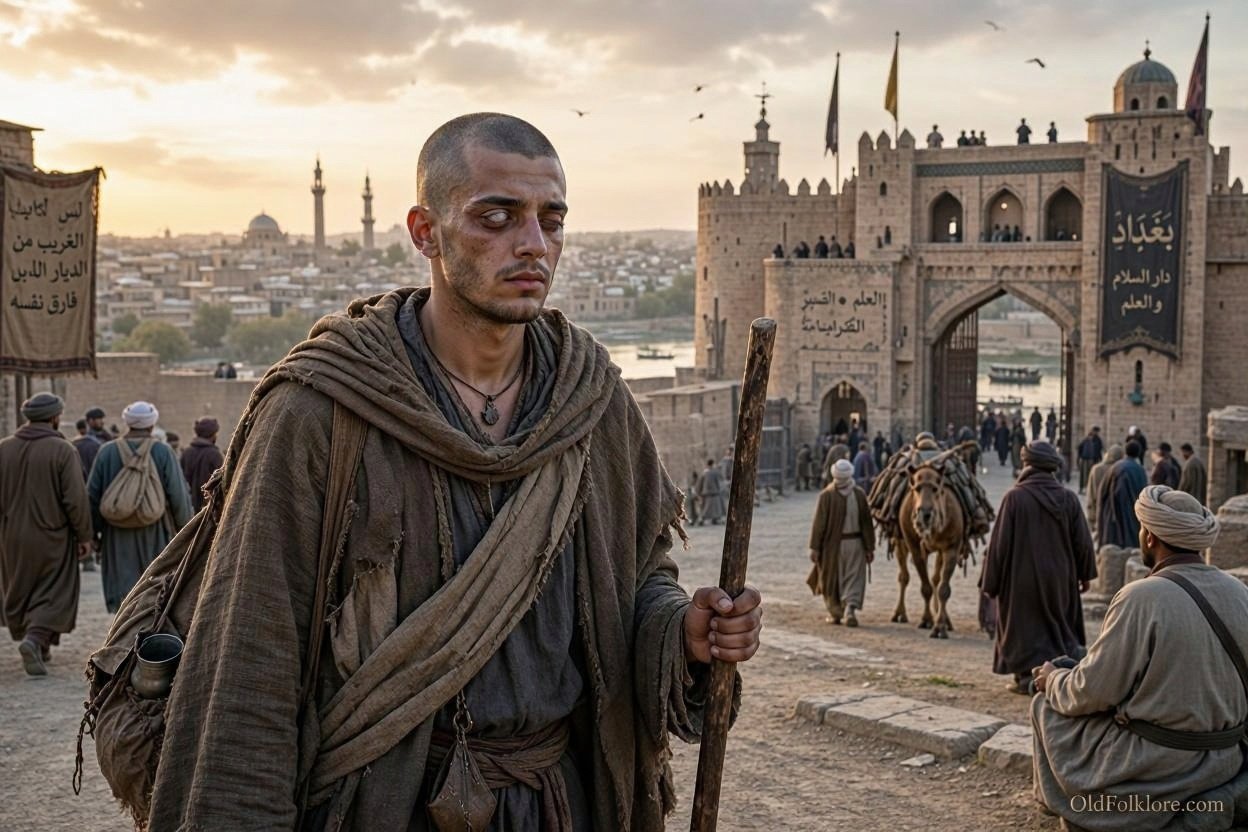
His account explains why he arrives in Baghdad as a shaven-headed, one-eyed Kalandar and why he is determined to seek an audience with the Caliph.
The Prince and His Cousin
The First Kalandar began his account by explaining that he had been born a prince. His father ruled one kingdom, while his father’s brother, his paternal uncle, governed another city.
The two royal cousins were born on the same day. As they grew older, they developed a close friendship. The prince regularly visited his uncle’s palace, sometimes staying for several months.
His cousin treated him with exceptional generosity. He provided rich meals, the finest wine and pleasant company. They spent many hours talking and enjoying one another’s company.
One evening, while they were drinking together, the cousin told him that he had an important favour to request. He wanted his friend to promise that he would not interfere with whatever he intended to do.
The prince agreed and swore a solemn oath.
His cousin then left the room. When he returned, he was accompanied by a woman whose face was covered by a veil. She wore expensive clothing and valuable ornaments.
The cousin explained that the prince had to take the woman to a particular burial ground. He described the location and instructed him to wait with her inside a certain tomb until he arrived.
Bound by his promise, the prince did not question the unusual request. He accompanied the woman to the cemetery, and they entered the designated sepulchre.
The Secret Beneath the Tomb
The prince and the veiled woman had barely settled inside the tomb when his cousin arrived carrying a bowl of water, a bag of mortar and a tool resembling a small hoe.
He went straight to the grave in the centre of the burial place. Using the tool, he broke open the tomb and moved the stones aside. He continued digging until he uncovered a large iron covering.
When he lifted it, a hidden staircase appeared. It descended through a narrow, winding passage beneath the ground.
The cousin turned towards the veiled woman and invited her to make her final decision. Without hesitation, she descended the staircase and disappeared from sight.
The prince was astonished by what he had witnessed, but his cousin had another favour to request.
He explained that he had spent an entire year secretly preparing the underground place. Nobody knew about it except himself. He wanted the prince to help conceal the entrance so that no one would suspect that the old tomb had been disturbed.
His instructions were detailed. After he descended, the prince was to replace the iron covering, return the earth to its former position and rebuild the stones. He also had to mix the mortar with the water and plaster the surface until it appeared untouched.
The cousin thanked him warmly and expressed the hope that his friends would never suffer from his absence.
He then descended the staircase and disappeared.
The prince followed the instructions. He replaced the covering, restored the earth and repaired the stones. Because he had been drinking, he worked almost unconsciously and did not fully consider the consequences of what he had done.
After finishing the work, he returned to his uncle’s palace.
The Mysterious Disappearance
When the prince reached the palace, he learned that his uncle had gone out hunting. He therefore retired for the night without seeing him.
The following morning, he remembered the events of the previous evening. He began to regret helping his cousin conceal the underground entrance. At first, he wondered whether the entire experience had been a dream.
He asked the palace attendants where his cousin was, but nobody could tell him.
The prince hurried to the cemetery and searched for the tomb. Unfortunately, he could no longer recognise the place where they had entered the underground passage.
Explore more stories from our The Arabian Nights collection.
He searched among the graves and burial structures until nightfall, but his efforts were unsuccessful.
He returned to the palace distressed and unable to eat or drink. His thoughts remained fixed on his cousin and the mysterious woman. He could not understand why his relative had disappeared underground or what had happened after he left.
The next morning, he returned to the cemetery and searched again. He spent seven days trying to locate the entrance, but each attempt failed.
Eventually, his anxiety became unbearable. Unable to discover what had happened to his cousin, he decided to return to his father’s kingdom.
The Fall of His Father’s Kingdom
The prince set out for home, hoping to find comfort among his own family.
However, as he approached his father’s capital, a group of armed men suddenly seized him. They tied his hands and took him prisoner.
He could not understand why his father’s subjects and even some of his own household servants were treating him like an enemy.
He questioned them, but they initially refused to explain what had happened.
Eventually, one of the men, who had previously worked in his family’s service, revealed the terrible news. His father’s soldiers had betrayed the king, and a powerful Wazir had murdered him and taken control of the kingdom.
The men had been ordered to capture the prince so that the new ruler could deal with him.
The news devastated him. His father was dead, and the kingdom that should have been his inheritance was now controlled by an enemy.
The prisoners took him before the usurping Wazir.
The Wazir’s Revenge
The Wazir already had a personal reason to hate the prince.
Some time earlier, the young man had been practising with a stone bow on the terrace of the palace. A bird landed on the roof of the Wazir’s house, where the official happened to be standing.
The prince aimed at the bird but missed. His shot struck the Wazir in the eye, destroying it.
The injury had been accidental. However, the Wazir could not openly punish the prince while his father remained king. He had been forced to endure the humiliation and had secretly held a grudge ever since.
Now that he had seized the throne, he could take revenge.
When the prince appeared before him, the Wazir immediately ordered his execution.
The young man asked what crime justified such a punishment. The Wazir pointed to his injured eye and reminded him of the earlier accident.
The prince explained that he had never intended to hurt him. The Wazir rejected the explanation, declaring that if the injury had been accidental, his own revenge would be deliberate.
He then approached the prisoner and destroyed one of his eyes.
The prince was left permanently one-eyed.
The Wazir was still not satisfied. He ordered that the young man be bound, placed inside a chest and taken into the wilderness. There, the executioner was to kill him and abandon his body to wild animals and birds.
The Executioner’s Secret Mercy
The executioner obeyed the order and carried the prince away from the city.
Once they reached a remote place, he removed the young man from the chest. The prince’s hands and feet were still tied, and the executioner prepared to carry out the sentence.
Realising that death was near, the prince began to weep. His distress moved the executioner, who also became emotional.
The prisoner then reminded him of the loyalty and kindness he had once shown to those who served his family. He recited verses expressing the pain of discovering that people expected to protect him had instead become instruments of his suffering.
The executioner recognised the prince’s words and remembered his own debt of gratitude. He had served the young man’s father and knew that the prince had treated him well.
Although he was under the Wazir’s orders, he could not bring himself to kill the man who had once shown him kindness.
He explained that he had little freedom to disobey the new ruler. If he openly released the prince, both of them might be killed. Nevertheless, he offered him a chance to escape.
He urged the young man to flee immediately and never return to the kingdom. He warned that the Wazir would certainly seek his life if he remained nearby.
The prince could hardly believe that he had been spared. He thanked the executioner and escaped into the wilderness.
Although he had lost an eye, he considered himself fortunate to have escaped death.
A Painful Reunion with His Uncle
After travelling for some time, the prince reached his uncle’s capital.
He went directly to the palace and explained everything that had happened. He told his uncle about the betrayal of his father’s soldiers, the Wazir’s seizure of the throne and the loss of his eye.
His uncle was overcome with grief. The news of his brother’s murder was painful enough, but he also revealed that his own son had disappeared.
The prince’s cousin had been missing for some time, and nobody knew where he had gone.
The uncle wept bitterly. He had no information about his only son and feared that something terrible had happened to him.
He examined the prince’s injured eye and considered applying medicine, but the damage was too severe. He told his nephew that preserving his life was more important than losing an eye.
The prince could no longer keep the secret of the underground tomb. He decided to explain what had happened during his previous visit.
He described the evening with his cousin, the veiled woman, the hidden staircase and the underground chamber. He also admitted that he had helped conceal the entrance but had been unable to find it afterwards.
His uncle listened carefully. Rather than becoming angry, he was delighted to learn that his son might still be found.
He immediately asked the prince to take him to the tomb.
The Discovery Beneath the Cemetery
The prince and his uncle travelled together to the burial ground.
At first, the prince was uncertain about the location. They searched among the graves, looking carefully at the structures around them.
Eventually, he recognised the tomb.
The two men were relieved to have found the entrance. They cleared away the earth, moved the stones and lifted the iron covering.
A staircase appeared beneath it. They descended approximately fifty steps until they reached the bottom.
There, they encountered a thick cloud of smoke that made it difficult to see. The uncle recited a prayer, and they continued forward.
They eventually entered a large underground chamber. It contained flour, grain, food and other provisions. A canopy stood over a couch in the middle of the room.
The uncle hurried towards it.
There, he found his son and the woman who had accompanied him into the tomb. They lay together, but both bodies had been burned until they were as black as charcoal.
The discovery was horrifying.
Instead of embracing his son or mourning quietly, the uncle reacted with anger. He spat at the young man’s body and condemned him for what he had done.
The prince was shocked by the harsh response. He felt that the sight of his dead cousin should have been enough punishment without further humiliation.
The Secret Behind the Underground Chamber
The uncle then explained the truth.
The woman in the tomb was his own daughter, the prince’s cousin’s sister.
According to the uncle, his son had been deeply attached to his sister from childhood. At first, he had dismissed their closeness because they were still young. As they grew older, however, the relationship became forbidden.
The uncle said that he had repeatedly warned his son and tried to separate the two. He had also confined his daughter and instructed the household servants to keep them apart.
Despite these efforts, the young man secretly constructed the underground chamber. He furnished it and stored food there so that he and his sister could hide together.
When their father went hunting, they used the hidden passage to escape his supervision.
The uncle believed that the deaths of his children were divine punishment for their forbidden relationship. He explained that they had been consumed by fire while hiding underground.
The prince listened with sorrow. He had helped his cousin conceal the entrance without knowing the full purpose of the secret chamber.
The uncle eventually stopped condemning his son and turned towards his nephew. He told him that he would now regard him as a son in the place of the child he had lost.
The two men wept together. Their grief was made worse by the memories of everything that had happened: the prince’s father had been murdered, his kingdom had been seized, and his cousin had died in terrible circumstances.
They climbed out of the underground chamber, replaced the iron covering and restored the tomb to its former appearance.
Then they returned to the palace.
The Wazir Attacks Again
The prince and his uncle had barely settled down when they heard the sounds of an approaching army.
Drums thundered, trumpets sounded and weapons clashed. Horses neighed, soldiers shouted and clouds of dust rose into the air.
The noise filled the city, and the two men wondered what had happened.
They soon learned that the Wazir who had seized the prince’s father’s kingdom had gathered a large army. He had also recruited numerous desert warriors and marched against the uncle’s city.
The attack came suddenly, leaving the defenders unable to organise an effective resistance.
The invading forces overwhelmed the city, and its people surrendered.
The uncle was killed during the attack.
The prince realised that he was in danger once again. If the Wazir discovered him, he would certainly be executed.
He escaped towards the outskirts of the city. He also feared that people who recognised him might betray him in an attempt to gain favour with the victorious army.
His royal clothing and appearance made him easy to identify. He therefore decided that he had to change his appearance completely.
The Making of a Kalandar
The prince chose to shave off his beard and eyebrows. He removed his fine clothing and exchanged it for the rough garments worn by a wandering Kalandar.
The disguise gave him a chance to leave his uncle’s capital without attracting attention.
He set out towards Baghdad, hoping that he might eventually reach the Caliph, the ruler whose authority could provide him with justice and protection.
He wanted to explain the events that had destroyed his family and left him without a kingdom.
After arriving in the city, he found himself uncertain about where to go. He hoped that someone might help him gain access to the Caliph’s presence.
That same night, he encountered another wandering Kalandar. He greeted the stranger, explaining that he was also a traveller without a settled home.
As they spoke, a third Kalandar approached and greeted them. He too was a stranger.
The three men recognised that they shared the same condition. They continued walking together until darkness overtook them and their journey brought them to the house of the three ladies in Baghdad.
There, the First Kalandar explained the events that had led him to lose his eye, shave his beard and abandon his royal life.
His story astonished the people listening to him. Even the Caliph, who was present in disguise, expressed amazement at the extraordinary misfortunes the young man had endured.
When the lady of the house invited him to finish his account and leave, the Kalandar refused to depart until he had heard the stories of his two companions.
His narration ended, and the Second Kalandar prepared to tell his own history.
Explore our complete Historic Folklore & Fairy-Tale Collections archive.
Moral Lessons
The First Kalandar’s Tale shows how quickly fortune can change. The prince begins life surrounded by royal privilege, family affection and friendship. Yet a series of unexpected events leaves him without his father, his kingdom or his former identity.
The story also warns against making promises without understanding what they involve. The prince agreed to help his cousin without asking why the task was necessary. His loyalty placed him in a situation he did not fully understand, and he carried the consequences of that decision for years.
Another lesson concerns the value of kindness. The executioner remembered the prince’s earlier good treatment and chose to spare his life, even though doing so placed him at risk. His decision shows that kindness can create lasting bonds that may become important during difficult times.
The tale further explores the danger of revenge. The Wazir allowed an accidental injury to become a lasting grievance. When he gained power, he used his position to punish the prince cruelly, even though the original incident had not been intentional.
Finally, the story reminds readers that wealth and royal status cannot guarantee safety or happiness. The prince loses nearly everything he once possessed, yet he continues to seek a way forward. His survival depends on courage, adaptability and the kindness of others.
Knowledge Check
1. Who was the First Kalandar before he became a wandering mendicant?
Answer: He was a prince whose father ruled one kingdom and whose paternal uncle ruled another.
2. What secret did the prince help his cousin conceal?
Answer: He helped his cousin hide the entrance to an underground chamber beneath a tomb, without knowing the full reason for its construction.
3. Why did the Wazir hate the prince?
Answer: The prince had accidentally struck and destroyed one of the Wazir’s eyes with a stone bow while aiming at a bird.
4. How did the prince escape execution?
Answer: The executioner remembered the prince’s kindness and secretly released him instead of carrying out the Wazir’s order.
5. What did the prince and his uncle discover inside the underground chamber?
Answer: They found the prince’s cousin and the uncle’s daughter dead, their bodies burned black. The uncle explained that they had been hiding their forbidden relationship there.
6. Why did the prince shave his beard and eyebrows?
Answer: He disguised himself as a Kalandar to avoid recognition after the Wazir’s army captured his uncle’s city and killed his uncle.
Source
“The First Kalandar’s Tale” appears within “The Porter and the Three Ladies of Baghdad” in Volume I of The Book of the Thousand Nights and a Night, translated and annotated by Richard F. Burton in 1885.
Explore More On The Arabian Nights
- The Tale of the Bull and the Ass
- The Envier and the Envied
- Tale of the Husband and the Parrot
- The First Shaykh’s Story
- The Third Shaykh’s Story: The Man Transformed into a Mule