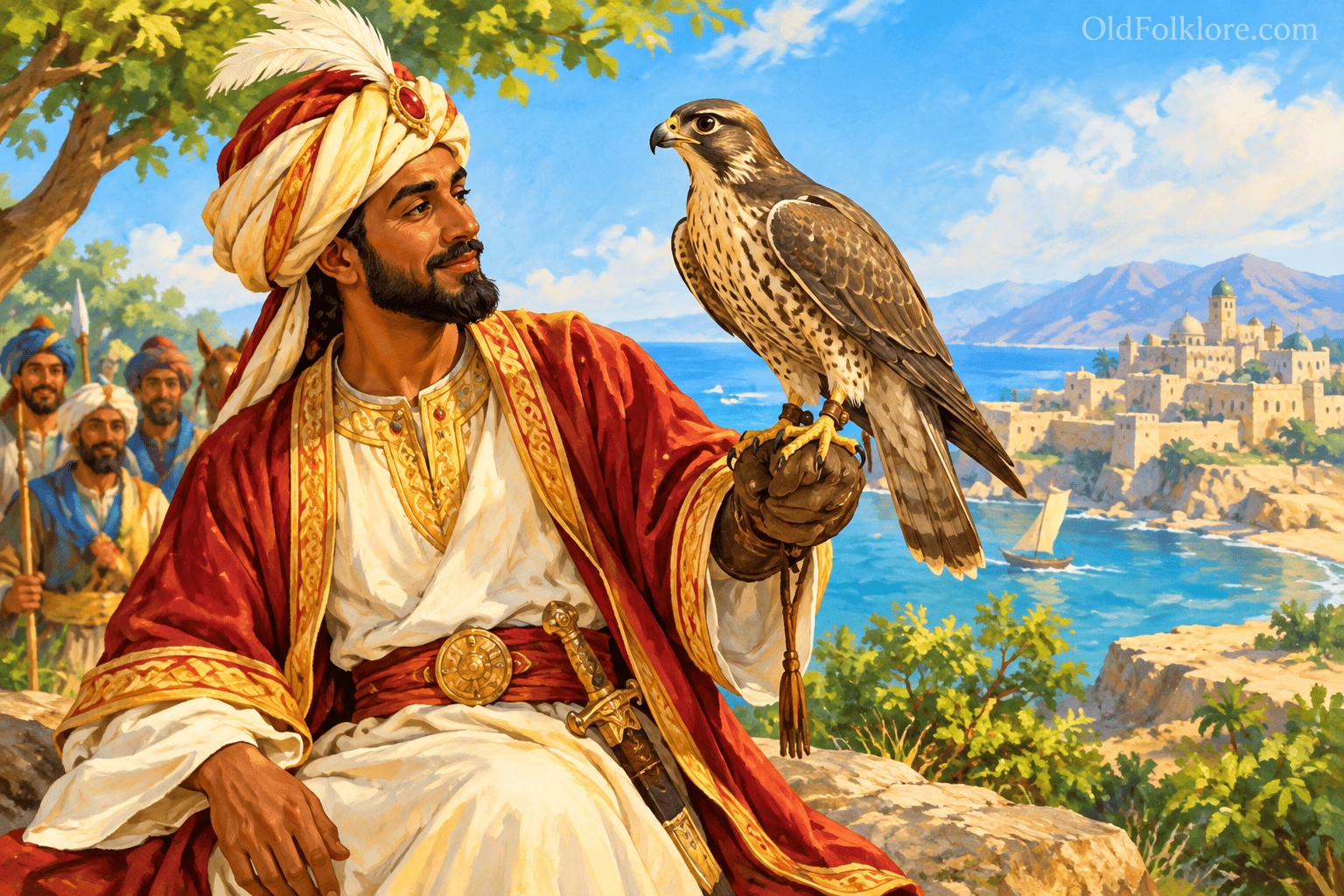
Long ago, a king of Fars loved the pleasures of royal life, especially hunting. Among his most treasured companions was a falcon he had raised and trained himself. The bird accompanied him on his hunting expeditions and was so dear to him that he had a small golden drinking cup attached to her neck.
One day, as the king rested in his palace, his chief falconer approached him.
“King of the age, today is a fine day for hunting.”
The king immediately ordered his attendants to prepare for the expedition. With the falcon perched on his hand, he rode out with his men until they reached a valley where nets were arranged to catch wild game.
Explore more stories from our The Arabian Nights collection.
Before long, a gazelle ran into the enclosure.
The king watched the animal closely and issued a stern warning to his men.
“Whoever allows that gazelle to leap over his head and escape shall pay for it with his life!”
The hunters tightened their nets as the gazelle approached the king. When she came near him, she lowered her hindquarters and crossed her forelegs over her chest, appearing to bow before the ruler.
The king bent his head in acknowledgment, but the gesture was a clever deception. In an instant, the gazelle sprang over his head and fled into the wilderness.
The king turned towards his men and noticed them exchanging glances and pointing at him.
“What are you men saying?” he asked his wazir, or chief minister.
“They remember your command, my lord,” the wazir replied. “You declared that whoever allowed the gazelle to leap over his head and escape would be put to death.”
The king’s pride was wounded. Determined to recover the animal and uphold his word, he swore that he would pursue it until he caught it.
He spurred his horse forward and followed the gazelle’s tracks across the wilderness. He continued until he reached the foothills of a mountain range, where the frightened animal disappeared into a cave.
The king released his falcon. The bird swooped towards the gazelle and struck at its eyes with her talons, leaving it confused and unable to escape. The king then dealt the animal a fatal blow with his mace.
After killing the gazelle, he dismounted, cut its throat, removed its skin and fastened the carcass to his saddle.
The Mysterious Drops from the Tree
By then, the midday heat had become unbearable. The land was dry, and neither the king nor his horse could find water. Thirsty and exhausted, the king searched for relief until he noticed a tree whose branches were dripping a strange liquid. It looked like melted butter, but in the heat and his desperation, he mistook it for water.
The king wore protective leather gloves to guard himself against poison. He removed the golden cup from the falcon’s neck, collected some of the dripping liquid and offered it to the bird.
To his surprise, the falcon struck the cup with her talons, spilling every drop.
The king was puzzled. Perhaps she was not thirsty enough, he thought. He filled the cup again and offered it to her a second time.
Once more, the falcon knocked it over.
Now the king became irritated. He had travelled far, the sun was scorching, and his own thirst was growing unbearable. He could not understand why the bird refused the drink and prevented him from giving water to his horse.
For a third time, he collected the liquid. This time, instead of offering it to the falcon, he held the cup towards his horse.
But the falcon would not allow it. With another movement of her wings, she sent the cup crashing to the ground.
The king’s patience finally broke.
“May Allah confound you, you wretched bird!” he cried. “You will neither drink yourself nor allow me or my horse to drink!”
Blinded by anger, he drew his sword and struck the falcon, cutting off one of her wings.
The bird, now gravely wounded, raised her head and made signs towards the tree, directing the king to look above him.
At last, he understood that she had been trying to warn him.
He lifted his eyes and examined the branches. There, hidden among them, was a brood of vipers. The liquid he had mistaken for water was poisonous venom dripping from the serpents.
The falcon had recognised the danger. Every time the king tried to drink or offer the liquid to another creature, she had intervened to prevent them from swallowing the poison.
The king stared at the tree in horror. The bird he had treated as disobedient had been protecting him all along.
A Regret That Came Too Late
Overcome with remorse, the king realised the terrible injustice he had committed. His faithful companion had saved his life, yet he had answered her loyalty with violence.
He could not undo what he had done. With a heavy heart, he mounted his horse, carried the dead gazelle and returned to the camp where his hunting party had begun its journey.
When he arrived, he handed the gazelle to the cook and ordered him to roast it. Then he settled into his chair, with the wounded falcon still resting on his hand.
Suddenly, the bird gasped and died.
The king was devastated. The falcon that had accompanied him on countless hunts, and that had just saved him from drinking poison, was gone because of his own impatience and anger.
He wept with regret, understanding that he had destroyed the very life that had protected his own.
This was the story of King Sindibad and his falcon. Remembering it, the king explained that he feared making a similar mistake and regretting it afterwards, just as the man who killed his parrot had done.
When the wazir asked how the man had killed his parrot, the king began to tell another story: The Tale of the Husband and the Parrot.
That is where the supplied episode ends, as the larger narrative moves into its next tale.
Explore our complete Historic Folklore & Fairy-Tale Collections archive.
Moral
Do not let anger or wounded pride control your decisions. Someone whose actions appear inconvenient or disobedient may be trying to protect you. Seek to understand the truth before acting, because a decision made in haste can destroy what you later discover was precious.
Knowledge Check
1. Why did the king take his falcon hunting?
He had raised and trained the falcon, valued her companionship and regularly took her on hunting expeditions.
2. Why did the falcon repeatedly overturn the king’s drinking cup?
She was trying to prevent the king, the horse and herself from drinking poisonous liquid that had dripped from vipers in the tree.
3. What caused the king to injure the falcon?
He became angry when she repeatedly spilled the liquid, mistakenly believing she was preventing them from drinking without good reason.
4. Why did the king regret his actions?
He realised that the falcon had been protecting him from poison, and she died from the injury he had inflicted on her.
5. How does this episode fit into the larger narrative?
The king tells the story as a warning against rash decisions and introduces another tale, The Tale of the Husband and the Parrot, to explain his fear of regretting a hasty action.
Source
Adapted from “King Sindibad and his Falcon,” an episode in The Book of the Thousand Nights and a Night, Volume 1, translated by Richard Francis Burton and published in 1885,
Explore More Arabian Nights Tales