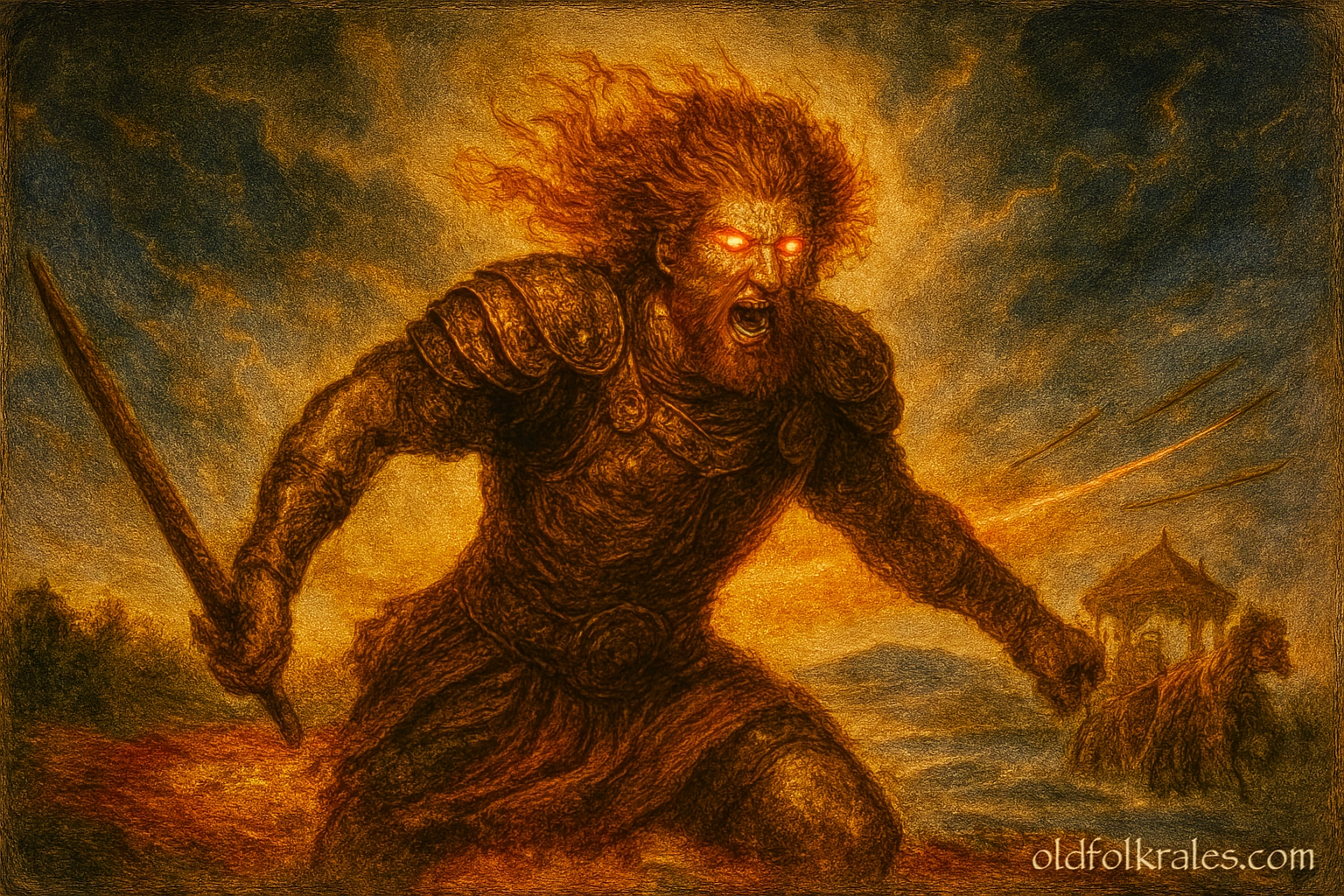
Before his name shook the four corners of Éire, before poets sang his battles in storm-lit halls, the boy who would become Cu Chulainn was called Sétanta, son of Deichtine and, whispered in secret, the son of the god Lugh, whose radiance guided kings and heroes. Those who saw the child spoke of an otherworldly fire in his eyes, as if destiny itself had stepped down to walk in mortal flesh.
From the moment he could lift a toy spear, the boy sought challenge. Not for glory, at least, not at first, but because some restless spirit within him demanded trial, demanded difficulty, demanded greatness. By the age of seven, he sensed that ordinary paths would never be his. The bards later said that it was Lugh’s blood stirring, urging him toward the shape of his fate.
Discover the ceremonies and sacred festivals that honored gods and balanced nature’s powers
His first great act came from mischief and misunderstanding. When he traveled to the feast of King Conchobar, he arrived late, and found the king’s monstrous guard-dog, a beast bred for war, lunging toward him with jaws like iron. In a blur of youthful fury, Sétanta slew the hound. But when he saw the grief of its master, Culann the smith, the boy felt a sudden weight… the first whisper of moral burden.
“Then I shall be your hound,” the boy declared, standing small but unshaken. “Until you raise another, I shall guard your hall.”
Thus he was named Cú Chulainn, the Hound of Culann, the first of many debts he would carry into legend.
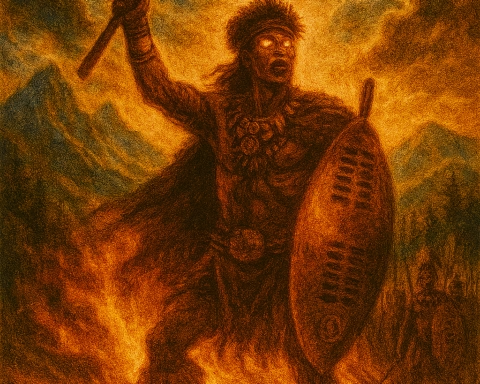
As he grew, so too did his power. When battle called, a supernatural fury overtook him, ríastrad, the warp-spasm granted by his divine father. His body twisted into a form terrible and magnificent: one eye swallowed into his skull, the other blazing out; hair rising like flames; muscles coiling with the strength of armies. In this shape he was both salvation and terror, a weapon the gods had forged too sharply for mortal hands.
And it was this lone weapon that Ulster would soon depend upon.
For Queen Medb of Connacht raised a vast army to seize the great Brown Bull of Cooley, a prize she believed would secure her supremacy over all Ireland. But Ulster lay under a curse: every warrior bedridden in great agony, every warrior except one.
The boy-hound, now a young man, stood alone at the border. His task was impossible: to hold back an entire invading host until the Ulstermen recovered. Yet he took his oath without hesitation. Such was the burden of those born for greatness.
He challenged Medb’s champions one by one, meeting them at the ford where the river ran cold and red with destiny. Each duel was a trial of strength, skill, and spirit. Yet none wounded him so deeply as the arrival of Ferdiad, his closest friend, foster-brother, and companion-in-arms.
Bound by honor, Ferdiad fought for Connacht; bound by loyalty, Cu Chulainn fought for Ulster. For three days they battled, matched in courage and skill. Their spears cracked like lightning. Their shields groaned like old trees in storms. By night they exchanged gentle words, sending healing herbs across the river. But at dawn, they returned to war.
On the third dusk, when Ferdiad fell upon Cu Chulainn’s deadly spear, the secret technique taught only to him by Scáthach, the Hound’s victory felt like ruin. He cradled his friend as the river carried their blood downstream.
“Ferdiad… my brother… it was never meant to be you.”
Thus Cu Chulainn learned that even divine heroes must pay the cost of fate.
Yet still he fought on, though every duel carved another scar into his spirit. Often he wondered whether his god-born gifts were blessings, or curses meant to sever him from the world he defended. Was a hero meant to stand with his people, or forever apart? His triumphs brought glory, but his loneliness was deeper than any wound.
When the Ulstermen finally rose with renewed strength, they found Medb’s army broken upon the hero’s lone defense. But Cu Chulainn had given more than flesh and blood. He had given friendship. Innocence. Hope.
And though Ulster was saved, he knew the path before him led only toward the twilight of heroes.
His end, when it came, was as fierce as his life. Surrounded by enemies and pierced by many spears, he tied himself to a standing stone so he would die facing them, unbowed. And even in death, none dared approach him until a raven, Morrígan herself, landed upon his shoulder, signaling his spirit’s departure.
The Hound of Ulster had fought his final battle.
But the echo of his defiance, his honor, his tragic fire lingered through the ages, woven into the tapestry of myth, reminding all who heard his story that destiny does not choose gently, yet greatness, even steeped in sorrow, can still illuminate the world.
Author’s Note
Cu Chulainn’s tale endures because he embodies the dual nature of heroism: radiant and ruinous, divine and heartbreakingly human. His loyalty to Ulster, his struggle against rage, and his unwavering courage elevated him to mythic status. Yet his tragedy, the loneliness, the moral burdens, the deaths he could not prevent, reminds us that even the greatest heroes pay dearly for their destiny. He stands as one of Ireland’s most iconic epic figures, symbolizing valor tempered by fate.
Knowledge Check
-
What was Cu Chulainn’s birth name before gaining his heroic title?
-
Which god is said to be his father?
-
What event first earned him the name “Hound of Culann”?
-
Why was Cu Chulainn forced to defend Ulster alone during Medb’s invasion?
-
Who was Ferdiad, and why is their duel so significant?
-
What symbolic act did Cu Chulainn perform at his death to show unyielding courage?
Culture Origin: Irish (Ulster Cycle)
Source: Táin Bó Cúailnge, translated by Thomas Kinsella (Oxford University Press, 1969)