In the village of Tendji, near Abomey, there was once a poor man named Kakpo. He earned his living by making handles for hoes. To find the wood he needed, he regularly went into the bush to cut suitable trees.
One day, while searching for timber, Kakpo came across a tree that seemed perfect for his work. He raised his axe and prepared to cut it down. Before he could strike, however, the tree spoke.
“Do not cut me down. No man must cut me down,” it said.
Kakpo soon discovered that the tree was no ordinary tree. It was called Loko, and three vodun were believed to dwell within it: Da, Dangbe and Tohwiyo of the Ayato clan. Recognising its sacred nature, Kakpo stopped his work and listened.
Loko then offered him an opportunity to become wealthy.
“Turn your back to me,” the tree instructed. “If I give you riches, will you do what I command?”
Kakpo agreed without hesitation.
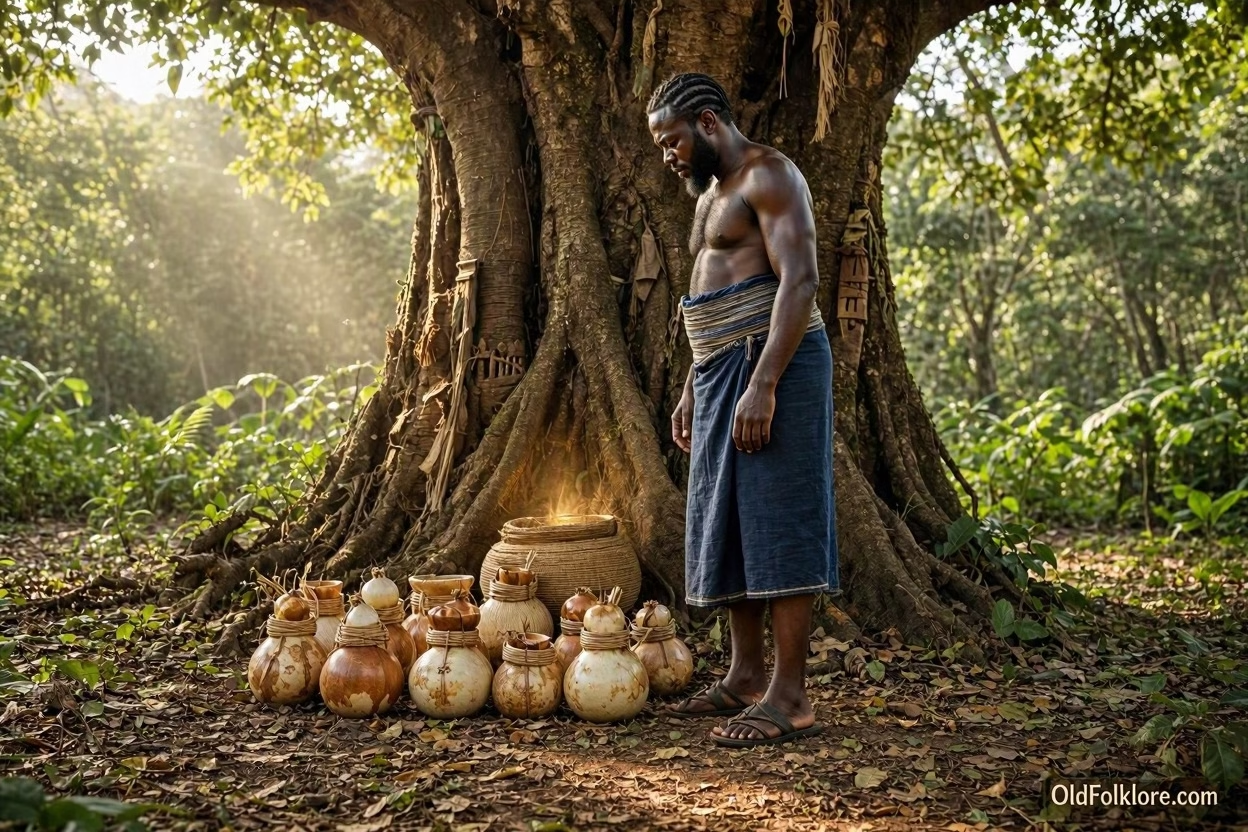
Loko gave him seven small double calabashes. Before handing them over, however, the sacred tree asked for a promise.
“If I make you wealthy, will you offer me an ox every year?”
Kakpo accepted the condition and promised to fulfil it.
The Seven Calabashes
Loko instructed Kakpo to find a suitable place and break the calabashes on the ground, one after another. Each one would bring a remarkable change.
Kakpo followed the instructions. The first calabash made the chosen place sacred. When he broke the second, numerous houses appeared. The third brought walls around the houses, transforming the settlement into a protected compound.
The fourth calabash produced hammocks and royal stools, the furnishings expected in a ruler’s household. The fifth filled the houses with people, while the sixth brought horses. Kakpo mounted one of the horses and saw the signs of his new position taking shape.
Finally, he broke the seventh calabash. This time, he encountered Fa and Legba themselves, not merely objects used in their worship.
Explore more stories from our Beninese Folktales Collections archive.
Through these wonders, Kakpo became a king. The poor craftsman who had once searched the forest for wood now possessed houses, horses, subjects and the wealth of a ruler.
Yet his sudden rise brought a serious responsibility. He had promised Loko an ox every year in return for the riches he received. Despite his new position, Kakpo failed to honour that agreement.
Loko Returns to Claim the Promise
Loko did not forget Kakpo’s promise. The sacred tree transformed itself into a man wearing raffia cloth and went to the king’s residence to ask for water.
There, Loko encountered Minga, a servant of Kakpo. Instead of welcoming the visitor, Minga dismissed him because of his poor appearance.
Loko left but returned a second time. On this occasion, Minga beat him with a whip and sent him away.
The sacred visitor came back a third time. The villagers were busy cultivating the land for their ruler when they encountered him. They too treated him harshly and beat him.
After enduring these repeated insults, Loko began to sing:
“Put down the hoes,
Come at once, and dance for me,
You dancers who dance well.”
As the song sounded, a terrible change took place. The people working in the fields disappeared. Kakpo’s wealth and royal position vanished with them. His houses, horses and subjects were gone, and he was left with nothing but the raffia cloth associated with Loko’s appearance.
The king who had once enjoyed extraordinary riches had become poor again.
Kakpo Loses Everything
Realising what had happened, Kakpo returned to Loko. He bowed before the sacred tree, lowered his forehead towards the ground and covered it with dust as he pleaded for forgiveness.
He promised once more to give Loko the ox he had originally agreed to offer.
But Loko refused to forgive him.
Kakpo had received great wealth through a promise he willingly made. When the time came to fulfil his obligation, he ignored it. His later apology could not undo the broken agreement.
The story concludes by connecting Kakpo’s loss to the existence of poverty. In the historical telling, this ending serves as a warning about the consequences of breaking a sacred promise.
Explore our complete Africa Folktales collection.
Moral Lesson
Kakpo’s story teaches the importance of keeping promises, particularly those made in connection with sacred obligations. His wealth came with a responsibility, but he allowed his success to make him forget the agreement that had brought him prosperity. The tale warns that wealth and status cannot protect someone who disregards a solemn promise.
Knowledge Check
1. Who was Kakpo before he became wealthy?
He was a poor craftsman who made handles for hoes.
2. What was special about the Loko tree?
It was a sacred tree inhabited by three vodun: Da, Dangbe and Tohwiyo of the Ayato clan.
3. What did Loko give Kakpo?
Loko gave him seven small double calabashes that brought him wealth, houses, people, horses and royal status.
4. What promise did Kakpo make to Loko?
He promised to offer Loko an ox every year in return for the wealth he received.
5. What happened when Loko sang?
The people working for Kakpo disappeared, and Kakpo lost his wealth and possessions.
6. What lesson does the story teach?
It teaches that promises and sacred obligations should be honoured, regardless of how wealthy or powerful a person becomes.
Source
Adapted from a Fon narrative recorded in Melville J. Herskovits and Frances S. Herskovits, Dahomean Narrative: A Cross-Cultural Analysis (1958), pp. 165–166.
Explore More Beninese Folktales
- The Princess and the Dangerous Lion
- The Orphan Girl and Her Stepmother
- The Truth Behind the King’s First Wife
- Turtle’s Revenge on the Lion
- The King and the Magic Stone