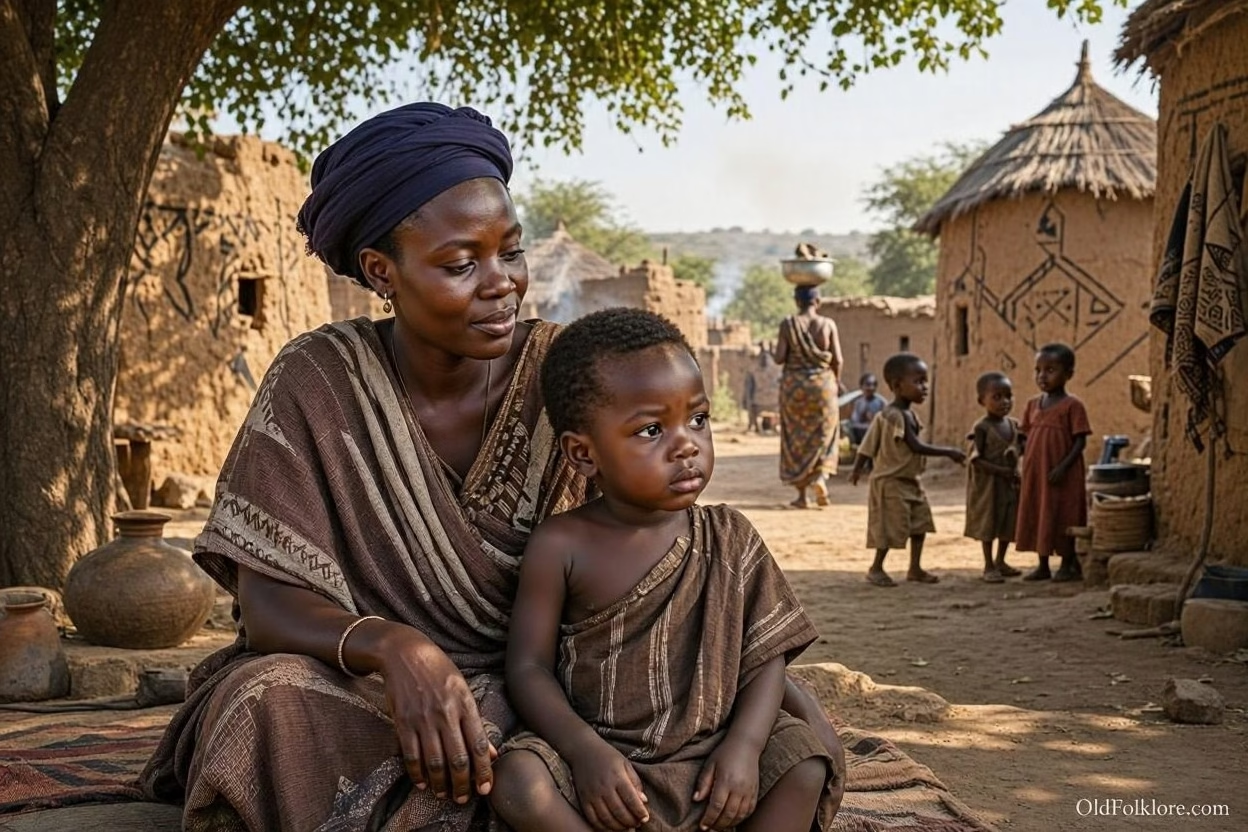
In a Bobo community in western Burkina Faso, the birth of a child brought happiness to a young family. Yet as the baby grew, his mother became increasingly aware of something unusual about him. His quiet nature and strange behaviour reminded the elders of an old belief: that a newborn’s journey into the human world was not always considered complete at birth.
Traditional Bobo beliefs about infancy include the understanding that a newborn may be regarded as a stranger who could return to the spirit world before becoming firmly established among the living. This idea gives the earliest years of childhood a special spiritual significance.
Inspired by this documented belief, this literary adaptation follows a mother and her son as they struggle to understand his unusual nature and discover the importance of love, patience and belonging.
The Child Who Seemed Different
Many years ago, in a small Bobo settlement in western Burkina Faso, a woman gave birth to a healthy baby boy. His arrival brought great happiness to the household. His father celebrated the birth, while relatives and neighbours visited to congratulate the family.
The mother named him Sanu.
During his earliest months, Sanu was unusually quiet. He rarely cried without reason, and he often stared into empty spaces as though something had caught his attention. Sometimes, he smiled when nobody was speaking to him. At other times, he followed movements with his eyes even when the people around him could see nothing unusual.
His mother found these habits amusing at first. She believed that every child had a different nature, and she took pleasure in watching her son discover the world.
As Sanu grew older, however, his behaviour continued to attract attention.
He sometimes stopped playing suddenly and looked towards the doorway. On other occasions, he stretched out his little hands as though expecting someone to take them. When his mother called him, he occasionally remained still for a moment before turning towards her.
One afternoon, while she was preparing food, she noticed him sitting alone near the entrance of their home.
“Who are you looking at, my son?” she asked.
Sanu smiled but gave no answer.
His mother looked towards the doorway, but nobody was there. She carried him inside and held him close.
Although she loved him dearly, she sometimes wondered why he seemed so fascinated by things that nobody else could see.
The Parents Seek an Explanation
As Sanu approached his early childhood years, his father became increasingly concerned.
He noticed that his son sometimes preferred sitting quietly to playing with other children. When his companions called him, he occasionally seemed reluctant to join them. He could spend a long time observing ordinary activities, as though he were trying to understand something that others had overlooked.
The father worried that the boy was becoming isolated.
Explore more stories from our Burkinabe Folktales Collections archive.
One evening, after Sanu had gone to sleep, he discussed the matter with his wife.
“Our son is growing, but he does not always behave like the other children,” he said. “I wonder whether something is troubling him.”
His wife looked towards the room where Sanu was sleeping.
“I have noticed it too,” she replied. “But I do not believe he is doing anything wrong. Perhaps he simply needs more time.”
The father was not convinced. He feared that the boy’s unusual behaviour might become a subject of discussion among their neighbours. He also wondered whether the family was overlooking something important.
After speaking with other family members, the parents decided to seek the advice of an elderly man respected for his knowledge of their community’s traditions.
The elder welcomed them and listened carefully as they described their son’s behaviour. The father explained how Sanu sometimes stared into empty spaces, withdrew from other children and appeared absorbed in thoughts beyond his age.
The elder did not accuse the child of wrongdoing or suggest that the family should fear him. Instead, he explained that traditional understandings of infancy sometimes connected a newborn’s presence among human beings with the spiritual world.
“Not every child is understood in the same way,” he told them. “The earliest years of life carry their own meaning. Do not allow fear to determine how you treat your son.”
The parents listened quietly.
The elder reminded them that a child needed care, affection and patience. Whatever spiritual meaning they attached to the boy’s unusual behaviour, they should not make him feel unwanted.
His words gave the parents something to consider. They returned home with the understanding that their responsibility was to raise Sanu with love rather than allow uncertainty to control their decisions.
The Boy’s Growing Curiosity
As the years passed, Sanu became more curious about the world around him.
He enjoyed listening to older people tell stories and often asked questions about things he did not understand. He was particularly interested in the traditions of his community. Whenever his parents visited relatives, he accompanied them and listened carefully to conversations among the adults.
He was especially fascinated by stories about the past.
One afternoon, he sat beside an elderly relative who was telling children about the lives of their ancestors. While the other children became distracted, Sanu remained attentive.
When the story ended, he asked, “How do we know the things that happened before we were born?”
The old relative smiled.
“People remember what their parents and grandparents taught them. Some knowledge is passed from one generation to another through stories.”
Sanu considered this answer.
“Then if nobody tells the stories, will people forget them?”
“That is why we must listen and remember,” the relative replied.
The conversation stayed with the boy. From then on, he became even more interested in listening to the experiences of older people.
Although he still enjoyed moments of solitude, he gradually began to play with other children.
One day, his father found him sitting beneath a tree, watching a group of boys making toys from pieces of wood.
“Why are you sitting here alone?” his father asked.
“I am watching how they make their toys,” Sanu replied.
His father smiled.
“Then why not join them?”
Sanu hesitated before walking towards the other children. He watched their work for a while before offering to help. At first, the boys were uncertain about including him, but they soon discovered that he was willing to share ideas and work with them.
His father watched from a distance.
For the first time, he began to realise that his son did not need to be forced into behaving exactly like everyone else. He needed encouragement and opportunities to discover his own interests.
His mother had understood this earlier, and now his father was beginning to share her view.
The Mother’s Fear
Despite the changes in Sanu’s behaviour, his mother continued to worry about him.
She remembered the traditional belief that an infant might return to the spirit world before becoming fully established among the living. Whenever her son became unusually quiet or withdrew from others, the thought returned to her.
She loved him too deeply to imagine losing him.
One night, after putting him to bed, she sat beside him and gently touched his forehead. She watched his peaceful face and remembered the day he was born. She had held him close then, just as she did now, promising herself that she would protect him as he grew.
“Stay with us, my child,” she whispered. “There is still so much for you to discover.”
Sanu opened his eyes.
“Mother, why do you always look worried when you watch me?” he asked.
She was surprised by the question. For a moment, she did not know what to say.
“I worry because I love you,” she answered. “You are precious to this family.”
The boy held her hand.
“Have I done something wrong?”
“No, my son. You have done nothing wrong.”
“Then why are you afraid?”
His mother paused before answering.
“Sometimes adults become afraid of things they do not understand. I have been trying to understand you, and I have worried too much.”
Sanu looked at her quietly.
“I want to stay with you,” he said.
His mother embraced him, relieved by his words.
She understood that no explanation could remove every fear, but she could make certain that her son always felt loved and protected.
A Lesson from the Elders
Some days later, the parents returned to the elder who had advised them earlier. They wanted to tell him about Sanu’s progress and ask whether they were doing enough for their son.
The elder listened as the father described how the boy had begun spending more time with other children and taking an interest in the activities around him.
The mother also spoke about her continuing worries.
The elder considered their words before responding.
“You have been watching your child carefully,” he said. “But remember that watching is not the same as understanding. A child needs room to grow. If you allow fear to guide every decision, you may prevent him from discovering his abilities.”
The father nodded.
“We only want what is best for him,” he replied.
“Then give him the opportunity to learn, make friends and become part of the community. Do not make him feel that he is a stranger in his own home.”
The mother’s expression softened.
She had spent so much time worrying about the possibility of losing her son that she had sometimes forgotten to enjoy the simple moments of raising him.
The elder continued.
“People may have different explanations for the mysteries of life. But the responsibility of a family remains important. A child should know that there is a place for him among those who love him.”
The parents thanked him and returned home.
His advice did not answer every question they had about the spirit world, but it helped them understand what they needed to do for their son.
Finding His Place Among His People
As Sanu grew older, his interests began to change.
He spent more time with his companions and became eager to learn the skills practised by the adults in the settlement. He listened to stories, helped his parents with simple household tasks and participated in activities with other children.
His quiet nature remained, but it no longer worried his family as much as it once had.
He discovered that he enjoyed learning from older people and helping younger children understand things they found difficult. When a younger boy struggled to make a toy, Sanu showed him how to arrange the pieces. When another child asked questions about a story, he tried to explain what he had heard from the elders.
His father became proud of the patience his son was developing.
One evening, the family sat together after their daily activities. Sanu spoke about the things he had learned that day and described a game he had played with his companions.
His mother listened with a smile.
“You seem happy today,” she said.
“I am,” he replied. “I like learning new things with the other children.”
His father looked at him approvingly.
“Then continue learning. There is always something new to discover.”
The family gradually stopped treating Sanu’s quiet moments as signs of something frightening. Instead, they recognised that he was a child with his own personality and way of understanding the world.
His father became more patient. His mother remained attentive, but she no longer allowed uncertainty to overshadow the happiness of raising her son.
The elder who had advised them was pleased when he heard about the boy’s progress.
“You have done well to care for him without allowing fear to guide your actions,” he told the parents. “A child needs a place where he is welcomed.”
Sanu continued growing within his family and community. The questions that had once troubled his parents gradually became less important than the life they were building together.
The boy who had once seemed distant was now an active member of the household, surrounded by people who loved him.
His mother, who had once feared that she might lose him, found peace in watching him grow. She understood that love did not require her to have an explanation for everything about her child.
It required her to remain beside him as he discovered his place in the world.
And so, Sanu grew up knowing that he belonged.
Explore our complete Africa Folktales collection.
Moral Lesson
Every child deserves love, patience and acceptance. Differences in behaviour should not become reasons for fear or rejection. A supportive family helps children develop confidence, discover their abilities and find a sense of belonging.
Knowledge Check
1. What was unusual about Sanu when he was young?
He was unusually quiet and sometimes appeared fascinated by things others could not see.
2. Why did Sanu’s father become concerned?
He noticed that his son sometimes preferred being alone and behaved differently from other children.
3. Whom did the parents consult for advice?
They consulted an elderly man respected for his knowledge of their community’s traditions.
4. What did the elder advise the parents to do?
He encouraged them to care for Sanu with patience and not allow fear to determine how they treated him.
5. How did Sanu change as he grew older?
He gradually became more involved in activities with other children and his community.
6. What is the moral lesson of the story?
Children need love, patience and acceptance as they grow and develop their identities.
Source
A contemporary literary adaptation informed by documented Bobo understandings of infancy and childhood. See Guy Le Moal, “Les activités religieuses des jeunes enfants chez les Bobo” (1981), Journal des Africanistes, vol. 51, pp. 235–250.
Explore More Burkinabe Folktales
- The Hare, the Dog and the Hyena
- Hare and the Bull
- The Hare and the Hyena
- How Man Became Stronger Than the Animals
- Hare and the Chief’s Daughter