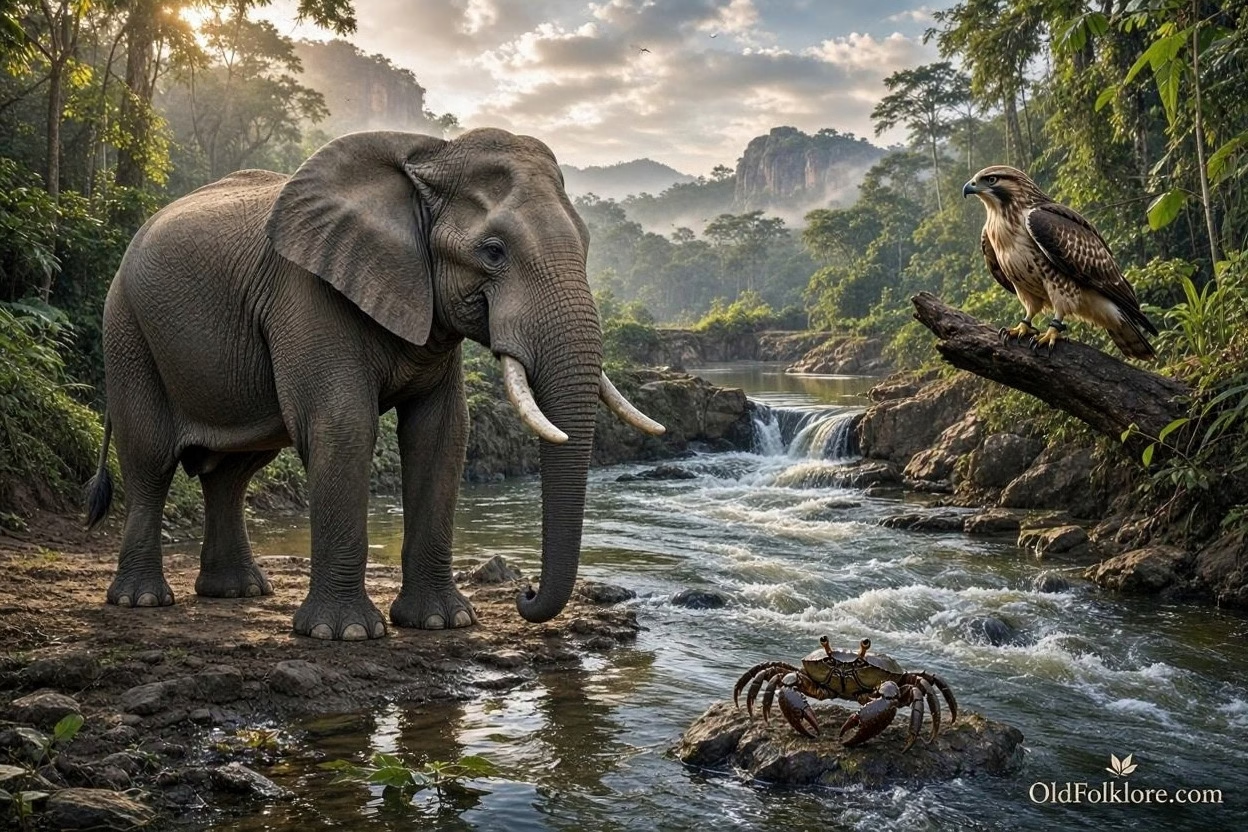
Long before rivers flowed across the land, the elephant, the hawk and the crab lived together as friends. Each animal had a different ability, and they worked together during their hunting expeditions. However, a disagreement over the animals they caught eventually destroyed their friendship.
In this traditional Ikom folktale, the crab’s desire for revenge leads to an unusual discovery. His actions explain how a river came into existence and why the crab has no head. The story also explores jealousy, greed, anger and the consequences of mistreating others.
The Elephant Becomes Ruler
In the beginning, the Creator appointed the elephant as the ruler of the world. The elephant held an important position among the animals, and his authority made him a powerful figure.
At that time, there were no rivers. The Creator therefore provided a pond where the elephant could drink whenever he became thirsty.
The elephant had two friends, the hawk and the crab. Although they were very different in appearance and ability, the three animals spent time together and often went hunting.
Explore more stories from our Ikom Folk Stories collection.
The elephant was strong and could hunt large animals. The hawk could fly and use his hunting skills to catch prey. The crab, however, moved slowly and could not use a bow and arrow like the others.
Despite these differences, the crab was allowed to accompany his friends. He carried a net and used it to catch animals wounded during their hunting expeditions.
For some time, the arrangement worked well. Each animal contributed according to his ability, and they continued hunting together.
The Hunting Expedition
One day, the elephant and the hawk decided to go hunting. The crab also joined them, carrying his net as usual.
During the expedition, the elephant caught five antelopes. The hawk caught three, while the crab managed to catch ten animals with his net.
Although the crab had not hunted in the same way as his companions, he had gathered the largest number of animals.
The result angered the elephant. He could not understand how the crab, who moved slowly and did not use a bow and arrow, could have caught more animals than he had.
Instead of recognising the crab’s contribution, the elephant became jealous of his success.
He ordered the hawk to put the crab down and cut off his head.
The crab was frightened by the elephant’s command. He begged for forgiveness and offered to surrender the animals he had caught.
The elephant eventually allowed him to go, but he kept the animals. The crab was left without the catch he had worked to obtain.
The Crab Plans His Revenge
The crab was deeply unhappy about what had happened. He had accompanied his friends on the hunt and contributed to their success, yet the elephant had taken everything from him.
His treatment by the elephant made him angry, and he began thinking about how he could take revenge.
He knew that the elephant depended on the pond provided by the Creator for drinking water. This gave him an idea.
The crab decided to visit the elephant’s wife. When he arrived, he told her that her husband wanted her to prepare a peppery soup.
The elephant’s wife accepted the message and prepared the soup as requested.
While she was occupied with the cooking, the crab went to the pond. He began filling it with earth until the water was covered with mud.
After completing this task, he hid himself inside the pond.
He knew that the elephant would eventually return from his activities and become thirsty. The pond was the place where he expected the elephant to discover what had happened.
The Elephant Discovers the Empty Pond
When the elephant returned home, he found that his wife had prepared the peppery soup.
The hawk was also present, and the two friends ate the meal together.
After eating, the elephant became thirsty. He therefore went to his usual drinking place, expecting to find the pond as he had left it.
However, the pond was no longer available for drinking. Its water had been covered with earth and mud.
The elephant was surprised and angry. He could not understand what had happened to the water he depended on.
He began digging into the mud to find the pond again. The hawk joined him, and together they continued removing the earth.
As they dug deeper, they eventually discovered the crab hiding inside.
The Crab Is Punished
The elephant immediately recognised that the crab was responsible for filling the pond with earth.
He understood that the crab had acted out of anger over the animals taken from him during their hunting expedition.
The elephant was furious. He had already threatened to cut off the crab’s head during the earlier quarrel, and now the crab had interfered with his drinking water.
This time, the elephant carried out his threat. He cut off the crab’s head and threw him into the pond.
As soon as the crab entered the water, something extraordinary happened. The water returned to the pond.
The elephant had recovered his drinking water, but he was concerned that the crab might interfere with it again.
He did not want the pond to be filled with earth another time.
How the River Was Formed
To prevent the crab from blocking the water again, the elephant ordered the hawk to dig through the lower end of the pond.
The hawk followed the instruction and opened an outlet through which the water could flow.
The water began moving out of the pond and continued along the newly opened passage. As it flowed, the stream grew larger until it became a river.
In this way, the water that had once remained in the elephant’s pond began flowing across the land.
The story explains that the river came into existence because the elephant wanted to protect his drinking place from another act of revenge by the crab.
However, the crab’s story was not yet over.
The Crab Receives New Eyes
Although the elephant had cut off his head, the crab survived and entered the river.
He approached the fish and asked them to heal his wounds and give him eyes so that he could see again.
The fish helped to heal him, but they did not have another pair of eyes to give him.
They therefore directed him to the prawn, who might be able to help.
The crab went to the prawn and explained his problem. The prawn agreed to provide him with eyes.
However, the eyes were not placed where a head would normally have been. Instead, the prawn placed them on the crab’s shoulders.
The crab was able to see again, but he never recovered his head.
According to the folktale, this explains why a crab has no head and why its eyes are positioned on its body.
The events that began with a quarrel during a hunting expedition had produced two lasting changes. The elephant’s pond had become a flowing river, and the crab had been left without a head.
Explore our complete Historic Folklore & Fairy-Tale Collections archive.
Moral Lessons
The story teaches that jealousy and greed can destroy friendships. The crab had contributed to the hunting expedition, but the elephant became angry because his friend had caught more animals. Rather than appreciating his contribution, he took the animals and threatened his life. The elephant’s behaviour created the resentment that eventually led to the destruction of his pond.
The tale also shows how anger and revenge can produce unexpected consequences. The crab’s actions were motivated by the unfair treatment he had received, but his revenge brought further suffering upon him. It reminds readers that conflicts can become more serious when people respond to wrongdoing with retaliation instead of seeking a peaceful resolution.
Knowledge Check
1. Who appointed the elephant as ruler of the world?
The Creator appointed the elephant as ruler.
2. Which two animals were friends with the elephant?
The hawk and the crab were his friends.
3. How did the crab catch animals during their hunting expeditions?
He carried a net and used it to catch animals wounded by the hunters.
4. Why did the elephant become angry with the crab?
The crab caught ten animals, more than the elephant and the hawk, making the elephant jealous.
5. How did the crab take revenge on the elephant?
He filled the elephant’s drinking pond with earth and hid inside it.
6. How does the folktale explain the origin of the river and the crab’s appearance?
The river formed when the hawk opened an outlet in the pond, while the crab lost his head and received new eyes on his shoulders from the prawn.
Source
This retelling is based on “How the River Came into Existence; or, Why a Crab Has No Head,” Chapter XVIII of Elphinstone Dayrell’s Ikom Folk Stories from Southern Nigeria, published in 1913. The original account was collected from Ewonkom, an Ikom woman, on 22 June 1910.
Explore More Ikom Folk Stories
- Why a Python Never Swallows a Tortoise
- The Partridge, Monkey, and Elephant
- Igiri and the Mushroom Baby
- How the Spider and Grasshopper Fell Out
- The Greedy Hare and the Tortoise’s Broken Shell
- Chief Alankor and the Giant Frog
- The Twin Child Saved by a Hawk
- Ewa Abagi and the Betrayal at the Cross River