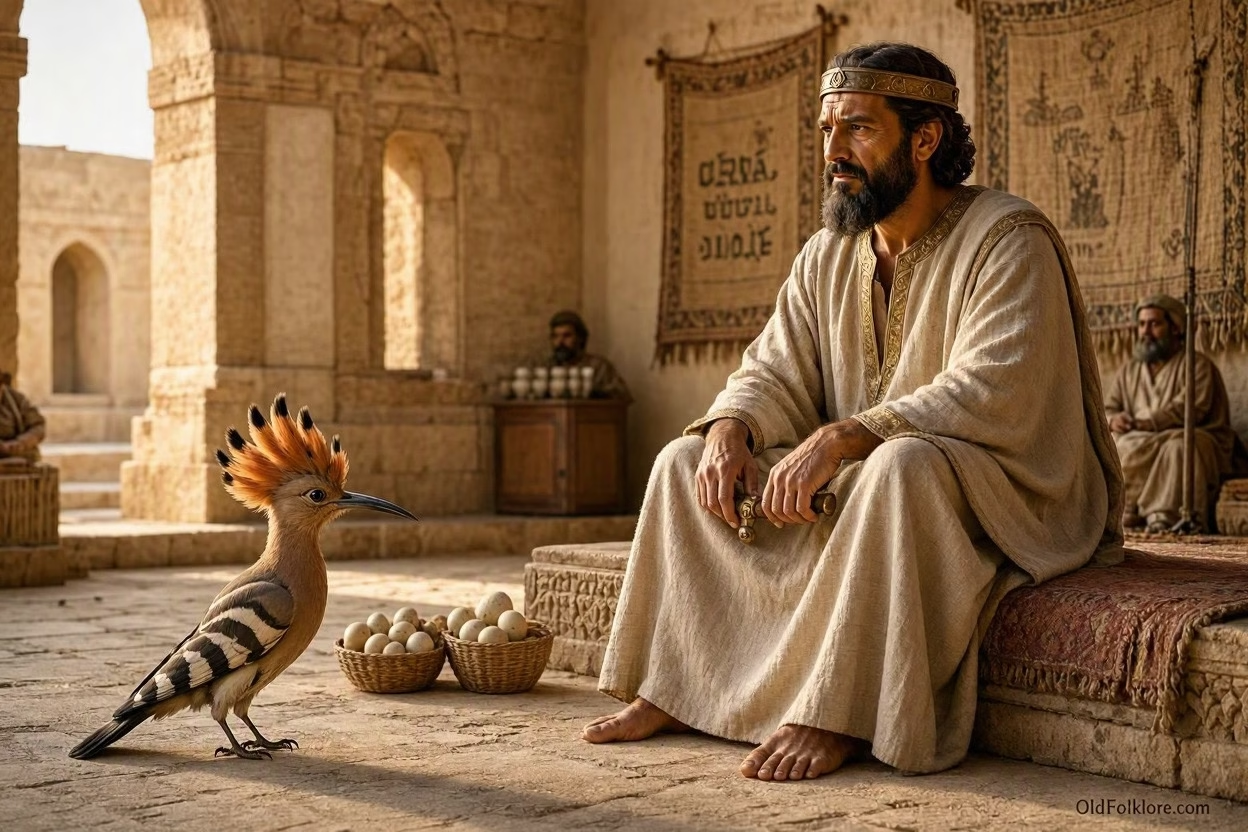
King Solomon believes that his authority is enough to make the impossible happen. When his beloved asks him to build a house entirely from eggs, he orders the birds to bring their eggs to him. Most importantly, he expects every bird to obey without question. But one hoopoe arrives without the required offering and challenges the king’s judgement with a sharp answer. Angered by the bird’s boldness, Solomon pronounces a curse that, according to the tale, explains the hoopoe’s unpleasant smell.
A King’s Unusual Promise
King Solomon was known in traditional stories as a ruler of extraordinary wisdom and authority. His name was associated with the ability to understand creatures and command the natural world. Yet even a powerful king could make a foolish decision when personal desire clouded his judgement.
Solomon had a beloved whose wishes mattered greatly to him. When she asked for something, he wanted to satisfy her. Rather than consider whether a request was sensible, he was tempted to prove that his power could overcome any difficulty.
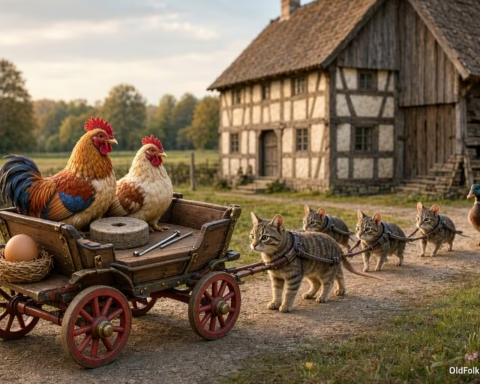
One day, she made an extraordinary demand. She wanted Solomon to build a house entirely from eggs.
The request presented a problem that should have been obvious. Eggs are delicate. Their shells can crack under pressure, and a house needs materials that can support a structure without breaking. Even if a great number of eggs could be gathered, making a durable house from them would be another matter altogether.
A sensible ruler might have stopped to consider the difficulty. He might have asked whether the request was a joke, or whether his beloved expected him to find another way to please her. Solomon, however, allowed the desire to satisfy her to overcome his better judgement.
He decided to attempt the impossible.
The Command Goes Out to the Birds
Solomon issued an order requiring the birds to bring their eggs. His authority was treated as a command that could not be ignored. The birds were expected to contribute to the king’s unusual project, although the task offered no clear benefit to them.
The order placed the king’s desire above the ordinary lives of the creatures. Eggs were not simply objects to be collected. They were part of the birds’ reproduction, and the demand required them to surrender something essential to their nests.
Nevertheless, the royal command had been given. The birds had to decide how to respond.
The king expected obedience, not disagreement. He believed that his position gave him the right to demand what he wanted. In his determination to please his beloved, he failed to recognise the absurdity of the undertaking.
A house built from eggs would not become sensible merely because a king had ordered it. Nor could the delicacy of the eggs be overcome by the strength of his authority.
The birds’ response would expose the difference between possessing power and exercising sound judgement.
The Hoopoe Arrives Without Eggs
Among the birds, the hoopoe became the central figure in the tale. The hoopoe is recognisable by its raised crest and long, slender bill. In this Algerian Amazigh story, the bird is remembered not for its physical strength but for its willingness to speak boldly before a powerful ruler.
When the hoopoe eventually appeared before Solomon, it brought no eggs.
The king was displeased. He had issued a command, and the bird had failed to provide what he wanted. Solomon expected an explanation and had reason to believe that the hoopoe would be treated as a disobedient subject.
The hoopoe, however, did not respond by simply apologising or making excuses. Instead, it explained that it had been considering a difficult question.
The question concerned the number of men and women in the world.
Solomon became interested in the answer. The bird had arrived without fulfilling the king’s demand, yet it offered a question that invited discussion. Rather than immediately dismissing the hoopoe, the king asked what conclusion it had reached.
The hoopoe answered that women were more numerous than men.
Its reasoning was not based on a count of the world’s population. It was a pointed joke about the king himself.
The Hoopoe’s Sharp Answer
The hoopoe explained that a fool such as Solomon, who was trying to build a house from eggs, should not be counted among men.
The answer turned the king’s own demand against him. Solomon had expected the birds to obey because he was powerful. The hoopoe instead used the request as evidence that his judgement had failed him.
Explore more stories from our West African Folk-Tales collection.
The bird’s remark was deliberately insulting. Rather than flatter the ruler or pretend that the egg house was a sensible undertaking, it openly challenged the foolishness of the project.
The humour depends on the contrast between Solomon’s reputation for wisdom and the unreasonable nature of his order. A ruler celebrated for understanding should have recognised that an egg house was an absurd demand. Yet his desire to satisfy his beloved had led him to act without proper consideration.
The hoopoe’s answer also challenged the idea that rank automatically makes a person’s decisions wise. Solomon could command the birds, but that did not mean every command deserved respect. The king’s position could make others obey him, yet it could not transform a foolish plan into a good one.
In the tale, the hoopoe speaks the truth in a form that Solomon cannot easily ignore. Its words expose the weakness hidden beneath the king’s authority.
Solomon’s Anger
Solomon did not receive the insult calmly. The king was accustomed to having his commands obeyed, and the hoopoe had not only failed to bring eggs but had also mocked his judgement.
The bird’s answer left him facing an uncomfortable truth. The house of eggs was a foolish undertaking, and his determination to please his beloved had made him the subject of ridicule.
Instead of accepting the criticism and reconsidering his decision, Solomon became angry. He used his authority to punish the bird for its boldness.
In the version recorded in the source, Solomon cursed the hoopoe with a foul smell. The curse was intended to last, and the tale uses it to explain why the hoopoe is believed to have an unpleasant odour.
The punishment gives the story its memorable ending. The hoopoe had exposed the king’s folly through a clever answer, but its courage did not earn it a reward. Solomon’s anger became the final demonstration of how power can be used to punish those who challenge it.
The tale does not describe the curse as a lesson Solomon willingly accepts. Instead, the king responds to embarrassment with retaliation.
Why the Hoopoe Is Remembered
The story connects the hoopoe’s behaviour with a traditional explanation for the bird’s smell. Within the folktale, its unpleasant odour becomes the lasting consequence of its encounter with Solomon.
This is a folkloric explanation, not a scientific account of the bird’s biology. The story’s purpose is to entertain while giving listeners a memorable explanation for a feature associated with an animal.
The hoopoe’s role is also important because the bird succeeds through wit rather than strength. It cannot match Solomon’s authority, but it can expose the weakness in his reasoning. Its answer makes the king’s demand look ridiculous without requiring a physical confrontation.
The story’s humour comes from seeing a powerful ruler challenged by a small bird. Solomon can issue commands, gather the birds and pronounce a curse, but he cannot make his foolish plan wise simply by insisting upon it.
The tale therefore leaves readers with two contrasting figures. Solomon represents power that has lost its proper direction, while the hoopoe represents the sharp intelligence needed to recognise and expose a foolish decision.
The king has the authority to punish the bird, but the bird has already revealed the truth about his judgement.
Explore our complete Algerian Folktales archive.
Moral Lesson
Power does not guarantee wisdom. Even a respected ruler can make foolish decisions when pride or personal desire takes control. The hoopoe’s answer reminds us that honest criticism can expose mistakes that authority tries to conceal. The story also warns against responding to embarrassment with anger instead of reflection.
Knowledge Check
1. What unusual task does Solomon agree to undertake?
Solomon agrees to have a house built entirely from eggs after his beloved asks for one.
2. Why does Solomon order the birds to bring their eggs?
He wants to gather the eggs needed for the unusual house he has promised to provide.
3. Which bird plays the central role in challenging Solomon?
The hoopoe is the bird that arrives without eggs and challenges the king with a clever answer.
4. What question does the hoopoe raise before Solomon?
The hoopoe raises the question of whether men or women are more numerous.
5. How does the hoopoe insult the king?
It argues that women are more numerous because a fool like Solomon, who wants to build a house from eggs, should not be counted among men.
6. What curse does Solomon pronounce, according to the folktale?
Solomon curses the hoopoe with a foul smell, which the tale presents as the explanation for the bird’s unpleasant odour.
Source
Adapted from “King Solomon and the Birds,” identified as an Amazigh story from Algeria in Laura Gibbs’s Tiny Tales from Africa: The Animals, Volume 2. The adaptation follows the documented plot of the egg house, the hoopoe’s challenge and Solomon’s curse.
Explore More Algerian Folktales
- Loundja, Daughter of Tseriel: A Strange Kabyle Folktale
- The Woman Who Ate a Serpent’s Egg: A Strange Kabyle Folktale
- The Cow of the Orphans: A Powerful Algerian Folktale
- The Seven Brothers: A Powerful Algerian Folktale
- The Orphan and His Cruel Uncle