Before chronicles carved his name into the stone of kingdoms, before Castile unfurled its banners in his honor, El Cid, Rodrigo Díaz de Vivar, was said, by the old singers who spoke to fire and night, to be born beneath an omen of flame. On the evening of his birth, a red star crossed the heavens, trailing sparks like a sword drawn from the forge of God Himself. The wise whispered that the boy carried a touch of the divine, a spark of heavenly mandate that would test the worth of his soul in both triumph and suffering.
As he grew, Rodrigo showed the makings of a warrior whose spirit could bend the world. His swordarm was sure, his mind precise, and his loyalty unwavering. Yet even greater than his skill was the radiance of his honor, a light so fierce that even kings felt its heat. It was said that he could not lie, nor bow unjustly, for the flame in his soul rebelled against all shadows.
Explore the mysterious creatures of legend, from guardians of the sacred to bringers of chaos
But such virtue, bright and uncompromising, can be a danger in courts where whispers hold more power than truth.
Rodrigo’s first great test came not on battlefield soil but in the heart of Castile itself. Accused by envious nobles of disloyalty to King Alfonso, he was condemned to exile, banished from the land he had defended with blood and blade. As he departed the gates of Burgos, the people wept but dared not speak; the king’s silence chained their tongues. Rodrigo did not curse the king nor the land. He placed his hand upon the cold earth and swore a warrior’s vow:
“If my honor is taken, I shall earn it anew. If my king doubts me, I shall make my truth blaze bright enough to blind the liars.”
Thus began the wanderings of the Cid-el señor, the lord without a home.
With only a loyal few at his side, Rodrigo roamed the borderlands between Christian and Muslim realms. The songs say that angels walked unseen beside him, recording each act of valor so that when heaven judged him, his deeds would speak with the weight of kingdoms. He defended villages abandoned by kings, forged alliances with enemies who recognized greatness, and fought battles where the sky itself trembled with the clash of steel.
His most fearsome challenge came at Valencia, where the powerful lord al-Qaḍir needed a champion to protect the city from overwhelming foes. Rodrigo took the burden, for he saw in every struggle an opportunity to prove that exile could not extinguish a righteous man’s flame.
For months the siege raged. Arrows fell like rain; hunger stalked the defenders; death walked boldly on the battlements. Rodrigo’s soldiers wavered, fearing the city’s doom. But the Cid stood on the walls, blade raised toward heaven, and cried:
“We fight not for conquest but for the justice denied us! Let Castile hear us through the thunder of our swords!”
His courage rekindled every dimming spirit.
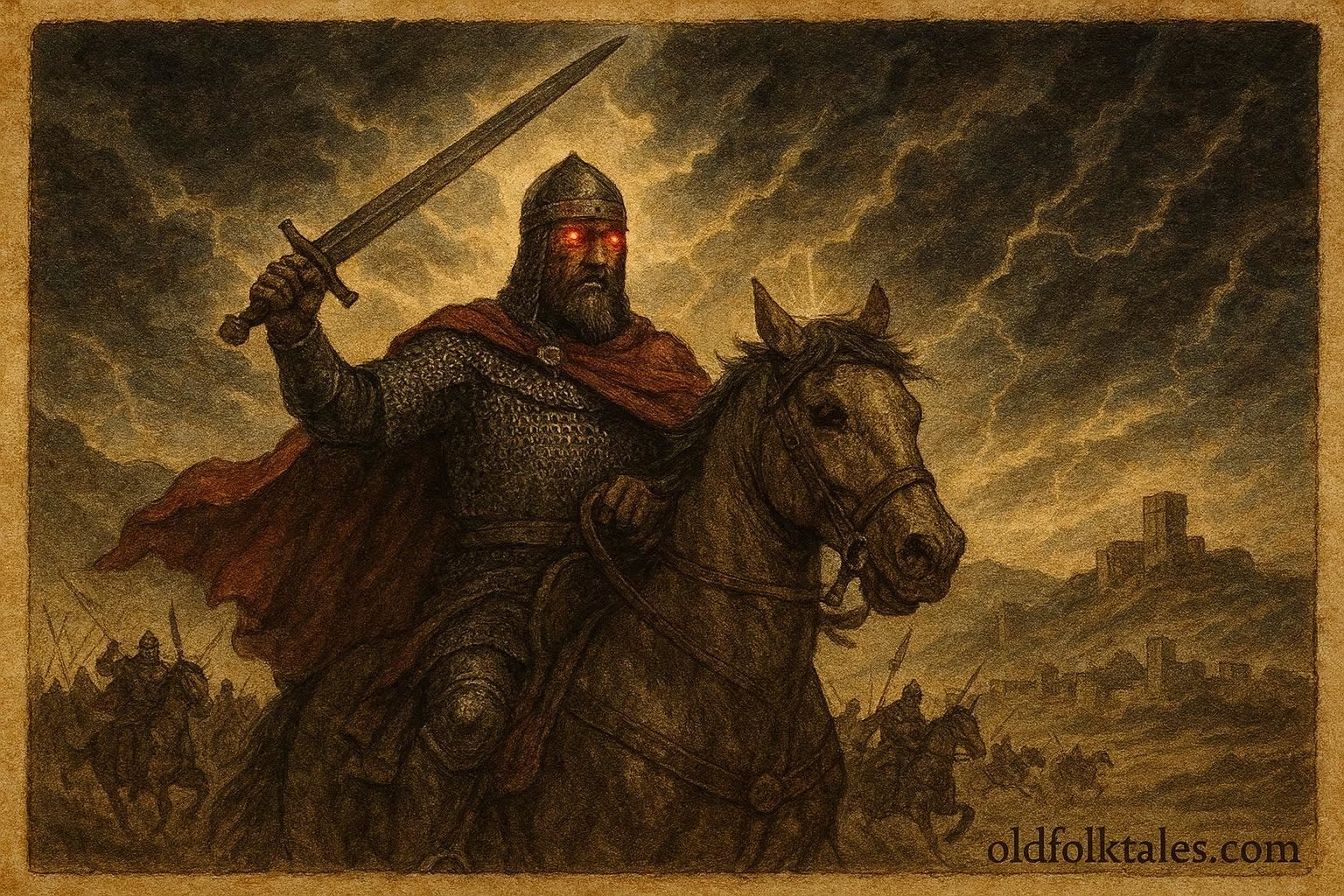
On the dawn of the final assault, the attackers surged like a tidal wave. Rodrigo rode ahead, his horse Babieca shining like a creature shaped from dawnlight. The old tales insist that during this charge, Rodrigo’s eyes burned with the same red radiance as the star that marked his birth, and that heaven itself bent to watch the battle.
He cut through the enemy lines with the impossible strength of a man carrying not only a sword but the weight of destiny. When he struck the enemy commander, the ground shook as though divine justice had spoken through his blade. Valencia, against all expectation, against every mortal prediction, was saved.
Yet triumph carried with it a deeper struggle.
In the city he had fought to protect, Rodrigo now governed with fairness and clarity. Christians, Muslims, and Jews alike found safety beneath his rule. But though Valencia revered him, the Cid’s spirit knew unrest. Could he truly live as ruler when his homeland still held his honor in chains? Could victory replace the yearning for reconciliation?
When word reached Alfonso of Rodrigo’s victories, victories achieved without treachery, without resentment, without disloyalty, the king’s heart turned. Pride softened into remorse. At last, he summoned Rodrigo back to Castile. And the Cid, always loyal, returned not as a beggar but as a blazing emblem of what a man should be.
Their reunion was solemn. Alfonso lifted the exile, restored Rodrigo’s name, and asked forgiveness. The Cid bowed, not in submission, but in the grace of a man whose honor had survived fire.
Still, fate had one final act.
Rodrigo’s death at Valencia came quietly, like the setting of a great sun. Yet even in death, the divine spark within him refused to dim. Legends say that his lifeless form was placed upon Babieca, armored and holding his sword, and that the sight alone drove invaders away, thus granting Valencia victory one last time.
So passed Rodrigo Díaz, El Cid Campeador, the man touched by heaven, the exile who became a nation’s flame. His life proved that honor, once forged in truth, can survive betrayal, battle, even death itself.
Author’s Note
El Cid’s legacy lives not merely in tales of conquest but in the moral radiance of a man who stood firm between kings and kingdoms, between faith and doubt. His story remains a cornerstone of Spanish epic tradition, teaching that exile cannot break the righteous, and that honor, once tempered by struggle, shines brighter than crowns.
Knowledge Check
-
What divine sign is said to mark Rodrigo’s birth?
-
Why was Rodrigo exiled from Castile?
-
How did El Cid inspire his soldiers during the siege of Valencia?
-
What moral struggle does Rodrigo face after ruling Valencia?
-
How does King Alfonso restore El Cid’s honor?
-
What symbolic event is said to occur after Rodrigo’s death?
Cultural Origin: Medieval Spanish epic tradition, rooted in the Cantar de Mio Cid and shaped by Iberian Christian–Muslim frontier culture.
Source: Burton Raffel (trans.), The Song of the Cid (Penguin Classics, 2009).