Once upon a time, a widowed queen had one surviving daughter, Bellissima, whom she loved more than anything in the world. Having already lost so many children, the queen feared that any hardship or disappointment might harm her precious girl. Instead of correcting her faults, she indulged her every wish.
Bellissima grew into a remarkably beautiful princess, but her beauty was accompanied by an enormous sense of superiority. She believed that no one could equal her appearance, intelligence, or importance.
Her mother encouraged this pride. Painters made portraits of the princess, which were sent to neighbouring kings. Those who saw them fell hopelessly in love with her. Soon, royal suitors filled the court, competing to impress her with lavish entertainments, extravagant gifts, poetry, and songs.
Explore more stories from our Andrew Lang’s Colour Fairy Books collection.
Yet Bellissima remained unimpressed. Not one prince seemed handsome or clever enough to deserve her.
The queen eventually pleaded with her daughter to consider marriage, warning that she could not remain unmarried forever. Bellissima, however, insisted that she was perfectly content as she was.
Desperate to find a solution, the queen decided to seek advice from a powerful witch known as the Fairy of the Desert. The witch lived beyond a dangerous passage guarded by terrifying lions. Travellers could pass them safely only by offering a special cake made from millet flour, sugar candy, and crocodile eggs.
The queen prepared the cake herself and set out. Tired from walking, she rested beneath an orange tree and fell asleep. When she awoke, her basket was empty. The lions were already approaching.
Terrified, the queen began to weep. Then a tiny yellow-faced dwarf appeared in the tree, eating oranges. He offered to save her, but only if she promised that Bellissima would marry him.
The queen hesitated. The dwarf was hideous, and she could not imagine her beloved daughter living with him. But the lions were almost upon her, and she finally agreed.
The dwarf led her through a hidden door in the orange tree to a miserable dwelling surrounded by thistles, nettles, and mud. He cheerfully described how Bellissima would live there, eating frogs and drinking from a nearby stream.
The queen fainted at the thought of such a future for her daughter. When she awoke, she was back in her own bed, wearing a beautiful lace nightcap. It was the only proof she needed that the encounter had been real.
The bargain that trapped Bellissima
The queen’s sadness did not escape Bellissima’s attention. Although the princess was proud, she genuinely loved her mother and worried about her distress. The queen refused to reveal the truth, so Bellissima decided to visit the Fairy of the Desert herself.
She prepared another cake for the lions and secretly left the palace one night. But at the orange tree, she stopped to gather and eat some fruit. Once again, her basket disappeared.
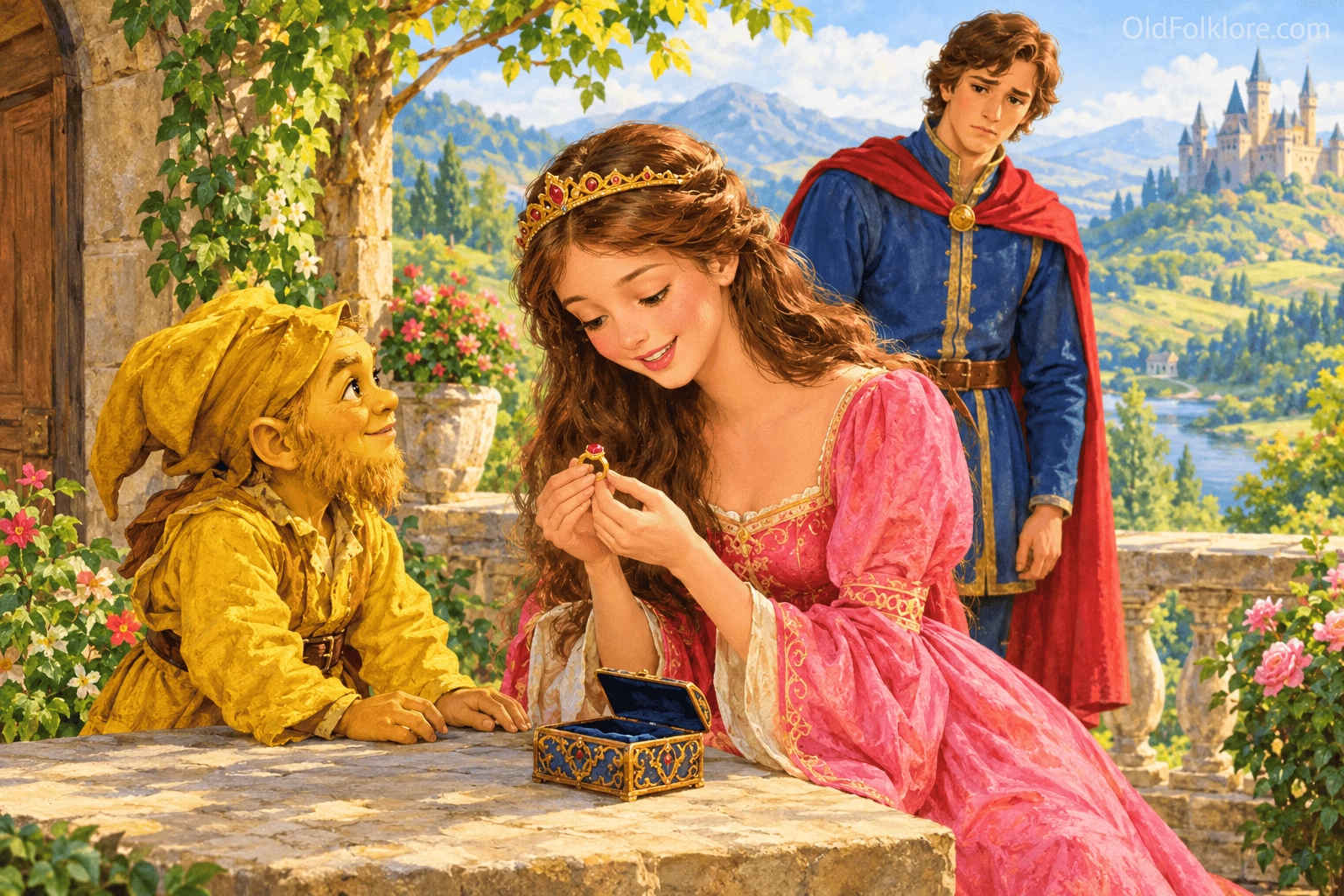
The Yellow Dwarf appeared and asked why she was crying. When Bellissima explained that she wanted to consult the Fairy of the Desert about her mother’s sadness and her own uncertain feelings about marriage, the dwarf told her the truth: her mother had already promised her to him.
Bellissima was horrified. She rejected the idea of marrying such an unpleasant creature, but the dwarf warned her that the lions were coming. Faced with death, she desperately agreed to marry him if he would save her.
When she regained consciousness in her own bed, she discovered that she had been dressed in beautiful lace and ribbons. On her finger was a ring made from a single red hair. No matter how hard she tried, she could not remove it.
The experience changed her. No longer quite so confident in her own invulnerability, Bellissima agreed to marry the King of the Gold Mines, a handsome and generous prince who had loved her for years.
As they spent time together, her affection grew into genuine love. The king treated her tenderly, wrote songs for her, and delighted in making her happy. Their wedding promised to be the grandest celebration the kingdom had ever seen.
A wedding interrupted by magic
On the wedding day, the palace glittered with jewels, gold, and magnificent decorations. Crowds gathered to celebrate the royal couple.
Then two enormous basilisks appeared, dragging a box behind them. An ancient, hideous woman followed, leaning on a crutch. She revealed herself as the Fairy of the Desert and accused the queen and princess of breaking their promises to the Yellow Dwarf.
The queen wept, while Bellissima reminded her mother that she, too, had made a promise without her daughter’s consent.
The King of the Gold Mines tried to drive the witch away. But the box opened, and the Yellow Dwarf sprang out, riding a monstrous Spanish cat. He displayed Bellissima’s hair-ring as proof that she belonged to him.
A terrifying battle began. The sky darkened, thunder roared, and the basilisks grew into enormous, fire-breathing monsters. The Fairy of the Desert mounted a winged griffin and struck Bellissima with her lance, leaving the princess bleeding and unconscious in her mother’s arms.
Distracted by Bellissima’s suffering, the king abandoned his fight. The Yellow Dwarf seized the princess and escaped with her.
The Fairy of the Desert then captured the king, intending to force him to forget Bellissima and love her instead. She imprisoned him in a cavern, but used her magic to disguise herself as a beautiful young fairy.
The king recognised her by her griffin-like feet. Pretending to fall for her deception, he told her that he might love her if she released him. Flattered by the prospect, the Fairy took him away in her flying chariot.
During their journey, he caught sight of Bellissima imprisoned in a castle of polished steel. The sun’s reflection made its walls so hot that approaching them was deadly. Bellissima saw the king beside the beautiful fairy and mistakenly believed that he had abandoned her for a more beautiful woman.
The king concealed his true feelings and continued flattering the Fairy, hoping to find a way to rescue Bellissima.
The mermaid’s gift
At the Fairy’s magnificent palace, the king eventually gained permission to walk along the seashore. There, overwhelmed by grief, he wrote verses lamenting his separation from Bellissima.
A mermaid rose from the stormy waves and offered to help him escape. She explained that she pitied Bellissima and hated the Yellow Dwarf and the Fairy of the Desert.
To deceive the Fairy, the mermaid transformed seaweed into a lifelike image of the king, which she left on the shore. The Fairy discovered it and believed her captive had died. Distraught, she began building an elaborate monument in his memory while the real king escaped.
The mermaid carried him to the Castle of Steel and gave him a sword made from a single diamond. It could overcome any danger, she told him, but he must never allow it to leave his hand.
Armed with this extraordinary weapon, the king fought his way towards Bellissima. He defeated four terrifying sphinxes and six dragons. Then he encountered twenty-four beautiful nymphs who begged him not to proceed, warning that allowing him through would bring misfortune upon them.
For a moment, he hesitated. But a voice urged him forward, reminding him that Bellissima’s life was at stake. He broke through their garlands and continued.
At last, he reached the brook where Bellissima sat weeping. He rushed towards her, eager to explain everything.
But in his excitement, he dropped the diamond sword.
The Yellow Dwarf, who had been hiding nearby, seized it immediately.
A tragic ending
The dwarf summoned two giants, who bound the king in heavy chains. He offered to spare the king’s life if Bellissima would agree to marry him.
The king refused to live under such a condition. Bellissima, unwilling to watch the man she loved die, offered to accept the dwarf’s demand instead.
But the Yellow Dwarf would not allow his rival to survive and perhaps reclaim her. He plunged the diamond sword into the king’s heart.
Bellissima, seeing her beloved lying dead, could not bear to live without him. She fell beside him and died of grief.
The mermaid’s magic could no longer save them, for the power of the diamond sword had been lost with the weapon.
The Yellow Dwarf preferred the princess’s death to seeing her married to the king. The Fairy of the Desert, furious when she learned how she had been deceived, destroyed the monument she had built for the king and turned her love for him into hatred.
The mermaid, heartbroken by the lovers’ fate, transformed them into two tall palm trees standing side by side. Their branches intertwined, and they remained together, whispering of their faithful love.
So the princess who had once believed herself superior to everyone ended her life not in a palace or a royal wedding, but in a tragic love story that even magic could not repair.
Explore our complete Historic Folklore & Fairy-Tale Collections archive.
Moral
Pride can blind people to the feelings and worth of others, while jealousy and the desire to control someone can destroy the very love a person claims to seek. The story also warns against making promises under pressure and shows how the choices of powerful people can place others in terrible situations.
Knowledge Check
1. Why did the queen promise Bellissima to the Yellow Dwarf?
She feared that the approaching lions would devour her, and the dwarf offered to save her in exchange for the promise.
2. What did the ring made from a single red hair represent?
It served as evidence of Bellissima’s promise to the Yellow Dwarf and could not be removed.
3. How did the king escape the Fairy of the Desert?
A mermaid helped him by creating a convincing image of him from seaweed and giving him a powerful diamond sword.
4. Why did the king lose his chance to rescue Bellissima?
He dropped the diamond sword while rushing to explain himself to Bellissima, allowing the Yellow Dwarf to seize it.
5. How does the story end?
The Yellow Dwarf kills the king, Bellissima dies of grief, and the mermaid transforms them into two palm trees standing together.
Source
Adapted from Madame d’Aulnoy’s “The Yellow Dwarf,” as translated by Minnie Wright and included in The Blue Fairy Book, edited by Andrew Lang, illustrated by Henry Justice Ford, and published by Longmans, Green, and Co., London, in 1889.
Explore More Andrew Lang’s Colour Fairy Books Folktales
- Prince Hyacinth and the Dear Little Princess
- The Bronze Ring: A Classic Fairy Tale
- Why the Sea Is Salt: The Blue Fairy Book
- The Shepherd and the Clever Chacal
- The Dish That Floated Away
- The Old Man and the River Spirit
- The Enchanted Date Palm of the Oasis