In the King Chameleon and the Animals folktale, the animals face a problem that threatens their peaceful existence. Without a ruler to settle disputes and punish wrongdoing, some take advantage of the freedom they enjoy. They decide to choose a king, but finding a suitable candidate proves difficult. Their solution is to hold a race, allowing the first animal to reach a special stool to claim the throne.
The race takes an unexpected turn when Chameleon uses his remarkable ability to blend into his surroundings to outwit Hare, the fastest runner. Although Chameleon wins according to the rules, his victory brings a result he never expected. This traditional tale explores the difference between winning a position and gaining the respect and loyalty of those one hopes to lead.
A World Without a King
In the olden days, all the animals of the world lived together in friendship. They shared their world, but they had no king to rule over them or judge their disputes.
Without a ruler, there was no one to punish animals who behaved wickedly. Wrongdoing continued because those responsible did not fear any consequences. What should have been a peaceful community became troubled by the behaviour of animals who took advantage of the absence of authority.
At last, the animals decided that something had to change. They gathered together to discuss their situation and agreed that they needed a king who could govern them and judge those who acted wrongly.
However, agreeing that they needed a ruler was easier than choosing one.
The Search for a Suitable Ruler
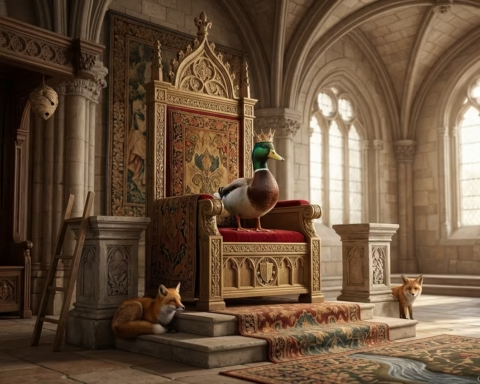
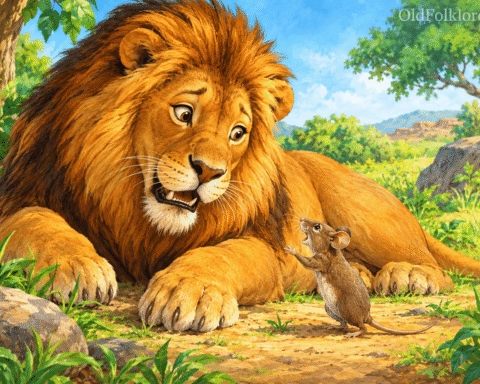
The animals first considered Lion. He was powerful, and his strength might have made him seem like a natural choice. Yet the others opposed his appointment because they believed he was too fierce.
If Lion became king, they feared that his fierce nature would make him an unsuitable ruler. They did not want to replace a world without proper judgment with one governed by a king who might frighten or mistreat his subjects.
The animals then suggested Wolf. But this proposal also met with resistance.
The sheep and goats refused to accept Wolf as their ruler because he was their enemy. They knew that if he became king, they would be treated badly. They could not trust a ruler whose interests were directly opposed to their own survival.
The animals found themselves unable to agree on a candidate. Each possible ruler had opponents, and no choice seemed likely to satisfy everyone.
They therefore abandoned the idea of selecting a king by discussion and decided to settle the matter through a contest.
The Race for the Throne
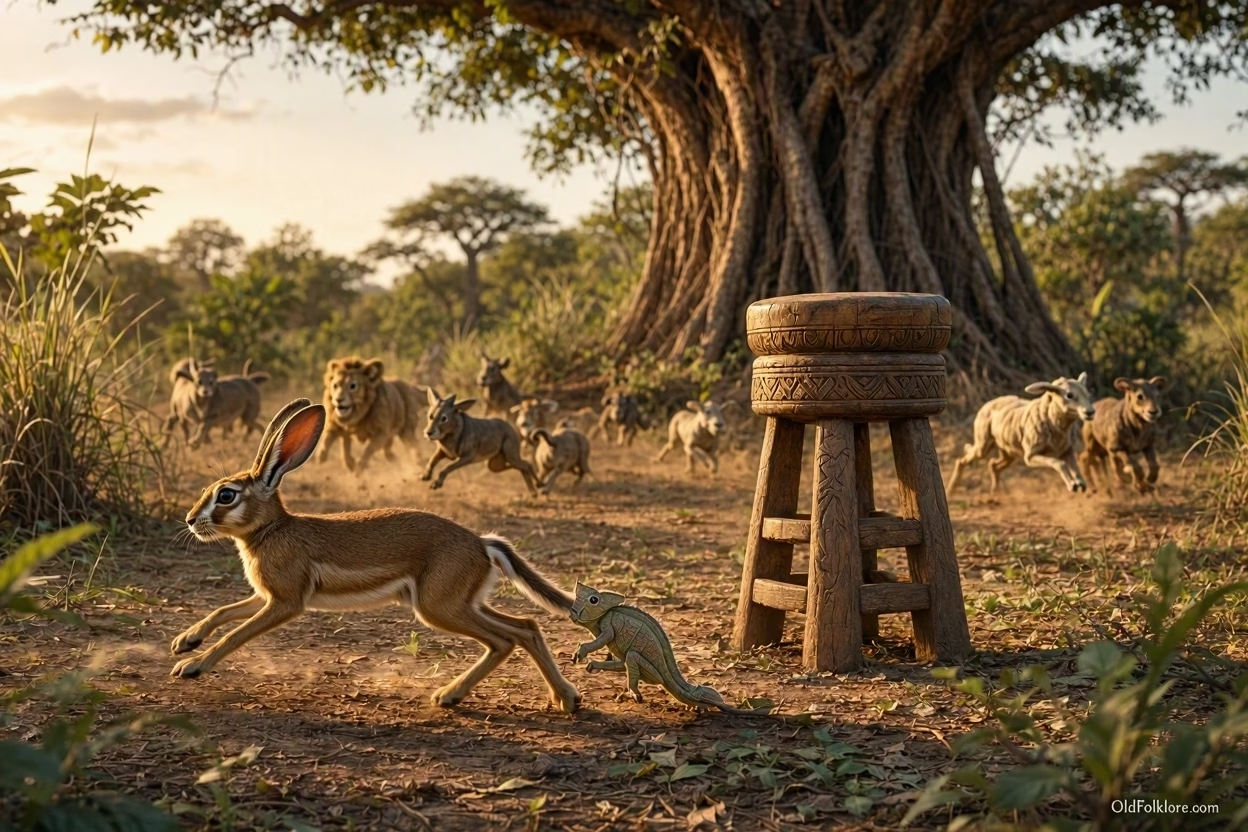
Two miles away stood a great stool beneath a very ancient tree. The animals believed that the tree was the dwelling place of some of their gods, making the spot an important place for their contest.
They agreed on a straightforward rule: every animal could take part in a great race, and whoever reached the stool and sat on it first would become king.
Explore more stories from our West African Folk-Tales collection.
The arrangement appeared fair. Instead of arguing over which animal deserved the throne, they would let the race determine the winner.
When the appointed day arrived, animals both great and small prepared to compete. They gathered at the starting point, ready to run for the honour of becoming king.
At the signal, the race began.
Among the competitors was Hare, an exceptionally fast runner. He soon moved ahead of the others, leaving them far behind as he raced towards the ancient tree.
Hare was confident in his speed, and he had every reason to believe that he would win. Before long, he reached the stool, arriving a considerable distance ahead of the next animal.
He had nearly achieved his goal. All he needed to do was sit down.
But Hare was about to discover that speed alone would not decide the contest.
Chameleon’s Clever Trick
Just as Hare was preparing to sit on the stool, a voice suddenly called out.
“Take care, Mr Hare, take care. I was here first.”
Hare was astonished. Someone was claiming to have arrived before him, even though he had reached the stool ahead of all the other competitors.
The voice belonged to Chameleon.
Chameleon had found a way to deceive the other animals by using his ability to change colour to match his surroundings. At the beginning of the race, he had seized Hare’s tail and held on tightly.
Because Chameleon’s colour blended with Hare’s, the other animals had not noticed him. Hare, concentrating on the race, had continued running without realising that he was carrying another competitor along with him.
Chameleon remained attached to Hare throughout the journey. While Hare did the running, Chameleon travelled with him, hidden from view.
When Hare finally reached the stool and turned around to sit down, Chameleon released his hold. He dropped from Hare’s tail and landed on the stool.
By doing so, he placed himself in the winning position.
Chameleon had not beaten Hare through speed or endurance. Instead, he had used deception and his natural ability to conceal himself. His trick allowed him to reach the destination with the fastest runner and claim the prize.
Hare Discovers the Deception
Hare immediately realised what had happened. He had run the race, covered the distance and reached the stool, only for Chameleon to take advantage of his effort.
Understandably, Hare was furious. He had every reason to feel cheated because he had believed he was competing against the other animals on equal terms.
He wanted to harm Chameleon, but the other animals arrived before he could act.
The race had been governed by a rule they had all accepted. The animal that reached the stool and sat on it first would become king. Chameleon had reached the stool and occupied it before Hare could sit down.
Although his victory depended on trickery, the animals had no agreed rule that allowed them to disqualify him for the way he had won.
They therefore had no choice but to honour their agreement.
Chameleon became king.
The result was not what many of the animals had wanted. Hare was angry, and the others were dissatisfied with the outcome. Nevertheless, the decision had been made according to the contest they had organised.
Chameleon had won the throne, but his victory had not earned him the admiration of his fellow animals.
A King Without Subjects
The animals did not accept Chameleon as a ruler they could respect. Once the meeting ended, they scattered in every direction, leaving him alone.
Chameleon had secured the title of king, but the animals over whom he was supposed to rule wanted nothing to do with him. They had fulfilled the agreement by making him their ruler, yet they refused to remain by his side.
Their departure left Chameleon ashamed.
He had used his cleverness to win the contest, but the trick that brought him the throne had also separated him from the community. He possessed the position he had sought without the company or support of those who were meant to be his subjects.
Unable to face the situation, Chameleon went away and made his home at the top of a very high tree on a mountain.
There he remained, far from the animals who had once lived together in friendship.
The tale says that, in the dead of night, Chameleon can still be heard calling for his attendants to come and stay with him. Yet no one comes. He remains alone, calling for followers who have abandoned him.
The story ends with a pointed observation: “A king without subjects is no king.”
Chameleon had won the race, but winning had not made him a respected leader. His cleverness had secured the title, while his actions had left him without the loyalty that gives leadership its meaning.
Explore our complete Historic Folklore & Fairy-Tale Collections archive
Moral Lesson
The story teaches that gaining a position does not automatically earn respect, trust or loyalty. Chameleon won through deception, but the animals refused to follow him. True leadership requires more than cleverness or the ability to claim victory; it also depends on the willingness of others to accept and support the leader.
Knowledge Check
1. Why did the animals decide to choose a king?
They had no ruler to judge disputes or punish wrongdoing, so wicked behaviour continued.
2. Why did the animals reject Lion as a possible king?
They believed he was too fierce.
3. Why did the sheep and goats oppose Wolf?
They considered him their enemy and feared he would treat them badly.
4. How did the animals decide who would become king?
They organised a race, declaring that the first animal to reach and sit on the stool would become king.
5. How did Chameleon win the race?
He held on to Hare’s tail and used his ability to blend into his surroundings to remain unnoticed. When Hare reached the stool, Chameleon dropped onto it first.
6. Why was Chameleon left alone after becoming king?
The animals were dissatisfied with his victory and scattered, leaving him without subjects or attendants.
Source
“King Chameleon and the Animals” appears as Chapter XXX in West African Folk-Tales, collected and arranged by W. H. Barker and Cecilia Sinclair and published in 1917.
Explore More West African Folk-Tales
- Thunder and Anansi: A West African Folktale
- Anansi and Nothing: The Trickster Who Lost Everything
- Why the Sun and the Moon Live in the Sky
- How Anansi Won the Right to Have Stories Named After Him
- The Grinding-Stone That Ground Flour by Itself