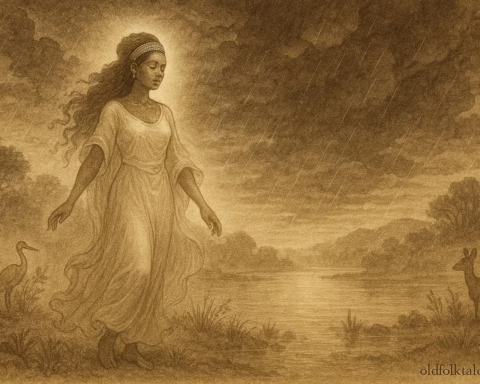
In the mists of medieval Britain, where the green hills whispered ancient secrets and the forests held the echoes of gods and spirits, there was born a child of humble lineage, yet destined for the divine: Perceval, son of a fallen knight. From his earliest days, the boy was touched by an otherworldly radiance; the glimmer of holy purpose shone in his eyes, as though the unseen light of the Grail called to him across the veil of destiny. His mother, fearful of the cruel world, sought to shield him from the ways of war and courtly ambition. She clothed him in rustic simplicity and kept him within the verdant bounds of their woodland home.
Yet fate is not so easily constrained. One day, while wandering among the towering oaks and murmuring streams, Perceval encountered a band of knights in shining armor. Their splendor ignited a fire within his heart; he saw not the vanity of the world, but a calling, one that would draw him toward a destiny greater than his simple upbringing. Inspired, he took up sword and shield, stepping into the perilous world of chivalry, where glory and sin entwined in shadowed corridors.
Perceval’s journey was marked by trials both external and internal. He confronted bandits and beasts, defended the weak, and slew those who wielded cruelty as a weapon. Yet, these feats, though remarkable, were but the prelude to the supreme test that awaited him: the quest for the Holy Grail. Rumored to be the sacred vessel of Christ’s blood, the Grail was a treasure beyond measure, a symbol of divine grace that could illuminate the soul of the seeker or cast him into despair.
Guided by visions and enigmatic omens, Perceval entered lands strange and perilous. At a grand castle, he beheld a wondrous procession: a maiden bearing a bleeding lance, and upon a golden table, a vessel of radiant light. Knights and lords surrounded it, yet Perceval, overwhelmed and uncertain, remained silent. He had been counseled by an elder knight to seek answers with humility and tact, yet in his youthful awe, he feared to speak. This failure haunted him as he rode onward, for he had glimpsed the sacred, yet refrained from embracing it.
Thus began the hero’s moral struggle. Perceval’s silence became a crucible, testing his courage not with steel, but with conscience. In the solitude of forests and the echoing halls of ruined abbeys, he pondered the nature of virtue. Was heroism measured by the strength of one’s arm, or the purity of one’s heart? Could a man attain divine grace through deeds alone, if he failed to seize the moment to act with faith and insight? In the mirror of his conscience, he faced the truth: that greatness without wisdom is as hollow as a sword without a hand to wield it.
Through wanderings and visions, Perceval encountered those who would teach him the deeper laws of the cosmos. Hermits and holy men, kings and commoners, spoke to him of humility, compassion, and the sacred interconnectedness of all beings. In each encounter, the Grail was present in shadow or symbol: a cup of kindness, a shield of mercy, a hand extended to the fallen. Slowly, the young knight learned that the Grail was not merely an object of pursuit, but the living essence of divine truth, manifest in deeds and the purity of intention.
Years passed. Perceval, tempered by sorrow and reflection, returned to the castle of the Grail. No longer the naive youth, he approached the sacred procession with eyes unclouded by pride or fear. He asked the questions he had once withheld, and the veil of mystery parted. The vessel of light shone brighter than the sun, illuminating the hall with celestial radiance. Perceval’s heart, now open to mercy and understanding, was filled with a peace beyond mortal ken. He had achieved not only the vision of the Grail, but the inner transformation it demanded: the unity of courage, wisdom, and divine purpose.
Thus, the hero’s quest reached its symbolic conclusion. The Grail remained a treasure hidden from worldly avarice, yet Perceval carried its essence within him. In his deeds and counsel, he became a living vessel of grace, inspiring knights and common folk alike. The tale of his trials, his moral awakening, and his triumph over fear and pride endured through centuries, a beacon of chivalric and spiritual aspiration.
Author’s Note
Perceval’s legacy is more than the pursuit of a sacred object; it is the pursuit of self-realization and moral integrity. His story teaches that true heroism is not the accumulation of victories or treasures, but the cultivation of virtue and understanding. The Grail, ever elusive and luminous, symbolizes the highest aspirations of humanity: compassion, wisdom, and the courage to act rightly even in the face of uncertainty. In this, Perceval remains a timeless exemplar of the knight’s path, the seeker of truth, and the human striving toward the divine.
Knowledge Check
-
What aspect of Perceval’s upbringing influenced his initial naivety?
-
How did Perceval first encounter the Grail, and what was his reaction?
-
What moral struggle did Perceval face in his quest?
-
Who guided Perceval in understanding the deeper meaning of the Grail?
-
What realization allowed Perceval to finally approach the Grail successfully?
-
What does the Grail ultimately symbolize in Perceval’s journey?
Cultural Origin: Medieval France, Arthurian Romance tradition
Source: Perceval, the Story of the Grail by Chrétien de Troyes (12th century)