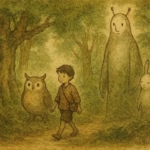
Long ago, when the elephant ruled over the animals, every year they gathered to clear his farmland and plant yams and plantains. Once the work was finished, the elephant rewarded them with a feast.
Among the regular visitors was a python who never helped with the farming. Yet whenever the food was served, he appeared at the feast and ate more than his fair share.
The tortoise watched this happen year after year until his patience ran out. One day, in front of all the assembled animals, he stood up and challenged the python.
“You do no work on the king’s farm,” he declared, “yet you come here to eat as though you helped plant the crops. Why should you enjoy the food prepared for those who worked?”
Explore more stories from our Ikom Folk Stories collection.
The other animals listened as the tortoise exposed the python’s selfishness. Embarrassed and unable to defend himself, the python had to leave the feast without continuing to eat.
But he did not forget the humiliation.
As he departed, the python vowed that he would find a way to punish the tortoise and the animals who had allowed him to be disgraced.
A Feast Turns into a Trap
When the next farming season arrived, the animals returned to the elephant’s farm as usual. They cleared the land and planted the crops, expecting their customary reward.
However, the elephant had suffered a poor harvest the previous year. When the work was completed, he explained that he had no yams or plantains to offer them. Instead, he gave the workers tombo, a traditional palm wine, and sent them home.
The animals left tired and hungry. For the python, their disappointment presented the perfect opportunity for revenge.
He took his wife into the bush, where they gathered large quantities of soft palm nuts, other nuts, and fruit. They arranged the food in heaps beside a path the animals would take on their journey home.
As evening approached, the hungry animals came upon the tempting piles. The smell and sight of the food made them eager to stop and eat.
One after another, they asked the python for permission to take some.
“Help yourselves,” he told them. “But remember this: if you eat my food today, I will come looking for you when I am hungry, and I will swallow you.”
The animals were frightened. Although their stomachs were empty, none dared accept his offer. They continued along the path, leaving the food untouched.
At last, the tortoise arrived. Seeing the palm nuts, he called out to the python and asked whether he, too, might have some.
The python reminded him of the insult at the elephant’s feast.
“You humiliated me before everyone,” he said. “Still, if you are hungry, you may eat. But when I am hungry, I shall swallow you.”
The tortoise hesitated. He wanted the food, but he understood the danger of accepting it. He therefore continued along the path, just as the other animals had done.
Yet hunger has a way of making an unappealing choice seem worth reconsidering.
Before long, the tortoise turned around. He returned to the python, determined to negotiate a different arrangement.
The Tortoise Makes a Dangerous Bargain
“I am hungry,” the tortoise told the python, “and I want to eat your fruit. But think carefully before you swallow me. My body is small, and most of it is covered by a shell. You would gain very little food from eating me.”
The python listened, but he was not persuaded.
“What does that matter?” he asked. “You have no right to promise me the other animals. They do not belong to you. How can you offer them as my food?”
The tortoise had anticipated this objection. He proposed a scheme.
He would visit the different animals and stay with them, one at a time. Each morning, after rain had fallen during the night, he would leave his host and disappear into the bush. The python would then come looking for him. Finding the tortoise gone, he could satisfy his hunger by swallowing the animal with whom the tortoise had spent the night.
The python considered the arrangement. It offered him a steady supply of victims, and the tortoise had promised to help him obtain what he wanted.
At last, he agreed.
The tortoise was allowed to eat the palm nuts and fruit. Once he had satisfied his hunger, he announced that he would spend the night with his friend, the bush buck.
That night, heavy rain fell over the forest.
When morning came, the tortoise slipped away into the bush, leaving the unsuspecting bush buck behind. The python arrived and, finding the tortoise gone, swallowed the bush buck instead.
The plan had worked.
How the Tortoise Kept Escaping
After the bush buck’s death, the tortoise continued his travels. He visited one animal after another, making himself a guest in their homes.
Each time, the same arrangement followed. The tortoise stayed with his chosen companion overnight. When rain fell, he disappeared into the bush the next morning, leaving his host behind for the python to find.
The python continued to swallow the animals he encountered, believing that the tortoise’s arrangement was providing him with the revenge he had promised himself.
But the tortoise always escaped.
One animal after another fell victim to the bargain, while the tortoise remained safe, using his cleverness to avoid the fate he had helped bring upon the others.
And so, the tale explains, the python never swallows the tortoise.
Explore our complete Historic Folklore & Fairy-Tale Collections archive.
Moral
Greed and revenge can turn a shared community into a place of danger. Cleverness may help someone escape a threat, but a scheme that saves one person by sacrificing others carries its own moral cost.
Knowledge Check
1. Why did the tortoise confront the python at the elephant’s feast?
Answer: The python refused to help with the farm but regularly attended the feast and ate more than his share.
2. Why did the python arrange fruit beside the animals’ path?
Answer: He wanted to use their hunger to take revenge on the tortoise and the other animals.
3. How did the tortoise persuade the python to let him eat?
Answer: He argued that his small, shell-covered body would not satisfy the python’s hunger and offered to direct him towards other animals instead.
4. How did the tortoise escape being swallowed?
Answer: He stayed with different animals, then disappeared into the bush after overnight rain, leaving his host behind for the python.
5. What kind of traditional narrative is this?
Answer: It is an animal-origin folktale, explaining through an imaginative story why pythons do not swallow tortoises.
Source
Dayrell, Elphinstone. Ikom Folk Stories from Southern Nigeria. Royal Anthropological Institute of Great Britain and Ireland, Occasional Papers, no. 3, 1913. Tale XXIX, “Why a Python Never Swallows a Tortoise.”