In the fertile valley of Aherlow, beneath the shadow of the Galtee Mountains, lived a poor craftsman named Lusmore. He was known by this nickname because he always wore a sprig of foxglove, called lusmore, in his little straw hat.
Lusmore had a large hump on his back that bent his body so severely that he struggled to lift his head. His unusual appearance made people wary of him, and some spread strange rumours about his supposed knowledge of herbs and charms. Yet Lusmore was a harmless man who earned his living by weaving straw and rushes into hats and baskets. He was so skilled at his work that people often paid him more than other craftsmen.
One evening, after travelling from the town of Cahir towards Cappagh, Lusmore found himself exhausted as darkness fell. He had a long way left to walk, and the weight on his back made every step difficult. When he reached the old mound of Knockgrafton beside the road, he sat down beneath it to rest.
Explore more stories from our Irish Fairy and Folk Tales collection.
As the moon rose above the mountains, a strange and beautiful melody drifted through the air. Lusmore listened in amazement. The singing seemed to come from many voices blending into one, each carrying a different tune while repeating the same mysterious words:
Da Luan, Da Mort, Da Luan, Da Mort, Da Luan, Da Mort.
The song paused briefly before beginning again.
At first, Lusmore was enchanted. Never had he heard music so beautiful. But after listening to the same refrain over and over, he began to wish for a little variety.
When the singers reached their familiar pause, Lusmore joined them. He continued their melody but added a new phrase: augus Da Dardeen.
The effect was immediate.
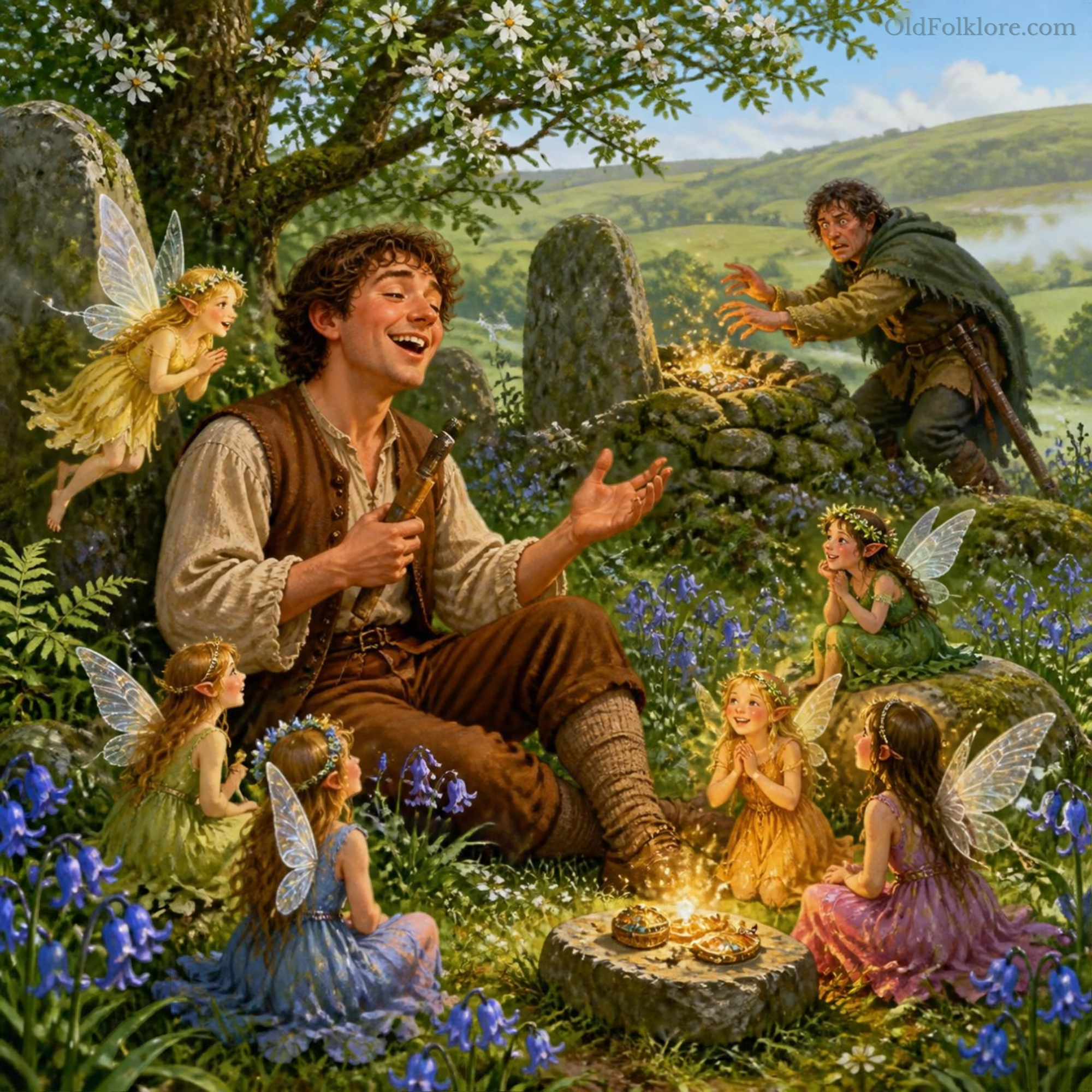
The voices within Knockgrafton delighted in this unexpected musical improvement. The singers were fairies, and they had heard a mortal add something pleasing to their song. Determined to welcome the gifted stranger, they swept Lusmore into their dwelling with the dizzying speed of a whirlwind.
Inside, he found a magnificent gathering. Music filled the splendid hall, and the fairies received him with extraordinary honour. They placed him above their musicians, provided attendants to care for him, and treated him like a distinguished guest. Everything was arranged to make him comfortable.
Before long, however, Lusmore noticed the fairies gathering for a serious consultation. Although they had treated him kindly, their mysterious behaviour made him uneasy.
One of them finally approached and spoke:
“Lusmore! Lusmore!
Doubt not, nor deplore,
For the hump which you bore
On your back is no more;
Look down on the floor,
And view it, Lusmore!”
Lusmore could hardly believe what he heard. He felt suddenly light, as though an enormous burden had been lifted from him. Looking down, he saw his hump lying on the floor.
For the first time in his life, he could raise his head freely. He gazed around the magnificent hall, overwhelmed by its beauty, until exhaustion overcame him and he fell into a deep sleep.
When he awoke, the fairies and their splendid hall had disappeared. He was lying in the daylight at the foot of Knockgrafton, surrounded by peacefully grazing cattle and sheep.
His first act was to say his prayers. Then he reached behind himself to feel for the hump. It was gone.
Lusmore had become a well-proportioned little man. He also discovered that he was wearing a complete suit of new clothes, which he believed the fairies had given him.
Overjoyed, he set off for Cappagh, walking with a lightness he had never known. People who met him could scarcely recognise him without his hump. He had to convince them that he was the same Lusmore they had known before.
News of his extraordinary transformation spread throughout the surrounding countryside. Before long, people far beyond Cappagh had heard that the fairies of Knockgrafton had removed his hump.
The Second Man Who Wanted the Same Reward
One morning, an old woman arrived at Lusmore’s cottage. She had travelled from Decies country in County Waterford because she had heard what happened to him.
A friend of hers had a son with a hump, and the family hoped that Lusmore could explain how the fairies might be persuaded to remove it.
Being good-natured, Lusmore told her everything. He described the mysterious music, the words he had added to the melody, his welcome among the fairies, and the removal of his hump. He also mentioned the new clothes he had received.
The woman returned home delighted with what she had learned. She and her friend decided to take the young man, Jack Madden, to Knockgrafton.
Jack, however, was unlike Lusmore. The story describes him as peevish and cunning, and he was determined to rid himself of his hump.
After a long journey, his mother and her friend brought him to the mound and left him there at nightfall.
Jack had barely settled down when he heard the fairies singing. Their melody was now even sweeter than before because they had incorporated Lusmore’s addition into their song:
Da Luan, Da Mort, Da Luan, Da Mort, Da Luan, Da Mort, augus Da Dardeen.
The tune continued without the pause that had allowed Lusmore to join in.
Jack listened impatiently. He wanted the same reward Lusmore had received, but he failed to understand that the circumstances of the first encounter could not simply be copied.
After hearing the song repeated seven times, he shouted his own addition:
augus Da Dardeen, augus Da Hena.
Jack believed that if one extra phrase had earned Lusmore a reward, adding another would bring him something even better. He imagined that he might receive two new suits of clothes and perhaps have his hump removed just as easily.
But the fairies were furious.
They swept Jack into their dwelling with tremendous force. The enchanted hall that had welcomed Lusmore now rang with angry voices demanding to know who had spoiled their music.
One of the fairies stepped forward and addressed him:
“Jack Madden! Jack Madden!
Your words came so bad in
The tune we felt glad in;
This castle you’re had in,
That your life we may sadden;
Here’s two humps for Jack Madden!”
The fairies brought out Lusmore’s discarded hump and placed it on Jack’s back, directly on top of his own.
They fixed the two together so firmly that the added weight could not be removed. Then they threw Jack out of their dwelling.
A Terrible Price for Greed
When morning came, Jack’s mother and her friend returned to the mound to collect him. They found him lying at its foot, nearly dead and carrying two humps instead of one.
The women stared at each other in horror. They were afraid even to complain, fearing that the fairies might punish them by placing humps on their own backs.
They carried the unfortunate Jack home, miserable and overwhelmed by what had happened. The added weight, combined with the hardship of the journey, proved too much for him. He died soon afterwards.
The tale ends with a warning: Jack’s unhappy fate left behind a curse against anyone tempted to seek out fairy music again.
Thus, the two men who visited Knockgrafton received opposite rewards. Lusmore had joined the fairies’ song naturally and won their favour. Jack, desperate to obtain more than Lusmore had received, tried to manipulate the same opportunity and suffered a dreadful punishment.
Explore our complete Historic Folklore & Fairy-Tale Collections archive.
Moral
Contentment, good judgement and respect are wiser than greed. Lusmore receives an unexpected blessing because he responds naturally to the moment, while Jack’s attempt to secure an even greater reward leaves him worse off than before.
Knowledge Check
1. Why was Lusmore called by that name?
Because he habitually wore a sprig of foxglove, known as lusmore, in his straw hat.
2. What did Lusmore add to the fairies’ song?
He added augus Da Dardeen during a pause in their repeated melody.
3. Why did the fairies reward Lusmore?
They were delighted by his musical contribution and welcomed him into their gathering.
4. Why was Jack Madden punished?
He impatiently added more words to the established song, believing that he could obtain a greater reward than Lusmore.
5. What happened to Jack at the end?
The fairies placed Lusmore’s discarded hump on top of Jack’s own. He returned home gravely weakened and died soon afterwards.
6. What is a distinctive feature of this Irish fairy legend?
It uses a repeated musical refrain, a supernatural encounter at a mound and two contrasting outcomes to explore the consequences of greed and poor judgement.
Source
W. B. Yeats, editor, Fairy and Folk Tales of the Irish Peasantry, first published 1888. Project Gutenberg 33887; working digitisation has an undated Walter Scott title page.