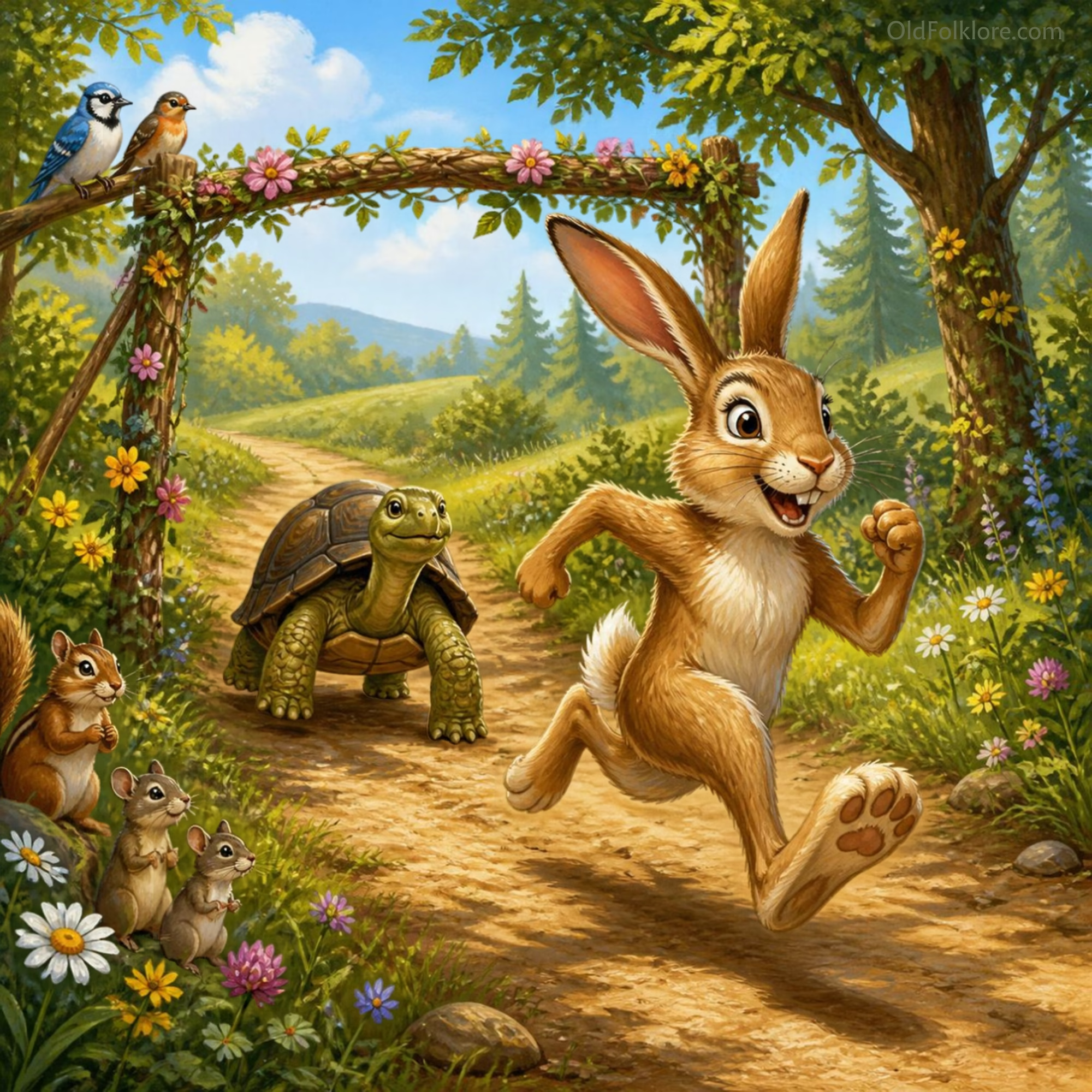
In a place where animals gathered to share news and watch one another’s activities, there lived a hare who was exceedingly proud of his speed. He believed that no creature could match his running ability, and he never missed an opportunity to remind the others of his advantage.
“I have never lost a race when I run as fast as I can,” he declared confidently. “Is there anyone here brave enough to challenge me?”
The other animals listened as the hare continued to praise himself. His confidence seemed unshakable, and he expected everyone to agree that he was the fastest among them.
Then, from among the animals, a tortoise quietly stepped forward.
Explore more stories from our Aesop’s Fables collection.
“I will race you,” the tortoise said.
The hare stared at him in disbelief. For a moment, he could hardly believe that the slow moving tortoise had taken his challenge seriously.
“What a ridiculous idea!” the hare exclaimed. “I could run circles around you and still reach the finish line before you!”
The tortoise remained calm. He was not interested in arguing or trying to prove himself through words.
“Let us see what happens when we race,” he replied. “You can celebrate your victory after you have actually won.”
The challenge was accepted, and a course was agreed upon. Soon, the two competitors were ready to begin.
At the signal to start, the hare sprang forward with remarkable speed. Within moments, he had raced so far ahead that the tortoise was almost out of sight behind him.
The hare looked back and saw the enormous distance between them. He was certain that the contest was already decided.
“That tortoise has no chance of catching up with me,” he thought.
Instead of continuing towards the finish line, the hare decided to take a break. He considered the race too easy to require his full attention and wanted to demonstrate just how little he thought of his opponent.
Finding a comfortable place to rest, he stretched out and soon fell asleep.
Meanwhile, the tortoise continued along the course. He did not possess the hare’s speed, but he did not allow that disadvantage to discourage him. Step after step, he kept moving towards the destination.
He neither stopped to boast nor abandoned the race because the hare had gained such a considerable lead. He simply continued forward, concentrating on the task before him.
Time passed, and the hare remained asleep.
The tortoise, however, kept advancing. Slowly but steadily, he drew closer to the finish line while his faster competitor wasted precious time resting.
Eventually, the hare awoke. Remembering the race, he sprang to his feet and immediately looked towards the finishing point.
What he saw filled him with alarm.
The tortoise was already close to the winning post!
The hare dashed forward as quickly as his legs could carry him. He had relied on his speed throughout his life, and now he tried to use it to recover the advantage he had carelessly thrown away.
But it was too late.
Before the hare could reach him, the tortoise arrived at the finish line. The race was over, and the tortoise had won.
The hare’s remarkable speed had not been enough to secure his victory. His confidence had caused him to underestimate his opponent, while his decision to rest had allowed the tortoise to move ahead.
The tortoise had little to say about the outcome. His steady effort had answered the hare’s earlier boasting.
The lesson was clear: plodding wins the race.
Explore our complete Historic Folklore & Fairy-Tale Collections archive.
Moral
Slow and steady wins the race.
Consistent effort and patience can accomplish what confidence alone cannot. Do not underestimate others because they move at a different pace, and do not allow early success to make you careless.
Knowledge Check
1. Why did the hare challenge the other animals?
He was proud of his speed and believed that no one could defeat him in a race.
2. Why did the hare lose despite being faster?
He underestimated the tortoise, stopped to sleep, and wasted the time he needed to secure victory.
3. What helped the tortoise win?
He continued moving towards the finish line without allowing the hare’s early lead to discourage him.
4. What does the hare’s behaviour teach us?
Overconfidence can lead to carelessness, and possessing an advantage does not guarantee success.
5. What type of story is The Hare and the Tortoise?
It is an animal fable associated with Aesop’s fables, in which animal characters illustrate a lesson about human behaviour.
Source
Joseph Jacobs, The Fables of Aesop, Macmillan, 1894. Project Gutenberg 28