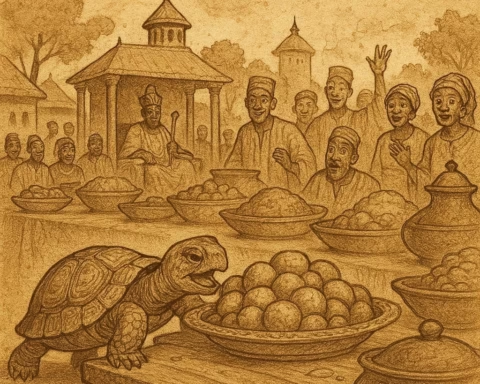
Long ago, in Calabar, there lived a wealthy king named Efriam Duke. Unlike many rulers who sought to expand their kingdoms through war, Efriam preferred peace. His greatest treasure was a remarkable magic drum. Whenever he beat it, an abundance of food and drink appeared as if from nowhere. Tables filled with fish, foo-foo, palm-oil dishes, soup, cooked yams, okra, and palm wine.
Whenever another country threatened to wage war against him, the king would invite his enemies to a feast instead of meeting them on the battlefield. He would beat his drum, and the food would appear. His enemies would eat until they were satisfied, their anger would subside, and they would return home peacefully.
Yet the drum came with a dangerous condition. If its owner stepped over a stick lying across a path or walked over a fallen tree, its magic would be broken. Three hundred Egbo men would then appear, armed with sticks and whips, and beat the owner and everyone who had been invited to a feast.
Despite this strange danger, the drum remained a source of wonder throughout the kingdom.
Efriam Duke was a prosperous ruler with many farms, a large store of kernels by the beach, quantities of palm oil, fifty wives, and numerous children. Every few months, he organised a grand feast for his subjects. Even wild animals, including elephants, hippopotamuses, leopards, bush cows, and antelopes, were welcome. In those days, according to the story, humans and animals lived peacefully enough to gather together without attacking one another.
Everyone admired the king’s magical drum and wished to possess it, but Efriam refused to give it away.
Explore more stories from our Folk Stories from Southern Nigeria collection.
How the Tortoise Acquired the Magic Drum
One morning, Ikwor Edem, one of the king’s wives, took her little daughter to a spring to wash her. The child had yaws, a disease that caused painful sores on the skin.
Nearby, the tortoise was high in a palm tree, cutting nuts for his midday meal. One of the nuts fell to the ground in front of the child. Seeing it, the little girl wanted to eat it, so her mother picked it up and gave it to her, believing it had simply fallen from the tree.
The tortoise climbed down immediately and demanded to know what had happened to his palm nut.
When Ikwor Edem explained that she had given it to her daughter, the tortoise saw an opportunity. He had long desired the king’s magic drum, and he thought that by turning this small incident into a serious dispute, he might finally obtain it.
He accused the king’s wife of stealing his food and threatened to report her to the king. In the custom described by the story, stealing another person’s food was considered a serious offence.
Ikwor Edem defended herself. She explained that she had found the nut on the ground and had given it to her child without knowing it belonged to anyone. She had not intended to steal.
After washing her daughter, she took the tortoise to the palace and explained the matter to her husband.
The king listened to the complaint and offered the tortoise several forms of compensation. He could have money, cloth, kernels, or palm oil. The tortoise rejected every offer.
“What will you take?” the king finally asked. “You may have anything you like.”
“The drum,” the tortoise replied. “That is all I want.”
Efriam agreed to give it to him. Perhaps he wanted to end the dispute quickly, or perhaps he was content to let the tortoise discover the danger for himself. Whatever his reason, the king did not explain the drum’s hidden condition.
The tortoise carried his prize home in triumph.
“I am a rich man now,” he told his wife. “I shall never have to work again. Whenever we need food or drink, I will simply beat this drum.”
His wife and children were delighted. They were hungry, so the tortoise beat the drum as he had seen the king do. At once, a wonderful feast appeared.
For three days, the family ate their fill. The children grew plump, and the tortoise became increasingly proud of his new possession.
Wanting everyone to admire his sudden wealth, he invited the king, the people, and the animals to a grand feast.
Many laughed when the invitations arrived. They knew the tortoise had been poor, and they could not understand how he could afford such generosity. Few attended.
The king, however, knew the secret of the drum and accepted the invitation. When the tortoise beat it, food and drink appeared in abundance. Those present enjoyed a magnificent meal and could scarcely believe what they had witnessed.
Soon, word spread throughout the kingdom. Those who had stayed away regretted missing the feast. From that day, people regarded the tortoise as a wealthy and important man, and they resolved not to refuse his invitations again.
The Feast That Turned Into a Punishment
Weeks passed, and the tortoise became lazy. Instead of working, he wandered about boasting of his riches. He also began drinking too much palm wine.
One day, after drinking heavily at a distant farm, he started home with the drum. Because he was intoxicated, he failed to notice a stick lying across the path and stepped over it.
The drum’s magic was broken.
The tortoise did not realise what had happened. He reached home, threw the drum into a corner, and went to sleep.
The following morning, hunger drove him to beat the drum again. His wife and children were calling for food, and he expected another feast to appear.
Instead, the house suddenly filled with three hundred Egbo men, who attacked the tortoise, his wife, and his children with sticks and whips.
The tortoise was furious. He had obtained the drum to feed his family, yet it had brought them a terrible beating. He decided that if he and his family had to suffer, the other people of the kingdom should suffer too.
He sent out invitations for another grand feast, announcing that everyone should arrive at three o’clock the next afternoon.
This time, the invitations were taken seriously. No one wanted to miss a free meal again. Even sick people and those who were lame or blind arranged for friends to bring them.
When the guests arrived, the king and his wives were absent, having sent their apologies. The tortoise had also sent his wife and children away beforehand because he knew what was likely to happen.
He beat the drum and quickly hid beneath a bench.
Immediately, the three hundred Egbo men appeared and began flogging the guests. The doors had been fastened, leaving the crowd unable to escape. For two hours, the beating continued, and many people were so badly injured that their friends had to carry them home.
Only the leopard escaped. As soon as he saw the men arrive, he sensed that danger was near and leapt out of the compound.
When the tortoise decided the punishment had lasted long enough, he crept to the door and opened it. The guests fled in anger and distress. After the tortoise gave the drum a particular tap, the Egbo men disappeared.
The injured guests complained bitterly, and the tortoise soon realised that he could no longer keep the drum without facing the consequences. The next morning, he returned to the king, hoping to exchange it for farms, cloth, rods, or other valuable possessions.
But Efriam refused to make the exchange.
Feeling some pity for the tortoise, the king offered him something else instead: a magical foo-foo tree.
The Foo-Foo Tree and the Broken Promise
The king explained that the magical tree would provide foo-foo and soup for the tortoise’s family. Although it bore fruit only once a year, it dropped enough food on the ground every day to feed the household.
There was, however, one strict condition: the family could collect its food only once each day. They must never return for a second supply.
The tortoise readily agreed.
When he returned home, he told his wife to bring her calabashes. Together, they went to the tree and gathered enough food for everyone. That evening, the family enjoyed another satisfying meal, grateful that they would no longer have to struggle for their daily food.
But the tortoise had a son whose appetite was matched by his greed. As he ate, he wondered where his father obtained such delicious food.
The next morning, he questioned his father, but the tortoise refused to reveal the secret. His wife supported the decision. She feared that if their children discovered the tree’s location, one of them might become hungry after the day’s supply had been collected and return for more, thereby breaking the condition.
The greedy son, however, would not give up. He decided to discover the secret for himself.
He found a long-necked calabash with a hole at its end and filled it with wood ashes. Then he took the bag his father usually carried when collecting food and made a small hole in its bottom. He inserted the calabash so that the ashes would trickle out as his father walked.
The following morning, the tortoise set out alone, as usual, carrying his bag. His son followed discreetly, tracing the trail of ashes without being noticed.
Eventually, the tortoise reached the hidden foo-foo tree. He placed his calabashes on the ground and collected the family’s daily supply. His son watched from a distance, then followed him home.
The boy said nothing about what he had discovered.
The next day, after his father had collected the usual amount of food and returned home, the greedy son gathered some of his brothers. Together, they followed the trail to the tree and collected another supply of foo-foo and soup.
They had broken the king’s condition.
The consequences appeared the following morning.
When the tortoise returned to collect food, he could no longer find the tree. The surrounding bush had become an impenetrable mass of prickly tie-tie palm, concealing the place where the tree had stood.
The tortoise understood what had happened. Someone in his household had returned to gather food a second time, breaking the magical condition and destroying their only source of endless daily provisions.
Heartbroken, he returned home and told his wife. He gathered the entire family and demanded to know who had disobeyed the rule. Everyone denied responsibility.
Finally, the tortoise led them to the place where the tree had once stood. Before the dense, prickly growth, he expressed his disappointment and declared that he had done everything he could for them, but they had destroyed their own blessing.
From then on, he told them, they would have to live beneath the tie-tie palm and find their food there.
And so, the tale concludes, tortoises came to live beneath the prickly tie-tie palm, having lost the magical tree that once provided their food.
Explore our complete Historic Folklore & Fairy-Tale Collections archive.
Moral
Greed can destroy the very blessings we already possess. The tortoise’s family had enough food to meet its needs, but the desire for more led to the loss of their magical supply.
The story also teaches that a gift comes with responsibility. Good fortune should be handled wisely, and disregarding important conditions can bring consequences that affect an entire family.
Knowledge Check
1. Who was Efriam Duke?
He was the peaceful king of Calabar who owned the magic drum that produced abundant food and drink.
2. How did the tortoise obtain the drum?
He used a dispute over a fallen palm nut to pressure the king into giving him the drum as compensation.
3. What caused the drum’s magic to fail?
The tortoise stepped over a stick while returning home after drinking too much palm wine.
4. Why did the king give the tortoise a foo-foo tree?
After refusing to exchange the drum for other valuables, the king took pity on him and offered an alternative source of food with a strict condition.
5. What destroyed the family’s access to the foo-foo tree?
The tortoise’s greedy son discovered its location and returned with his brothers to collect food a second time, breaking the condition attached to the gift.
6. What is the main lesson of the story?
Greed and disobedience can cause people to lose what they already have, while responsibility and contentment help preserve a blessing.
Source
Elphinstone Dayrell, Folk Stories from Southern Nigeria West Africa, Longmans, Green, 1910. Project Gutenberg 34655.