Igiri and her husband Inkang long for a child of their own. Although they care deeply for one another, the years pass without a baby to inherit their household and support them in old age. Their hopes finally change during a visit to the forest, where Igiri discovers something extraordinary among the mushrooms she has been gathering.
A simple wish brings an unexpected answer, and the couple welcomes a baby boy into their home. They raise him with love and keep his unusual beginnings a secret. However, when a hungry child from a neighbouring town repeatedly steals the food prepared for him, the mushroom boy begins to believe that his foster parents no longer care for him.
His decision to return to the forest changes their lives forever. The tale explores the fragility of trust, the consequences of misunderstanding, and the sadness that can follow when people fail to recognise the cause of another person’s suffering.
A Couple Longing for a Child
Chief Inkang of Inkum was married to a woman named Igiri. She was a fine-looking woman, and Inkang loved her so deeply that he did not wish to take another wife.
Igiri remained faithful to her husband, and the couple lived together happily in many respects. Yet one sadness troubled them: they had no children.
As the years passed, their desire for a baby grew stronger. They wanted a son who could inherit Inkang’s property and care for his mother when she became old.
Eventually, Inkang asked Igiri to consult the local spiritual practitioner to discover what might help her conceive. She followed his advice, and the usual sacrifices of fowls and eggs were made. Despite their efforts, nothing changed.
The couple remained childless, and their longing for a family continued.
The Wish in the Forest
When the rainy season arrived, it was time to gather mushrooms. Igiri took her basket and went into the forest, accompanied by her husband.
Once they reached the forest, the two separated to search for mushrooms in different directions. They remained close enough to call to one another if necessary.
Explore more stories from our Ikom Folk Stories collection.
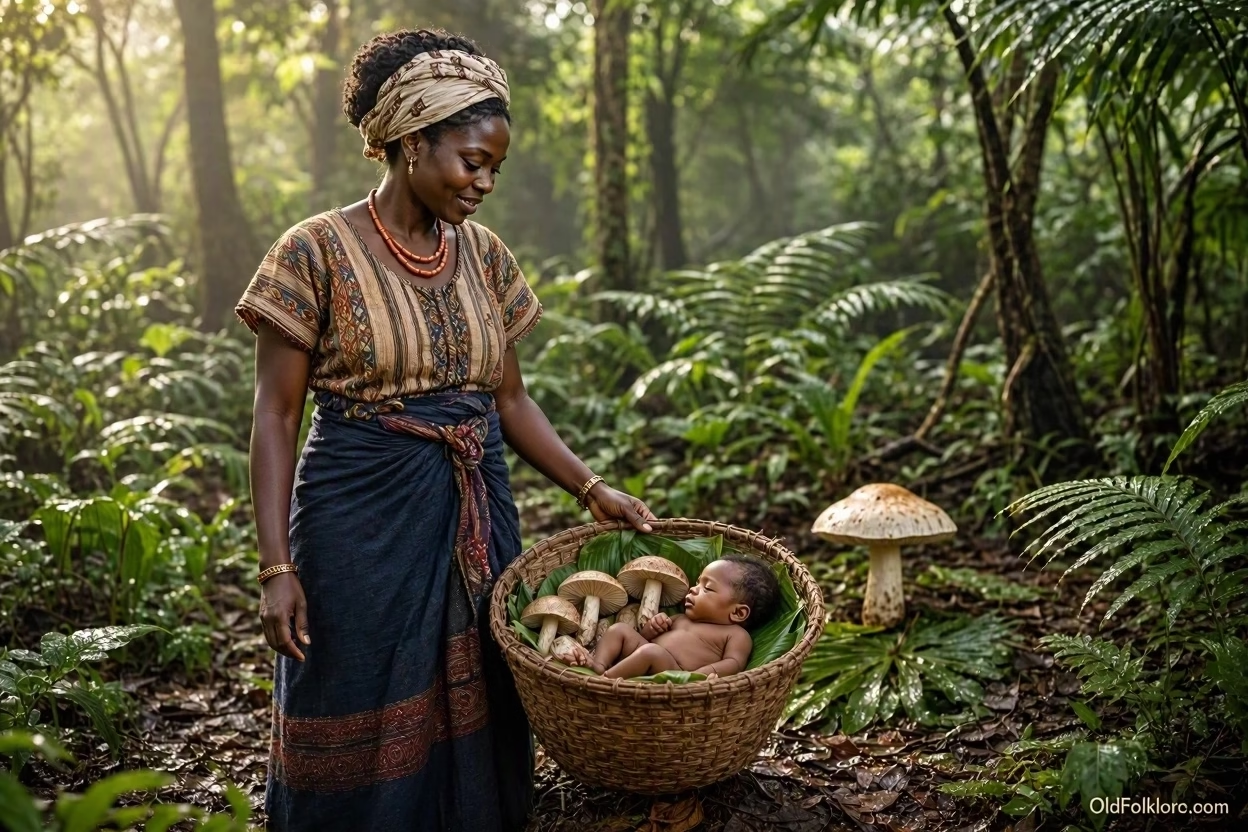
Igiri walked through the forest, collecting mushrooms and placing them in her basket. As she searched, she eventually came across a particularly large mushroom. It was fat, white, and unlike the others she had gathered.
Looking at it, she thought about the child she and Inkang wanted so desperately.
She wished aloud that the mushroom might turn into a baby boy, the son they had long hoped to have.
To her astonishment, the mushroom took pity on her. It transformed itself into a baby boy.
Igiri was overjoyed. She lifted the child and placed him carefully in her basket among the mushrooms.
She no longer felt the need to continue gathering. The discovery had given her something far more precious than the food she had set out to collect.
Calling to her husband, she announced that she was going home and told him to follow.
Inkang Discovers the Baby
When Igiri arrived home, she was eager to show Inkang what she had found. She asked him to help lower the basket from her head.
Inkang was surprised. People commonly helped women lower heavy loads after returning from farm work, but a basket of mushrooms would not ordinarily be heavy enough to require assistance.
He wondered what his wife had placed inside the basket to make it so heavy.
Igiri did not reveal her secret immediately. Instead, she asked him to help her put the basket down, promising that he would soon see what she had brought home.
His curiosity grew, and he helped her lower the basket carefully.
Together, they opened it.
At the bottom lay a plump little baby boy, smiling and partly covered by the mushrooms.
Inkang could hardly believe what he was seeing. His surprise quickly turned to joy, and he embraced Igiri as she explained what had happened in the forest.
Their long-held wish had been answered in a way neither of them could have imagined.
Inkang then proposed that they keep the child hidden until he grew older, so the people of the town would not discover what had happened.
Igiri agreed, and the couple began raising the boy as their own.
Six Years of Happiness
Igiri cared for the child devotedly. Over the next six years, he grew into a strong boy.
The couple’s home was no longer without a child. They had someone to love and raise, and the boy had parents who provided for him.
When the planting season arrived, Inkang and Igiri went to their farm early each morning and returned in the evening.
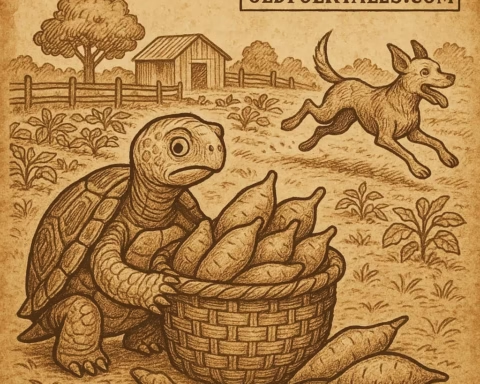
Because the boy was still young, they left him at home. Before leaving, Igiri prepared his food and placed it high above the fireplace. She showed him how to reach it by standing on a locally made box.
The arrangement worked at first. The boy would climb up, take his food, and eat while his foster parents were away.
However, someone from a neighbouring town had begun watching him.
The Stolen Food
On the first day of the planting season, the mushroom boy took down his food and ate it. He did not notice that another boy was watching him.
The following day, the hungry boy from the neighbouring town waited until the mushroom boy had left the house. He then entered quietly and stole all the food Igiri had prepared.
To hide what he had done, he filled the empty calabash with water and returned it to the place where he had found the food.
When the mushroom boy returned, he discovered that his meal was gone. He did not know who had taken it or why.
The same thing happened the next day.
Once again, the other boy waited until the house was empty, stole the food, and replaced it with water.
For three consecutive days, the mushroom boy found nothing to eat.
He could not understand why his food had disappeared. His foster parents prepared meals for him, but every time he went to collect his portion, it was gone.
He did not know about the thief who entered the house while he was away. From his perspective, it seemed that the people who had taken him into their home were no longer providing the food he needed.
Hunger made the situation unbearable, and he began to believe that Inkang and Igiri were deceiving him.
The Decision to Return to the Forest
The mushroom boy became angry and distressed. He could not understand why his foster parents appeared to have stopped feeding him.
Rather than discovering who had stolen his food, he decided that he would return to the forest from which he had come.
He intended to become a mushroom again.
On his way, he met Inkang and Igiri returning from their farm. He told them what he planned to do.
The couple were shocked. They had loved the boy and cared for him for six years. They did not want to lose the child who had brought so much happiness into their lives.
They tried their best to persuade him to return home with them. They wanted him to remain with them, but he would not change his mind.
The boy ran away, determined to return to the place where he had first appeared.
The Mushroom Boy Disappears
The mushroom boy reached the part of the forest from which he had come. There, he transformed himself back into a mushroom.
Then he disappeared forever.
Inkang and Igiri had discovered a child through a remarkable act of kindness, but they could not persuade him to remain with them once he believed they had neglected him.
The true cause of his hunger had been the other boy’s theft. Yet the mushroom boy never learned what had happened to his food, and his foster parents could not make him understand that they had not intended to deceive him.
The tale ends by explaining that, from that time onwards, mushrooms no longer took pity on childless women by turning themselves into babies.
The extraordinary gift Igiri had received was never repeated.
Explore our complete Historic Folklore & Fairy-Tale Collections archive
Moral of the Story
The tale highlights the importance of trust, understanding, and communication. The mushroom boy suffered because he misunderstood why his food had disappeared, while the couple lost the child they loved. It also reminds readers that actions taken without knowing the full truth can have lasting consequences.
Knowledge Check
1. Why were Igiri and Inkang unhappy despite their loving marriage?
They had lived together for years without children and longed for a son who could inherit Inkang’s property and care for his mother in old age.
2. How did Igiri find the mushroom baby?
While collecting mushrooms in the forest, she found a large white mushroom and wished it would turn into the baby boy she and her husband wanted. The mushroom took pity on her and transformed into a child.
3. Why did Inkang and Igiri decide to keep the boy hidden?
Inkang suggested hiding him until he grew older so that the people of the town would not discover what had happened.
4. How did the mushroom boy’s food disappear?
A hungry boy from a neighbouring town repeatedly entered the house when the mushroom boy was away, stole the food, and replaced it with water.
5. Why did the mushroom boy decide to return to the forest?
After finding his food missing for three days, he believed his foster parents were deceiving him and decided to return to where he had come from.
6. What happened when the mushroom boy returned to the forest?
He transformed himself back into a mushroom and disappeared forever. The tale explains that mushrooms have not turned themselves into babies for childless women since then.
Source
Ikom Folk Stories from Southern Nigeria, by Elphinstone Dayrell, first published in 1913 by the Royal Anthropological Institute of Great Britain and Ireland. “The Story of Igiri and her husband Inkang, who brought up a mushroom baby boy, and what became of him,” Story III.
Explore More Ikom Folk Stories