Long ago, when the Buddha was travelling towards Sāvatthi, an incident among his disciples troubled him deeply.A wealthy supporter named Anātha Piṇḍika had completed a monastery and sent word inviting the Buddha to visit. The Buddha set out from Rājagaha, travelled to Vesāli, rested there briefly, and continued towards Sāvatthi with his community of monks.
Among the monks were the followers of a group known as the Six. These monks hurried ahead of the others and claimed every available sleeping place before the senior monks could arrive. They set aside rooms for their own superior and instructor, then occupied the remaining spaces themselves.
When the older monks reached the lodging, they discovered that nothing was left for them. Even the followers of Sāriputta, one of the Buddha’s chief disciples, could not find a place for their teacher to sleep.
Explore more stories from our Ikom Folk Stories collection.
With nowhere else to go, Sāriputta spent the night walking back and forth or sitting beneath a tree near the place where the Buddha was staying.
Early the next morning, the Buddha came outside and coughed. Sāriputta, who was still nearby, coughed in response.
“Who is there?” the Buddha asked.
“It is I, Lord, Sāriputta,” came the reply.
“What are you doing here so early?”
Sāriputta explained how the younger monks had taken all the available lodgings, leaving the senior monks without shelter.
The Buddha was deeply concerned. If his disciples showed so little respect for one another while he was still alive, he wondered, how would they behave after his death? He worried about the future of the teachings and the conduct of the community.
As soon as daylight came, he summoned the monks and asked whether the report was true. They admitted that the followers of the Six had occupied the lodgings before the elders arrived.
The Buddha rebuked those responsible and asked the assembled monks who deserved the best seat, the best water, and the best rice.
Their answers differed. Some believed that a monk born into a noble family deserved such privileges. Others favoured those from priestly or wealthy families. Some argued that the honour should go to monks who understood the rules of their community, had mastered the teachings, or had attained advanced stages of spiritual development.
The Buddha explained that these were not the proper standards for deciding whom to honour. In his teaching, respect, service, courtesy, and consideration were to be shown according to seniority. The best seat, water, and food should be reserved for those entitled to them through their standing in the community.
He reminded the monks that Sāriputta was his chief disciple and deserved to receive lodging immediately after the Buddha himself. Yet Sāriputta had been forced to spend the night beneath a tree.
To make the lesson clearer, the Buddha told the monks that even animals had once recognised the importance of respecting one another. He then recounted the story of three unlikely friends who discovered which of them was the oldest and agreed to honour that one.
Three Friends Beneath a Banyan Tree
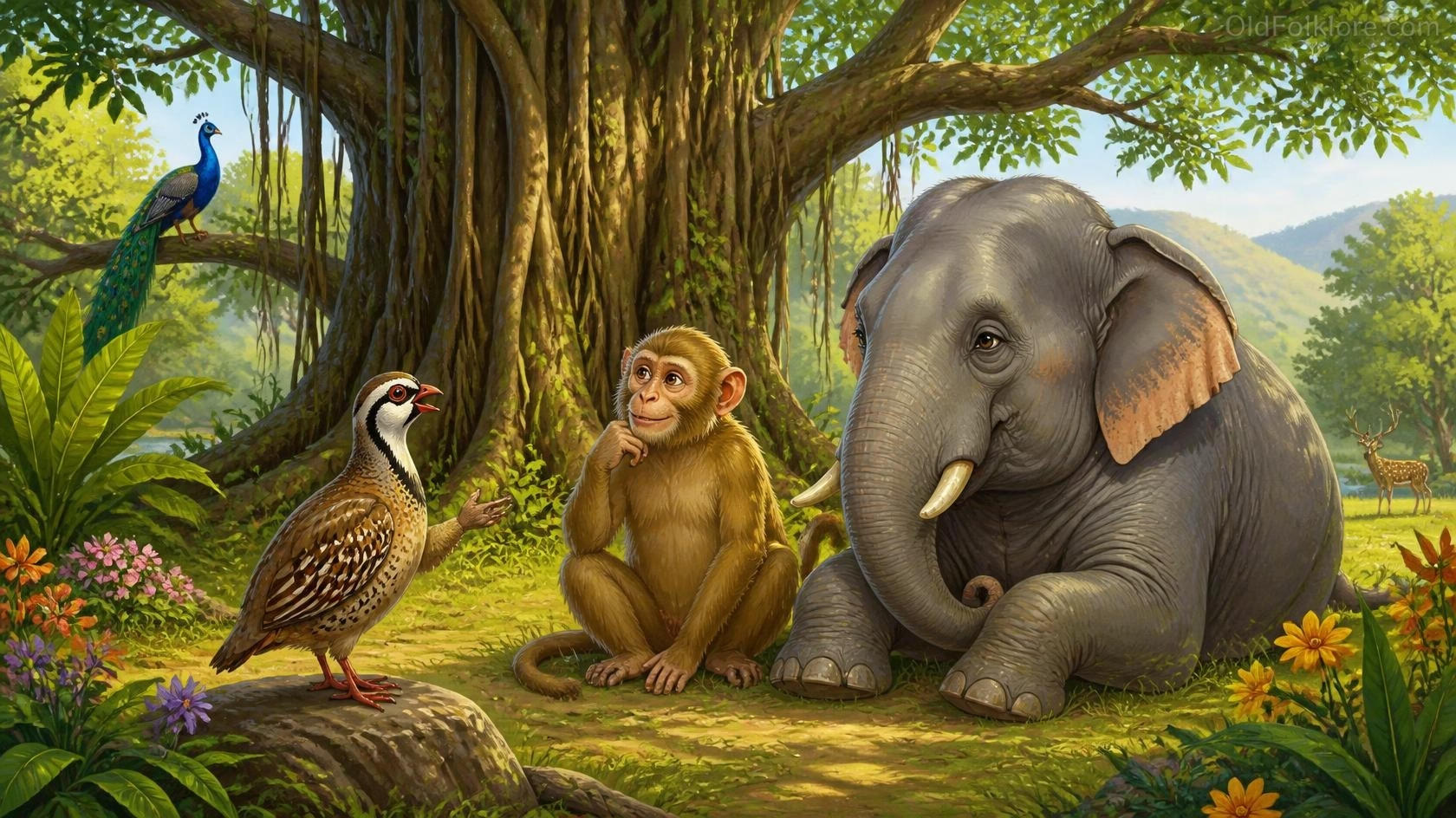
Long ago, on the slopes of the Himalayas, a partridge, a monkey, and an elephant lived near a great banyan tree.
Although they shared the same surroundings and spent time together, they did not treat one another with proper respect. Each went about as though there were no reason to defer to the others, and their friendship lacked the courtesy that would have allowed them to live together harmoniously.
Eventually, the three recognised that their behaviour was not right.
“We should not continue living this way,” they agreed. “Would it not be better if we showed respect to whichever of us is the oldest?”
There was only one difficulty. None of them knew who was eldest.
They considered the matter until they devised a way to discover the answer. Since they had all known the banyan tree for some time, they decided to describe what it had been like when each first encountered it.
One day, they gathered beneath its spreading branches. The monkey and the partridge turned to the elephant and asked him to explain how large the tree had been when he first knew it.
The elephant thought back to his earliest memories.
“When I was very small,” he said, “this banyan was nothing more than a little shrub. I could walk over it with the plant between my thighs. When I stood with it between my legs, its highest branches reached my navel. I have known this tree since it was scarcely more than a bush.”
The others listened carefully. The tree had clearly been young when the elephant first encountered it, but they wanted to hear what the monkey remembered.
The monkey smiled as he recalled his own childhood.
“When I was a little monkey, I could sit on the ground and stretch my neck to eat the tender shoots at the very top of this tree. It was still young then, and I have known it since the earliest stage of its growth.”
The elephant and the partridge considered this answer. The monkey’s memory suggested that the tree had been smaller still when he first knew it.
At last, they turned to the partridge.
“And what about you?” they asked. “How large was the banyan when you first knew it?”
The partridge had a very different story to tell.
“Friends,” he began, “there was once a great banyan tree growing in another place. I ate its fruit, and the seeds passed from my body here. From those seeds, this very tree grew. I knew of this tree before it was born, before it existed as a plant at all. Therefore, I am older than either of you.”
The elephant and the monkey understood what the partridge meant. The elephant had known the banyan as a small shrub, and the monkey had known it as a young tree. But the partridge remembered the earlier tree whose fruit had produced the seeds from which their present banyan had grown.
The partridge was the eldest of the three.
The Smallest Animal Becomes Their Guide
The elephant and the monkey did not argue with the discovery simply because the partridge was smaller and less physically powerful than either of them. Instead, they accepted the evidence and acknowledged his seniority.
“You are the oldest among us,” they told him. “From now on, we will serve you, honour you, bow before you, and treat you with the respect and courtesy you deserve. We will also listen to your advice. When we need guidance, we shall come to you.”
The partridge accepted their decision and took his responsibility seriously.
From that day forward, he advised his companions and reminded them of their duties. He did not merely demand respect from the monkey and the elephant; he also followed the proper conduct he encouraged in them.
Together, the three friends observed the Five Commandments, as the text calls them. They treated one another with respect, behaved courteously, and lived in harmony beneath the banyan tree.
Their friendship became an example of peaceful and disciplined living. According to the story, because they respected one another and observed their moral duties, they were destined to be reborn in heaven after their lives ended.
The Lesson Returns to the Monks
Having finished the tale, the Buddha brought its meaning back to the conduct of his disciples.
The elephant was the largest and strongest of the three animals, yet strength did not make him the eldest. The monkey was lively and capable, but his abilities did not establish seniority either. The partridge, though physically the smallest, possessed the earliest connection to the tree and was therefore recognised as the oldest.
The three animals had done what the monks should have done: they had investigated the matter, recognised the proper order among themselves, and acted with respect.
The monks, by contrast, had allowed selfishness to determine who received shelter. The followers of the Six had secured comfortable lodgings for themselves without considering the older members of their community.
The Buddha’s message was clear. A community could not remain harmonious if its members ignored courtesy and placed personal advantage above their responsibilities to one another. The animals had shown that respect was not merely a matter of words. It had to be demonstrated through service, consideration, and conduct.
The partridge, monkey, and elephant had learned to live together properly. The monks were expected to learn the same lesson.
Explore our complete Historic Folklore & Fairy-Tale Collections archive.
Moral
Respect those who came before you, and show that respect through your actions. Strength, status, and personal achievement should not become excuses for selfishness. A peaceful community depends on humility, courtesy, service, and the willingness to recognise the proper place of others.
Knowledge Check
1. Why did Sāriputta spend the night without a proper lodging?
The followers of the Six had occupied all the available sleeping places before the senior monks arrived.
2. How did the three animals discover who was the oldest?
They compared their earliest memories of the banyan tree. The partridge explained that the tree had grown from seeds produced by fruit he had eaten from an earlier banyan.
3. Why was the partridge recognised as the eldest?
He had known the tree’s origin before the tree itself existed, making him older than the monkey and elephant.
4. What did the animals do after discovering the eldest among them?
They promised to honour and serve the partridge, seek his counsel, observe the Five Commandments, and live together respectfully.
5. What connection does the story have with Buddhist teaching?
The Buddha tells the animal story to teach his monks that respect, courtesy, and proper conduct are essential to a harmonious community.
Source
Adapted from “Tittira Jātaka. The Partridge, Monkey, and Elephant,” Jātaka No. 37, in Buddhist Birth Stories; or, Jātaka Tales, Volume I, edited in Pāli by V. Fausbøll and translated into English by T. W. Rhys Davids, published by Trübner & Co., London, in 1880, pp. 310–315. The animal story appears on pp. 313–315. The original text is available through Project Gutenberg, eBook No. 51880.