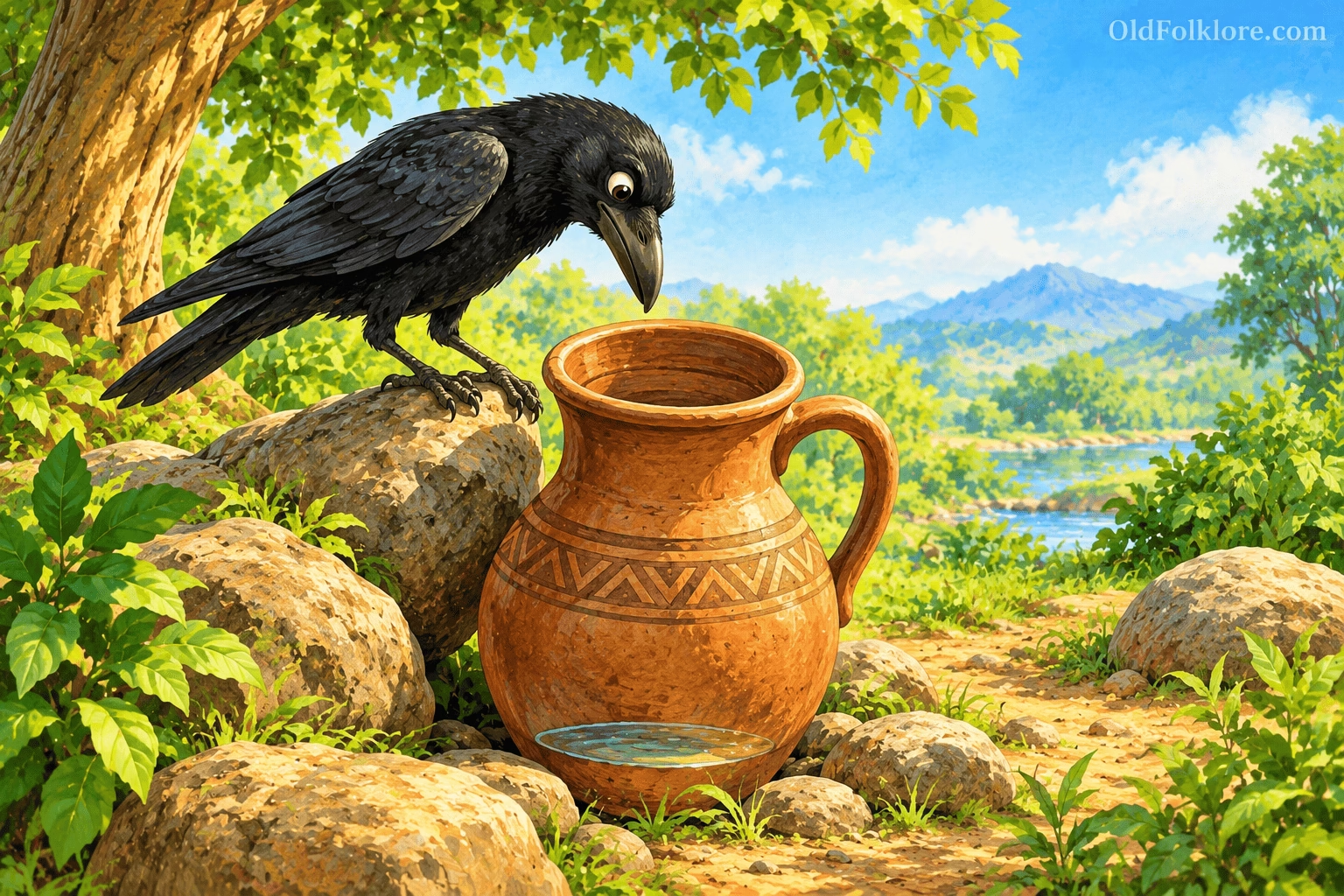
On a hot day, a crow flew across the countryside in search of water. Its throat was dry, its wings were growing heavy, and every passing moment made its thirst more unbearable.
It searched wherever it could, hoping to find a pool, a stream, or even a small puddle. But the ground offered little relief, and the desperate bird continued its search.
At last, the crow discovered a pitcher.
Hope stirred within it. Surely, there would be enough water inside to quench its thirst. The crow hurried over, lowered its beak into the narrow opening, and tried to drink.
Explore more stories from our Aesop’s Fables collection.
But there was a problem.
The pitcher contained only a little water, and it had settled too far down for the crow to reach. No matter how far it stretched its neck, its beak could not touch the water.
The crow tried again. It tilted its head and stretched as far as it could, but the water remained beyond its reach.
Again and again, it attempted to drink. Each effort ended in disappointment.
For a moment, the crow seemed to have reached the end of its strength. The water was right there, yet it might as well have been miles away.
Then, just as despair threatened to overcome it, an idea came to mind.
The crow looked around and noticed some small pebbles on the ground. It picked one up in its beak, carried it to the pitcher, and dropped it inside.
Plop!
The pebble disappeared into the water.
The crow watched carefully, but the water had risen so little that it still could not reach it. Instead of giving up, the bird picked up another pebble and dropped it into the pitcher.
Then it found another.
And another.
One by one, the crow carried the pebbles to the pitcher and let them fall inside. Each time, it returned to the ground for another stone and repeated the process.
The work was slow, and the solution required patience. Yet the crow continued, refusing to abandon the possibility of reaching the water.
Gradually, something remarkable happened.
As more pebbles accumulated at the bottom of the pitcher, the water level began to rise. What had once been too far below the opening slowly moved closer to the crow’s beak.
The bird noticed the change and continued with renewed determination.
It gathered a few more pebbles and dropped them into the pitcher.
At last, the water rose high enough for the crow to reach it.
The thirsty bird lowered its beak and drank. With each swallow, its strength returned, and the suffering that had driven it across the countryside began to fade.
The crow had found a way to save itself, not by forcing the pitcher or abandoning the water, but by thinking carefully and making use of what was available.
What had seemed impossible was accomplished one small step at a time.
Explore our complete Historic Folklore & Fairy-Tale Collections archive.
Moral
Where there is a will, there is a way. Intelligence, patience, and persistence can help us overcome difficulties that initially seem impossible. When one approach fails, looking at the problem differently may reveal a solution.
Knowledge Check
1. Why could the crow not drink from the pitcher at first?
The water was too low for the crow to reach with its beak.
2. What did the crow use to raise the water level?
It collected small pebbles and dropped them into the pitcher.
3. Why did the crow continue adding pebbles?
It noticed that the water was gradually rising and continued until it could reach the water.
4. What is the main lesson of the fable?
Patience, intelligence, and persistence can help solve difficult problems.
5. What type of traditional story is The Crow and the Pitcher?
It is a fable, a short narrative that uses a story, often involving animals, to communicate a moral lesson. The tale is traditionally associated with Aesop’s Fables.
Source
Joseph Jacobs, The Fables of Aesop (1894), “The Crow and the Pitcher.”
Explore More Aesop’s Fables
- The Hare and the Tortoise: A Timeless Fable About Patience and Perseverance
- The Fox and the Crow: How Flattery Cost a Crow Her Cheese
- The Dog and the Shadow: An Aesop Fable
- The Wolf and the Crane: An Aesop Fable