Long ago, King Udo Ubok Udom ruled at Itam, an inland town without a river. He and his wife depended on a spring behind their house whenever they wished to wash. The king had one daughter, whom he loved dearly. He protected her carefully as she grew into a beautiful young woman.
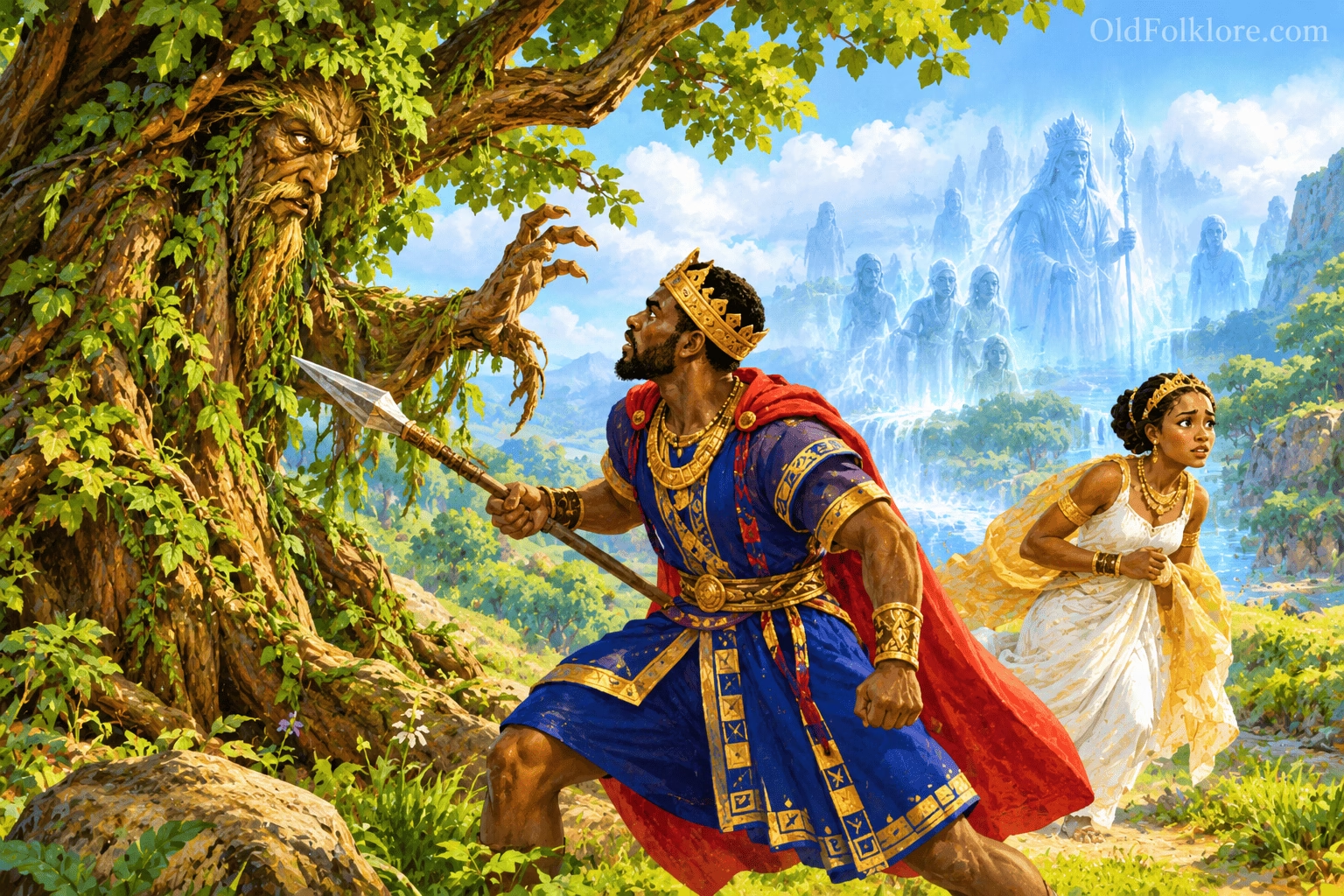
For two years, the king had been away from home and had not visited the spring. When he finally returned, he discovered that an Idem Ju Ju tree had spread its branches around the water, blocking the place where he used to wash.
Annoyed by the obstruction, King Udo summoned fifty young men and ordered them to cut the tree down. Armed with their machetes, they worked throughout the day. Yet every time they cut into the wood, the wound closed again. By evening, the tree remained untouched.
Explore more stories from our West African Folk-Tales collection
When the men reported their failure, the king became furious. He decided to handle the matter himself and went to the spring the following morning with his own machete.
As he struck at the tree, a small splinter of wood flew into his eye. The pain was so severe that he dropped his weapon and hurried home. His suffering grew worse with every passing hour. For three days, he could neither eat nor sleep properly.
Desperate for relief, the king summoned his diviners and asked them to discover the cause of his illness. After casting lots, they declared that the Ju Ju tree was angry because he had attempted to destroy it.
They prescribed an offering of seven baskets of flies, a white goat, a white chicken and a piece of white cloth. King Udo provided everything they requested, hoping the sacrifice would calm the tree’s spiritual power. The diviners also applied their remedies to his injured eye, but his condition continued to deteriorate.
He dismissed them and called for another group of spiritual practitioners. They admitted that they could not cure him, but they knew of a man who lived in the spirit land and possessed the necessary power.
The king ordered them to bring this man without delay. The spirit man arrived the following day and stood before the suffering ruler.
“Before I treat your eye,” he said, “what will you give me in return?”
King Udo offered him half his town, including its people, seven cows and money. The spirit man rejected every offer.
“Name your price,” the king pleaded. “I will give you whatever you ask.”
“The only payment I will accept is your daughter.”
The king was horrified. He wept and ordered the spirit man to leave, declaring that he would rather die than surrender his beloved child.
But that night, the pain became unbearable. Some of his subjects urged him to reconsider. They argued that if he died, he would lose everything, whereas he might have another daughter if he survived.
Overwhelmed by pain and surrounded by desperate advice, King Udo sent for the spirit man again. This time, he agreed to the terrible bargain and handed his daughter over to him.
The spirit man went into the bush, gathered leaves and soaked them in water before beating them into a mixture. He poured the liquid into the king’s injured eye and told him that, when he washed his face the following morning, he would see what had been troubling him.
King Udo begged his visitor to remain for the night, but the man refused. He returned to the spirit land immediately, taking the princess with him.
Before daylight, the king washed his face. The tiny splinter fell from his eye, the pain vanished, and his sight returned.
At last able to think clearly, King Udo understood the full cost of his bargain. He had surrendered his own daughter to save one of his eyes. Grief overwhelmed him, and he ordered his entire kingdom to observe three years of mourning.
The Princess in the Spirit Land
Meanwhile, the king’s daughter had been taken to the spirit man’s dwelling. During the first two years of her captivity, she was kept in a fattening house and given food regularly.
A skull in the house became her unexpected protector. It warned her that the food was not being provided to prepare her for marriage. The spirit man intended to fatten her before killing her and serving her as food.
Terrified by this revelation, the princess stopped eating what she was given. Instead, she passed the food to the skull and survived on chalk.
As the third year drew towards its end, the spirit man invited some friends to visit. He announced that he would kill the princess the next day so they could feast on her.
The skull overheard his plans. When the spirit man brought the princess her usual meal the following morning, the skull called her aside and revealed the danger awaiting her.
“You must escape today,” it told her. “When the spirit man goes into the bush with his friends to prepare the feast, run back to your father.”
The skull gave her medicine to strengthen her for the journey and explained how to find her way home. There would be two roads at a certain point, but she must drop some of the medicine at the junction. The roads would then become one.
It also warned her not to greet anyone she encountered along the way. A greeting would reveal that she was a stranger in the spirit land and might place her in danger. If anyone called after her, she must not turn around or stop. She was to keep moving until she reached her father’s house.
The princess thanked the skull and slipped out through the back door when the opportunity came. She passed through the bush, reached the road and ran for three hours until she arrived at the fork.
Following the skull’s instructions, she dropped some of the medicine on the ground. Immediately, the two roads became one. She continued towards home without greeting the people she passed or looking back when voices called to her.
By then, the spirit man had returned from the bush. Discovering that his captive was missing, he questioned the skull, which admitted that the princess had left through the back door but claimed not to know where she had gone.
The spirit man quickly guessed that she was heading home. He set off in pursuit, shouting as he ran.
When the princess heard his voice behind her, she ran even faster. At last, she reached her father’s house and told him what had happened.
There was no time to waste. She instructed the king to take a cow, a pig, a sheep, a goat, a dog, a chicken and seven eggs. He was to divide the offerings into seven parts and place them on the road as a sacrifice. When the spirit man encountered the offering, she explained, he would stop instead of entering the town.
King Udo immediately followed her instructions.
The spirit man arrived at the road and found the sacrifice waiting for him. Rather than continue his pursuit, he sat down and began to eat. When he had satisfied his hunger, he gathered the remaining food and returned to the spirit land. He made no further attempt to reclaim the princess.
The King’s Final Decree
Once the danger had passed, King Udo beat his drum and made a declaration throughout his kingdom.
From that day forward, he decreed, people who died and went to the spirit land must not return to the world of the living as spirits to cure the sick.
The king had recovered his sight, but the price of his desperation had nearly cost him his daughter forever. Her courage, the skull’s guidance and her quick thinking had saved her from the fate intended for her.
Thus, the tale ends with a royal decree explaining, within its traditional narrative, why the dead should no longer return from the spirit land to heal the living.
Explore our complete Historic Folklore & Fairy-Tale Collections archive.
Moral
Desperation can lead to painful choices, while wisdom, courage and careful action can open a path to safety. The princess’s escape also shows that help can come from unexpected places, even from someone others might overlook.
Knowledge Check
1. Why did King Udo attempt to cut down the Ju Ju tree?
He wanted to regain access to the spring behind his house, which the tree had surrounded.
2. What payment did the spirit man demand to cure the king?
He demanded the king’s daughter in exchange for healing his injured eye.
3. How did the princess discover the danger she faced?
A skull in the spirit man’s dwelling warned her that she was being fattened so that she could be killed and eaten.
4. How did the princess escape from the spirit land?
She followed the skull’s instructions, used the medicine at the fork in the road to unite the two roads, and continued home without greeting anyone or looking back.
5. What did King Udo decree at the end of the story?
He declared that the dead must no longer return from the spirit land as spirits to cure sick people.
Source
The retelling is based on “The King and the Ju Ju Tree,” Chapter XXVIII, pages 98–103, in Folk Stories from Southern Nigeria, West Africa, by Elphinstone Dayrell, with an introduction by Andrew Lang. The book was published in London, New York, Bombay and Calcutta by Longmans, Green and Co. in 1910.
Explore More West African Folk-Tales
- Thunder and Anansi: A West African Folktale
- Igiri and the Mushroom Baby: An Ikom Folktale
- Why the Bat Flies by Night: A Nigerian Folktale
- Soria Moria Castle: Halvor’s Quest to Win Back His Princess
- The Envier and the Envied: A Powerful Arabian Nights Tale
- The Old Man and the River Spirit
- The Enchanted Date Palm of the Oasis