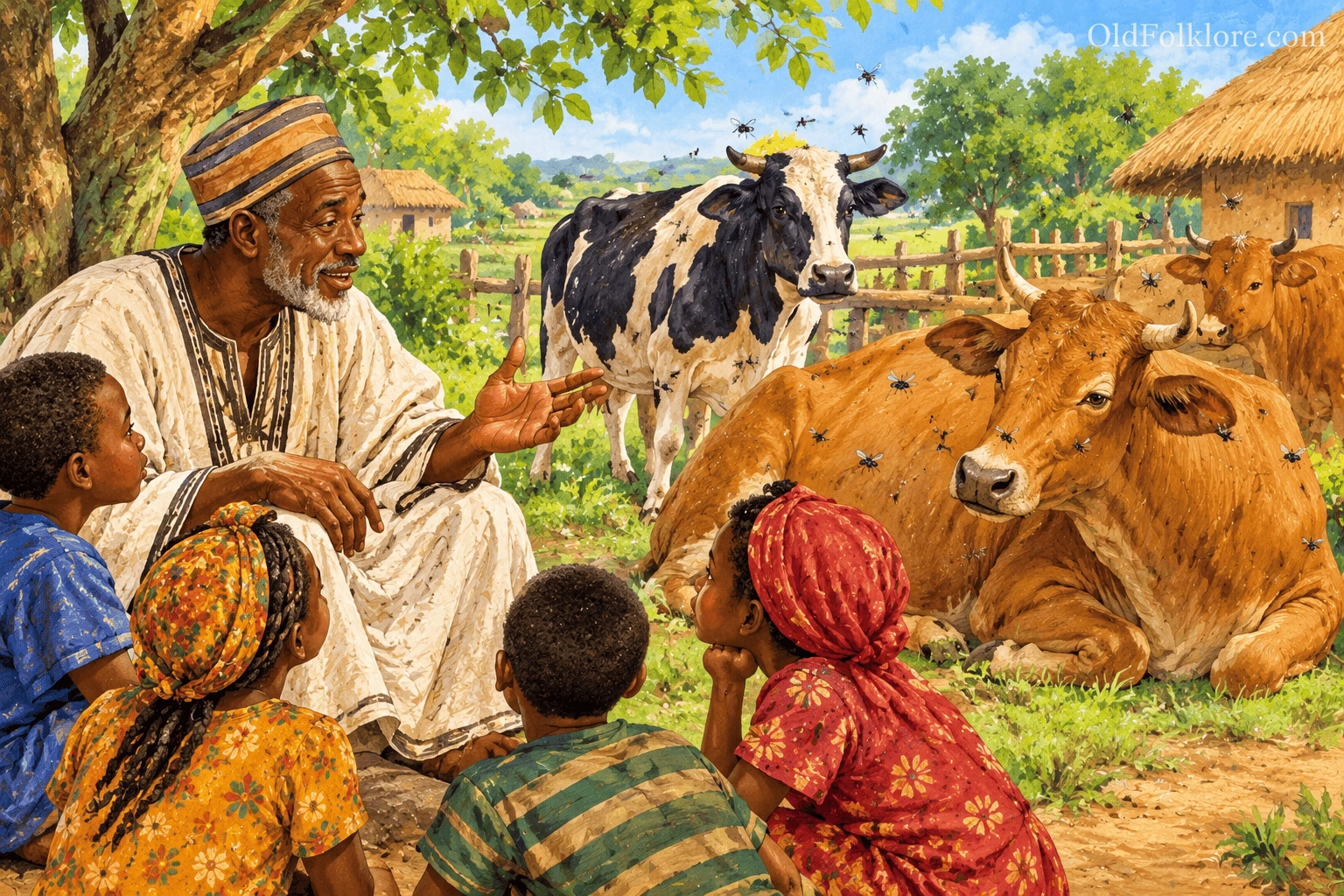
Long ago, when Queen Adiaha Umo ruled over Calabar, she was known for her great wealth and generosity. She enjoyed entertaining her subjects and frequently organised enormous feasts for the domestic animals. Her celebrations brought the animals together to share food and enjoy the queen’s hospitality.
There was, however, one group she never invited: the wild animals. The queen feared them and preferred to keep her gatherings among the creatures she considered safe.
At one particular feast, three large tables were prepared, and the animals gathered eagerly to enjoy the food. Queen Adiaha Umo appointed the cow to preside over the meal. Since the cow was the largest animal present, the queen considered her the most suitable creature to distribute the dishes among the guests.
Explore more stories from our West African Folk-Tales collection.
The cow gladly accepted the responsibility.
When the first course arrived, she began sharing the food among the assembled animals. She attended to the larger guests, making sure that everyone received a portion. But in the middle of distributing the meal, she overlooked one little visitor.
The fly had received nothing.
Being so small, the fly had been forgotten entirely. He waited for a while, hoping the cow would notice him, but when it became clear that she had no intention of sharing any food with him, he called out.
“Please, Cow, what about my share? You have given food to everyone else, but I have not received anything.”
The cow paid little attention to his complaint.
“Be quiet, my friend,” she replied. “You must have patience.”
The fly reluctantly waited, believing that his turn would come when the next course was served.
Soon another collection of dishes arrived. Once again, the cow distributed the food among the animals. The fly watched as the meal was passed around, but she still gave him nothing.
He called out a second time, reminding her that he had not yet received his portion.
Instead of offering him food, the cow pointed towards her eye.
“Look there,” she told him. “You will get food later.”
The fly took note of her strange response, but he was still left waiting.
As the feast continued, the dishes were emptied and the animals enjoyed their meal. Eventually, every course had been served, and the gathering came to an end. Yet the fly had not received even a morsel.
He had trusted the cow’s promise that food would come later, but later never arrived. With nothing to eat, the disappointed fly went to bed hungry.
The following day, he decided that he would not allow the matter to pass without complaint. He went straight to Queen Adiaha Umo and told her what had happened at the feast.
He explained how the cow, despite being entrusted with distributing the food, had repeatedly overlooked him. When he asked for his share, she had told him to be patient. When he asked again, she had pointed towards her eye and promised that he would find food there later.
The queen listened to his complaint and considered the matter.
The cow had been placed in charge of the feast because of her size and position among the animals. She had accepted the responsibility of sharing the food, yet she had failed to give every guest a portion. Worse still, she had directed the hungry fly towards her eye instead of feeding him when she had the opportunity.
Queen Adiaha Umo therefore made a decision.
From that day onwards, the fly would be permitted to obtain his food from the eyes of cows wherever they went. Since the cow had pointed towards her eye when the fly asked for his share, that would be where he would find his food.
And so, the queen’s order became the explanation for a curious sight that people continued to observe.
Even today, wherever cattle are found, flies can often be seen gathering around their eyes, feeding there in accordance with the queen’s judgment.
Explore our complete Historic Folklore & Fairy-Tale Collections archive.
Moral
Everyone deserves consideration, regardless of their size or importance. Those entrusted with responsibility should treat all those under their care fairly and should not overlook anyone simply because they appear insignificant.
Knowledge Check
1. Who was Adiaha Umo?
Queen Adiaha Umo was the ruler of Calabar in the traditional story.
2. Why did the cow receive responsibility for distributing the food?
She was the largest animal present at the feast.
3. Why did the fly complain to the queen?
The cow repeatedly failed to give him food, despite his requests.
4. What did the cow tell the fly when he asked for his share a second time?
She pointed towards her eye and told him to look there for food later.
5. What decision did the queen make?
She decreed that flies could obtain their food from the eyes of cows wherever they went.
Source
Elphinstone Dayrell, Folk Stories from Southern Nigeria, West Africa, with an introduction by Andrew Lang. London: Longmans, Green and Co., 1910.
Explore More West African Folk-Tales
- Thunder and Anansi: A West African Folktale
- Tom Tit Tot: The Girl Who Outwitted a Terrifying Imp by Guessing His Name
- Why the Sun and the Moon Live in the Sky: A Southern Nigerian Folktale
- Igiri and the Mushroom Baby: An Ikom Folktale
- The Envier and the Envied: A Powerful Arabian Nights Tale
- The Old Man and the River Spirit
- The Enchanted Date Palm of the Oasis