Long before Rhonabwy’s strange adventure, Madawc, the son of Maredudd, ruled the kingdom of Powys. His authority extended across a considerable territory, and he enjoyed the honour and power that came with his position. His brother, Iorwerth, however, lived in a very different condition. He was of lesser standing and deeply resented the difference between their circumstances.
Unable to accept his brother’s greater authority, Iorwerth gathered his companions and foster-brothers to discuss his situation. They advised that some of their number should seek a means of supporting him. Madawc himself offered to make Iorwerth the Master of his Household, providing him with horses, weapons, honour, and a position that would allow him to live almost as comfortably as his brother.
But Iorwerth refused.
Instead of accepting the offer, he invaded Loegria, killing inhabitants, burning houses, and carrying away prisoners. Madawc could not allow such disorder to continue. He consulted the men of Powys, and they agreed to send a hundred men into each of the kingdom’s three principal commotes to search for Iorwerth and bring an end to his raids.
Explore more stories from our The Mabinogion collection.
Among those sent on this mission was a man named Rhonabwy.
One day, Rhonabwy travelled with Kynwrig Vrychgoch of Mawddwy and Cadwgan Vras of Moelvre in Kynlleith. Their journey brought them to the home of Heilyn Goch, the son of Cadwgan, the son of Iddon.
The house was a miserable sight. Its old hall was blackened, with smoke rising from its upright gable. The floor was covered in mud, puddles, and cattle dirt, making it difficult to walk without sinking into the filth. Holly branches lay scattered across the ground, their leaves already eaten by the animals.
Inside, the visitors found dark, dusty rooms. An old woman sat beside the fire, feeding it with handfuls of chaff whenever she felt cold. Each addition sent thick smoke through the hall, making the air almost unbearable. On one side lay a yellow calf-skin, and anyone fortunate enough to secure a place upon it would enjoy the best resting spot in the house.
Rhonabwy and his companions asked where the other people of the household were, but the old woman merely muttered in response.
Before long, the inhabitants arrived. A red-faced, rough-looking man with curly hair carried firewood on his back, while a pale, slender woman brought another bundle beneath her arm. They offered their visitors little welcome, but the woman prepared a simple meal of barley bread, cheese, milk, and water.
Outside, the weather worsened. Wind and rain swept across the land, making it dangerous to continue travelling. Exhausted, the three men decided to spend the night in the hall.
Their sleeping arrangements were scarcely better than the rest of the house. Their bed consisted of coarse, dusty straw filled with vermin, with an old, torn blanket and a thin, badly stuffed pillow. The cattle had eaten much of the straw, leaving uncomfortable gaps in the bedding.
Rhonabwy’s companions eventually fell into a troubled sleep. He, however, could find no rest. Hoping to escape the vermin and discomfort, he moved to the yellow calf-skin on the floor.
There, at last, he fell asleep.
Rhonabwy Meets Iddawc Cor dd Prydain
As soon as sleep overcame him, Rhonabwy dreamed that he was travelling with his companions across the plain of Argyngroeg towards the ford of Rhyd y Groes on the River Severn.
Suddenly, a tremendous noise came from behind them. Turning around, they saw a young horseman approaching at an extraordinary speed.
The rider had curling yellow hair and a freshly trimmed beard. His chestnut horse had striking grey markings on its legs, while the rider wore yellow satin embroidered with green silk. A magnificent sword with a golden hilt hung at his side, and his horse’s equipment matched the splendid colours of his clothing.
The sight of him was so imposing that Rhonabwy and his companions became frightened and attempted to escape.
But the horseman pursued them. Whenever his horse breathed out, the distance between them seemed to increase. Whenever it drew in its breath, the travellers were pulled closer, until they found themselves almost against its chest.
Realising they could not escape, they begged the rider for mercy.
He granted it immediately.
Rhonabwy then asked the stranger who he was. The horseman introduced himself as Iddawc, the son of Mynyo, although he was better known by his nickname, Iddawc Cor dd Prydain.
Curious about the meaning of the name, Rhonabwy asked him to explain.
Iddawc revealed that he had once served as a messenger between King Arthur and Medrawd, Arthur’s nephew, during the conflict that led to the Battle of Camlan.
At the time, Iddawc had been young and reckless. Arthur had sent him to speak with Medrawd, reminding him that Arthur was both his uncle and foster-father. His mission was to encourage peace and prevent the deaths of the island’s kings, nobles, and warriors.
Arthur had carefully chosen words of reconciliation for the message.
Iddawc, however, delivered the opposite. Driven by his love of conflict, he deliberately used harsh language and stirred up anger between the two men. His actions helped turn an opportunity for peace into a cause of war.
That was why he had received the nickname Cor dd Prydain, meaning the cause of discord in Britain.
Three nights before the end of the Battle of Camlan, he had abandoned the fighting and travelled to Llech Las in North Britain to perform penance. He remained there for seven years before finally receiving forgiveness.
Rhonabwy now understood that the stranger accompanying them was a man whose reckless words had helped bring disaster upon Arthur’s kingdom.
King Arthur and the Warriors of Britain
As they continued towards the Severn, another horseman approached. He was a handsome, red-faced youth dressed in red satin embroidered with yellow silk. His horse was equally magnificent, and his appearance seemed to glow with the colours of fire and blood.
The rider asked Iddawc to allow him to accompany the little group. Iddawc agreed, and Rhonabwy learned that the stranger was Rhuvawn Pebyr, the son of Prince Deorthach.
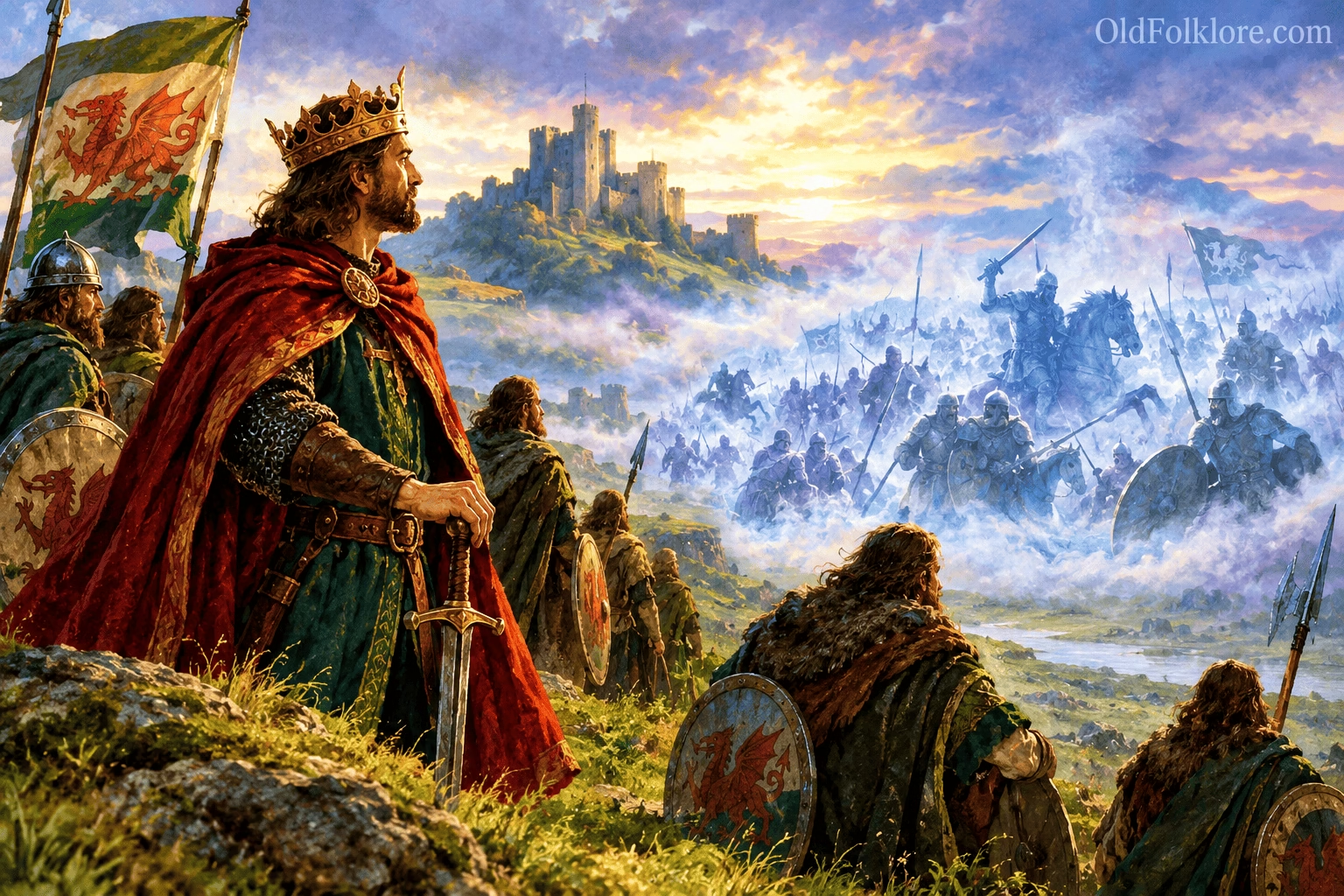
Eventually, they reached the ford of Rhyd y Groes. The surrounding countryside was filled with tents, soldiers, horses, and the noise of a tremendous army. It was there that Rhonabwy saw King Arthur.
The great king sat upon a small island below the ford, accompanied by Bedwini the Bishop and Gwarthegyd, the son of Kaw. Before him stood a tall, handsome young warrior dressed in black satin, holding a sheathed sword.
When Iddawc and his companions approached, Arthur welcomed them. He asked Iddawc where he had found such small-looking men.
Arthur’s response was curious. He explained that he was saddened to think that men of their stature now guarded the island, considering the mighty warriors who had defended it in earlier times.
Iddawc then drew Rhonabwy’s attention to a ring on Arthur’s hand. A precious stone was set into it, and the stone possessed a remarkable power. Anyone who saw it would be able to remember everything witnessed during the dream. Without it, Rhonabwy would never have retained the memory of the extraordinary events unfolding before him.
As they watched the great army gather, Rhonabwy noticed several remarkable groups of warriors.
First came the companions of Rhuvawn Pebyr. Their horses and riders were entirely red, and their leader was so magnificent that he resembled a pillar of fire moving across the sky. They were men of exceptional courage, always willing to stand at the front or rear of the army when danger threatened. Their bravery had earned them generous hospitality and the affection of the daughters of Britain’s kings.
Another company arrived with horses and riders marked in contrasting black and white. One of their knights charged recklessly through the ford, sending water splashing over Arthur, the bishop, and the counsellors gathered around them.
The young warrior standing before Arthur immediately struck the horse across its nostrils with his sheathed sword.
The knight demanded to know whether the blow was an insult or an attempt to advise him. The young warrior explained that he had behaved foolishly by riding so carelessly and soaking the king and a consecrated bishop.
The knight accepted the correction as good advice and returned to his company.
Rhonabwy asked Iddawc who the two men were. The knight who had accepted the rebuke was Adaon, the son of Taliesin, renowned for his wisdom and eloquence. The young man who had struck the horse was Elphin, the son of Gwyddno, whose nature was rather troublesome.
Another distinguished warrior then addressed Arthur. He remarked that it was astonishing to see such a vast army assembled in one narrow place, especially when the men had promised to reach the Battle of Badon by midday to fight Osla Gyllellvawr.
Arthur agreed that they should move forward together.
The speaker was Caradawc Vreichvras, Arthur’s cousin and chief counsellor, a man whose position allowed him to speak freely before the king.
Iddawc took Rhonabwy behind him on his horse, and the great army began its journey towards Cevndigoll. As they crossed the Severn, Rhonabwy looked along the valley and noticed two more impressive companies approaching.
One wore brilliant white clothing with black borders. Their horses were white, except for black markings on their knees and shoulders, and their banners were white with black points. Iddawc identified them as the men of Norway, led by March, the son of Meirchion, who was related to Arthur.
The other company wore black garments bordered in white. Their horses had white markings on their shoulders and knees, and their banners were black with white points. These were the men of Denmark, led by Edeyrn, the son of Nudd.
Rhonabwy was surrounded by a spectacle of warriors from different lands, each company distinguished by its own colours, banners, horses, and leaders.
When the army reached the area below Caer Badou, another commotion began. Men moved from the front to the rear, while those in the middle shifted towards the sides.
Rhonabwy wondered whether the army was preparing to flee.
Iddawc immediately corrected him. King Arthur, he explained, never fled. The confusion was caused by Kai, one of the finest horsemen in Arthur’s court. His riding was so magnificent, and his horse so powerful, that warriors rushed towards the rear to watch him pass while others moved aside to avoid the force of his horse.
Soon afterwards, Kadwr, the Earl of Cornwall, was summoned. He appeared carrying Arthur’s sword, a magnificent weapon decorated with two golden serpents. When the sword was drawn, it seemed as though flames burst from the serpents’ mouths. Its brilliance was so extraordinary that few could look directly at it.
The appearance of the sword brought the army to silence.
Kadwr was responsible for arming Arthur whenever the king prepared for battle.
Next came Eirynwych Amheibyn, Arthur’s servant, riding a tall red horse. He carried a large travelling pack containing a golden chair and a beautiful satin carpet. The carpet, called Gwenn, possessed a remarkable property: anyone seated upon it could see everyone else without being seen. It also retained its own colour regardless of its surroundings.
Eirynwych spread the carpet before Arthur and placed the enormous golden chair upon it. Arthur settled into the chair, and Owain, the son of Urien, stood before him.
Then Arthur proposed a game of chess.
Owain accepted, and the servant brought out a silver chessboard with golden pieces. The two men began to play while the enormous army remained assembled around them.
Owain’s Ravens and the Battle Against Arthur’s Men
While Arthur and Owain were occupied with their chess game, a remarkable disturbance began elsewhere in the camp.
A young messenger emerged from a white tent decorated with a red canopy. A black serpent with glaring red eyes and a fiery tongue was displayed upon its roof.
The messenger was dressed in yellow satin and carried an impressive three-edged sword. He approached Owain and explained that the emperor’s young attendants were tormenting and harassing Owain’s ravens.
Owain was surprised that the messenger addressed him rather than Arthur. But Arthur explained that the young man had already spoken to him and had come to deliver a message specifically for Owain.
Owain asked Arthur to order his attendants to leave the ravens alone.
Arthur simply told him to continue playing chess.
The messenger returned to his tent.
A second young man soon appeared from a bright yellow tent decorated with the image of a red lion. He was dressed in fine yellow clothing and carried another enormous sword.
He approached the chess players and repeated the complaint. The emperor’s attendants were still troubling Owain’s ravens, killing some and injuring others.
Once again, Owain appealed to Arthur.
Once again, Arthur told him to continue the game.
The disturbance grew worse.
A third messenger emerged from an enormous yellow tent decorated with a golden eagle. He carried a powerful spear with a banner attached to it and was visibly furious.
He informed Owain that most of his ravens had been killed. Those that remained alive were so badly wounded that they could barely lift their wings.
Owain again asked Arthur to intervene, but the king remained absorbed in the chess game.
This time, however, Owain gave the messenger a different instruction.
He told him to return to the place where the fighting was fiercest, raise his banner, and leave the outcome to Heaven.
The messenger obeyed.
As soon as the banner was raised, the ravens rose into the air. They shook off their exhaustion, spread their wings, and gathered their strength. Filled with renewed fury, they descended upon the men who had attacked them.
They seized warriors by their heads, eyes, ears, and arms, carrying some high into the air. Their cries and the beating of their wings filled the sky, while the soldiers screamed beneath them. Several men were torn apart or killed.
Yet Arthur and Owain continued playing chess.
Before long, a knight approached them on a remarkable dun-coloured horse. His armour was magnificent, his helmet was decorated with a fearsome leopard, and his spear was stained with the blood and feathers of Owain’s ravens.
The knight reported that the ravens were slaughtering the emperor’s attendants and young warriors.
Arthur turned to Owain and ordered him to restrain the birds.
Owain answered that the king should continue his game.
The knight returned to the battlefield, and the ravens continued their attack.
The violence became even more terrible. More messengers arrived, each describing the destruction taking place among Arthur’s followers.
One knight, riding a light grey horse and wearing heavy blue armour, warned Arthur that his young men, pages, and the sons of Britain’s nobles were being killed. He reminded the king that the island would be left vulnerable if so many of its defenders were lost.
Arthur again asked Owain to call off the ravens.
Owain refused to interrupt the game.
Another knight arrived on a magnificent piebald horse. His armour was richly decorated, and his helmet carried the figure of a griffin. He reported that the ravens had destroyed his household and killed the sons of leading men throughout the island.
This time, Arthur personally begged Owain to stop the birds.
Owain still did not give the order.
Arthur’s patience finally broke. He seized the golden chess pieces from the board and crushed them until they were nothing but dust.
Seeing that the game had ended, Owain instructed Gwres, the son of Rheged, to lower the banner.
The banner came down, and immediately the ravens stopped fighting. Peace returned to the battlefield.
Rhonabwy was astonished by everything he had witnessed. He asked Iddawc about the men who had first approached Owain with news of the ravens’ suffering.
Iddawc identified them as Selyv, the son of Kynan Garwyn of Powys; Gwgawn Gleddyvrudd; and Gwres, the son of Rheged, who carried the battle standard.
He also identified the last three messengers who had appealed to Arthur. They were Blathaon, the son of Mawrheth; Rhuvawn Pebyr, the son of Prince Deorthach; and Hyveidd Unllenn. These were among the bravest men in the army, deeply concerned about the king and the welfare of his followers.
Arthur’s Council and the Dream’s Ending
While the army was still gathered, twenty-four knights arrived from Osla Gyllellvawr. They requested a truce lasting a fortnight and a month.
Arthur rose to consider their request and summoned his counsellors.
Among those gathered were Bedwini the Bishop, Gwarthegyd, March of Norway, Caradawc Vreichvras, Gwalchmai, Edeyrn of Denmark, Rhuvawn Pebyr, Rhiogan of Ireland, Howel of Llydaw, Kadwr of Cornwall, Adaon the son of Taliesin, and many other distinguished warriors and leaders from Britain and beyond.
Rhonabwy noticed a tall, auburn-haired man who appeared to have a particularly important position in the gathering. Iddawc explained that he was Rhun, the son of Maelgwn Gwynedd, whose privilege allowed him to participate in every council.
Rhonabwy also wondered why a young man named Kadyriaith, the son of Saidi, had been admitted among such experienced counsellors.
Iddawc explained that age was no barrier to wisdom. Kadyriaith was considered the most skilled counsellor in all Britain.
Soon, bards arrived and recited verses in Arthur’s honour. Their poetry was so difficult to understand that only Kadyriaith could comprehend its meaning.
Afterwards, twenty-four donkeys arrived carrying burdens of gold and silver. Each was accompanied by a weary traveller bringing tribute to Arthur from the Islands of Greece.
Kadyriaith proposed a generous arrangement. He suggested that Arthur grant Osla Gyllellvawr the requested truce and that the gold and silver brought by the travellers be given to the bards as payment for their poetry and service during the period of peace.
The proposal was accepted.
Iddawc then asked Rhonabwy whether it would be right to exclude a young man capable of offering such excellent counsel from his lord’s council.
But before the gathering could settle, Kai stood up and made a declaration.
Anyone who wished to follow Arthur should join him that very night in Cornwall. Anyone who refused would be treated as an opponent, even though a truce had been requested.
The announcement caused such an enormous commotion that Rhonabwy suddenly awoke.
He found himself lying on the yellow calf-skin in Heilyn Goch’s miserable hall. To his astonishment, he had slept for three whole days and three nights.
The strange adventure had been a dream, but its details remained in his memory.
The tale explains that the dream could not be remembered by a bard or gifted seer without the aid of a book. The extraordinary number of colours displayed on the horses, weapons, armour, banners, garments, and precious stones made the vision impossible to retain through memory alone.
And so ends the extraordinary adventure known as The Dream of Rhonabwy.
Explore our complete Historic Folklore & Fairy-Tale Collections archive.
Moral
Reckless pride, provocative words, and neglected responsibilities can turn disagreements into destructive conflicts. True leadership requires wisdom, restraint, and attention to the welfare of others. The story also reminds us that good judgement is not determined by age or status.
Knowledge Check
1. Why did Iorwerth rebel against his brother Madawc?
He resented the greater honour, authority, and power enjoyed by Madawc. Although his brother offered him an important position and generous privileges, Iorwerth refused.
2. Who was Iddawc Cor dd Prydain?
He was a former messenger between Arthur and Medrawd. His deliberately provocative words helped turn an attempt at reconciliation into a cause of conflict.
3. What was special about Arthur’s ring?
Its precious stone enabled Rhonabwy to remember the extraordinary events he witnessed in his dream.
4. Why did Arthur and Owain play chess while the ravens fought?
They became absorbed in their game and repeatedly ignored the messengers reporting the ravens’ suffering and the deaths of Arthur’s men.
5. How did the fighting between the ravens and Arthur’s men end?
Arthur crushed the golden chess pieces, and Owain ordered Gwres to lower the banner. The ravens stopped attacking, and peace returned.
6. How long did Rhonabwy sleep?
He slept for three days and three nights on the yellow calf-skin.
7. Which literary tradition does the story belong to?
It belongs to medieval Welsh literature and forms part of the Arthurian narratives preserved in The Mabinogion.
Source
The Mabinogion from the Llyfr Coch o Hergest, and Other Ancient Welsh Manuscripts, with an English Translation and Notes.