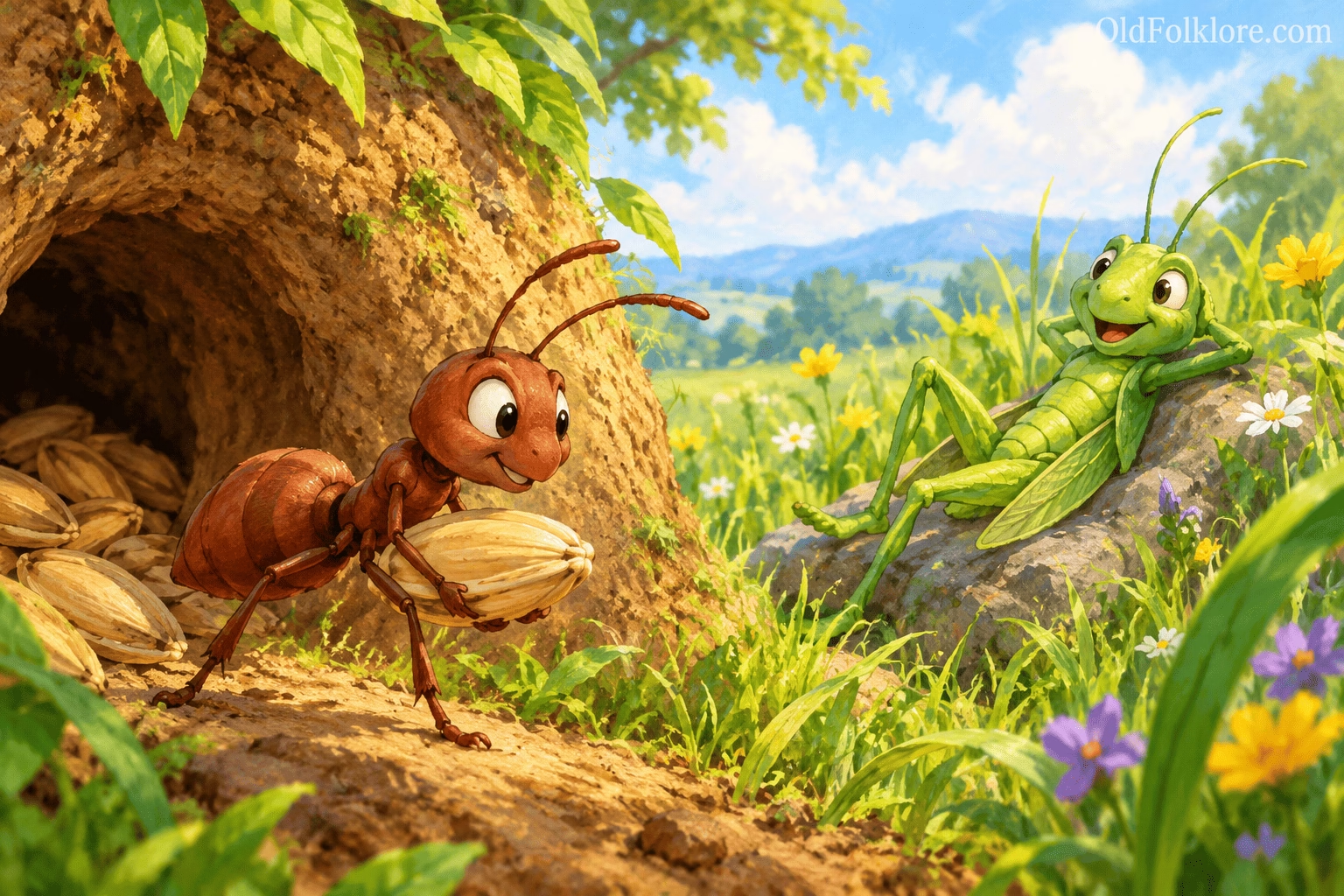
One warm summer’s day, a grasshopper hopped happily through a field, singing and chirping beneath the bright sunshine. There was plenty of food around, the weather was pleasant, and he had no particular worries. He spent his days enjoying himself, with no thought of what might happen when the seasons changed.
As he wandered through the grass, he noticed an ant struggling along beneath a heavy ear of corn. The little creature was making a determined journey towards its nest, carrying the food with considerable effort.
The grasshopper watched with amusement.
“Why spend such a beautiful day working so hard?” he called. “Come and sit with me. We can talk, sing and enjoy the sunshine instead of wearing ourselves out.”
Explore more stories from our Aesop’s Fables collection.
The ant paused briefly but did not put down its load.
“I am gathering food for the winter,” it explained. “There will not be much to eat when the cold weather comes. You would be wise to make preparations while food is still plentiful.”
The grasshopper laughed at the suggestion.
“Winter is a long way off! Why worry about tomorrow when there is more than enough food today? There is plenty of time to think about such things later.”
The ant made no further argument. It continued towards the nest, determined to complete its work before the summer ended.
Throughout the remaining warm months, the ant and its companions continued gathering corn and grain. They carried their provisions into the nest and carefully stored them for the difficult days ahead.
The grasshopper, meanwhile, carried on as before. He sang, hopped through the field and enjoyed the abundance of summer. Whenever he saw the ants working, he wondered why they spent so much time preparing for a season that had not yet arrived.
But summer eventually came to an end. The days grew colder, the fields lost their abundance, and winter settled over the land.
Now the grasshopper had a serious problem. The food he had taken for granted was no longer available, and he had nothing stored away. Hungry and exhausted, he struggled to find something to eat.
As he wandered in search of food, he saw the ants bringing out the corn and grain they had collected during the summer. Their storehouses had provided them with enough provisions to survive the cold season.
The grasshopper finally understood the wisdom of the ant’s earlier advice. What had seemed like unnecessary labour during the summer had become the very thing that protected the ants from hunger in winter.
He had enjoyed the present without considering the future, and now he was suffering the consequences.
The lesson was clear: It is best to prepare for the days of necessity while there is still an opportunity to do so.
Explore our complete Historic Folklore & Fairy-Tale Collections archive.
Moral
It is best to prepare for the days of necessity.
Do not allow present comfort to make you forget future responsibilities. Wise preparation during favourable times can protect you when circumstances become difficult.
Knowledge Check
1. What was the grasshopper doing during the summer?
He was singing, chirping and enjoying himself instead of gathering food.
2. Why was the ant carrying an ear of corn?
It was collecting food to store for the winter.
3. What advice did the ant give the grasshopper?
The ant advised him to gather food while it was still available.
4. What happened when winter arrived?
The grasshopper had no food and suffered from hunger, while the ants survived on the provisions they had stored.
5. What is the main lesson of the fable?
People should prepare for future difficulties rather than assume that present favourable circumstances will last forever.
Source
This article is an original literary adaptation of “The Ant and the Grasshopper”, based on Joseph Jacobs’s 1894 version of the Aesopic fable.
Explore More Aesop’s Fables
- The Dog and the Shadow: An Aesop Fable
- The Greedy Hare and the Tortoise’s Broken Shell
- Anansi and Nothing: The Trickster Who Lost Everything
- Tom Tit Tot: The Girl Who Outwitted a Terrifying Imp by Guessing His Name
- Why the Sun and the Moon Live in the Sky: A Southern Nigerian Folktale
- The Dog and the Shadow: An Aesop Fable