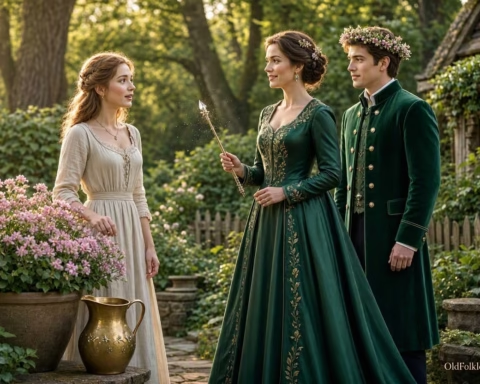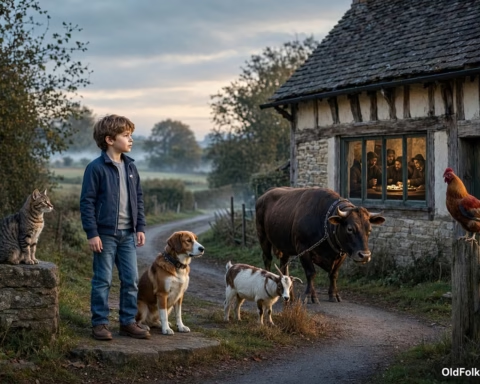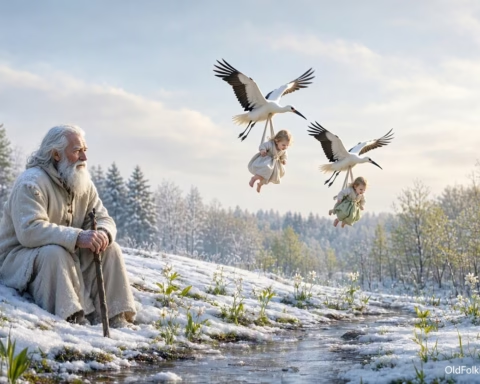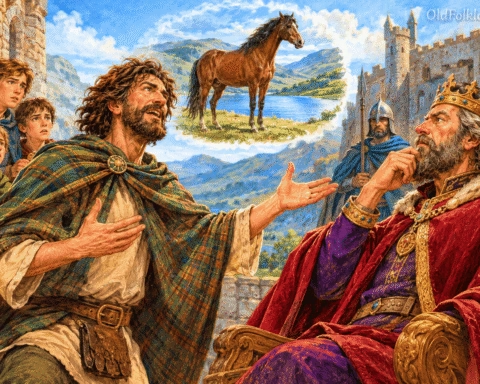
Two brothers could hardly be more different. True is generous, patient and honest, while Untrue is selfish, deceitful and quick to take advantage of others. When their widowed mother can no longer provide for them, the brothers leave home to seek their fortunes. Their journey soon reveals the difference between their characters.
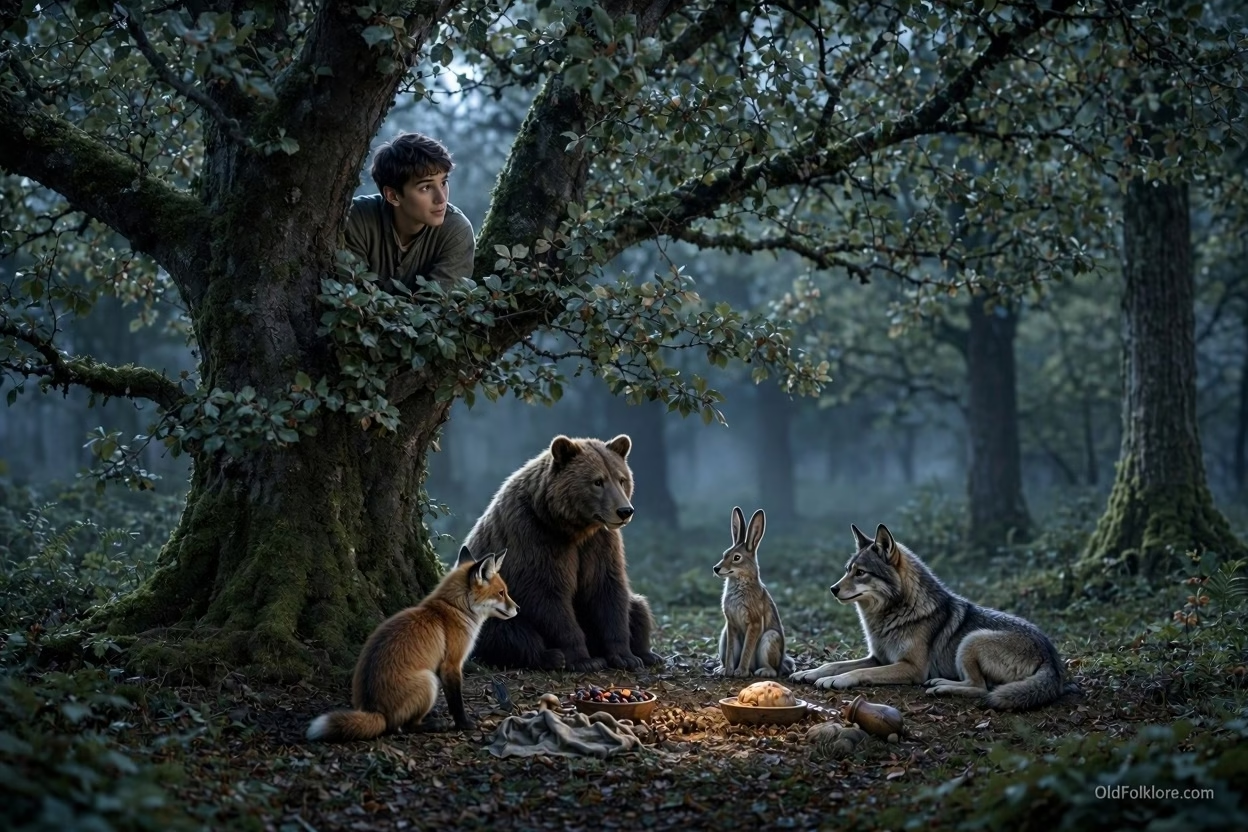
After Untrue betrays his brother and leaves him helpless in a forest, True finds shelter in an unexpected place. There, he overhears a conversation between four animals whose knowledge holds the answers to several problems troubling the king of England. True uses what he learns to rebuild his life, while Untrue later attempts to benefit from the same opportunity. Their contrasting experiences reveal the consequences of kindness, greed and dishonesty.
The Story of True and Untrue
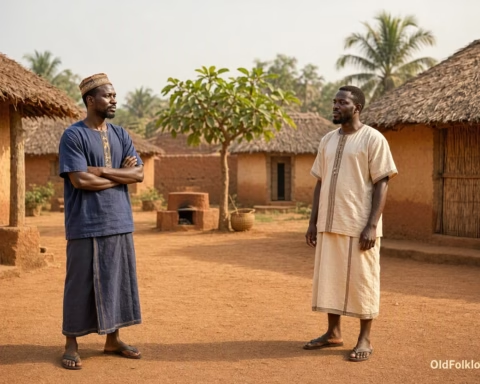
Once upon a time, there were two brothers named True and Untrue. True was a good and upright young man who treated others fairly. He was honest in his dealings and did not enjoy deceiving people. His brother, however, was very different. Untrue was dishonest, selfish and full of lies. People who knew him could not trust his words because he rarely spoke the truth.
The brothers lived with their mother, who was a widow. She had little money and struggled to provide for them. As her sons grew older, she realised that she could no longer support them both. She therefore decided that they should leave home and find work wherever they could.
Before they departed, she gave each son a small bag containing food for the journey. The brothers thanked her and set out together, hoping to find a way to earn their living.
They walked for a long time through the countryside. By evening, they were hungry and tired, so they sat down on a fallen tree in the forest to eat.
Untrue looked at the two bags and suggested that they should begin by eating from True’s supply. He proposed that they should continue sharing his brother’s food until it was finished, and only then turn to his own.
True saw no reason to refuse. He believed that brothers should help each other, particularly when they were travelling together. He agreed, and they opened his bag.
Untrue, however, did not share fairly. He took the best pieces of food for himself and ate greedily, leaving True with burnt crusts and scraps. True did not complain. He accepted what remained because he trusted his brother and believed they would share the next meal more equally.
The following morning, they again ate from True’s bag. They continued doing so until every last piece of food was gone. By then, Untrue had enjoyed most of the better portions, while True had received very little.
Later that day, they continued their journey. When evening came, they stopped again because they were hungry. True suggested that they should now open Untrue’s bag and share the food inside.
Untrue refused.
He claimed that the food belonged to him and that he had only enough for himself. True reminded him that they had agreed to share and that Untrue had eaten from his bag until nothing remained.
Explore more stories from our Asbjørnsen & Moe’s Norwegian Folk Tales collection.
Untrue dismissed the complaint. He argued that True had been foolish to allow someone else to eat his food and that he should now accept the consequences. He told his brother that he could sit there and starve if he had nothing left.
True was hurt and angry. He realised that his brother had deliberately taken advantage of his kindness.
“You are Untrue by name and untrue by nature,” he told him. “You have always been so, and you will remain so all your life.”
Untrue could not bear to hear the truth about his behaviour. In a sudden fit of anger, he attacked his brother and plucked out both his eyes.
He mocked True for accusing him of dishonesty, saying that a blind man would no longer be able to see whether people were truthful. Then he abandoned him in the forest and ran away.
Poor True was left alone, blind and helpless. He could not see the path ahead or know which direction to follow. He moved slowly through the trees, feeling his way with his hands and trying not to stumble.
As night approached, he feared that wild animals might attack him if he remained on the forest floor. While searching for somewhere safe, he came upon a large lime-tree with thick branches. He managed to climb into it and settled among the leaves.
He decided to remain there until morning. He reasoned that when the birds began singing, he would know that daylight had arrived and could try to continue his journey.
True had not been sitting in the tree for very long when he heard movement below. Someone was approaching, and soon several creatures gathered beneath the branches.
He listened as they greeted one another and recognised their voices. They were Bruin the bear, Greylegs the wolf, Slyboots the fox and Longears the hare.
The animals had come together to celebrate St John’s Eve beneath the lime-tree. They began eating and drinking, enjoying their gathering in the darkness.
When they had finished their meal, they settled down to talk. The fox suggested that each animal should tell a story to entertain the others. The company agreed, and the bear began.
Bruin explained that the king of England suffered from very poor eyesight. The king could scarcely see anything at a distance, but there was a simple remedy. If he came to the lime-tree early in the morning, while the dew still covered its leaves, and rubbed the dew into his eyes, his sight would become clear again.
The wolf followed with another piece of information. He said that the king’s daughter was deaf and dumb. Her condition had begun after she attended communion. A small piece of the bread had fallen from her mouth, and a large toad had swallowed it.
The toad was still hidden beneath the altar rails in the church, with the bread lodged in its throat. If someone dug up the floor, found the toad, cut it open and gave the bread to the princess, she would recover her speech and hearing.
The fox then spoke about the king’s palace. He explained that the king had poor drinking water, even though he had arranged for water to be brought from a great distance. Yet a spring of clear water lay beneath a large stone in the palace yard. If the stone were removed and the ground dug up, the king would find an excellent supply of fresh water.
Finally, the hare spoke about the royal orchard. It was a beautiful garden, but its trees produced no fruit. The reason was that a heavy gold chain lay buried in three turns around the orchard. If the king had the chain dug up, the trees would bear fruit abundantly.
The animals finished their stories and soon departed together.
True had listened carefully to everything they said. Although he was blind, he understood that the animals had revealed information that could change his life. He had no reason to remain in the forest if he could reach the king and prove that their discoveries were true.
As soon as daylight came, he climbed down from the tree and began making his way towards the king’s palace. He travelled slowly, feeling his way along the road until he eventually arrived.
At the palace, he asked for work. The king was willing to employ him, and True soon found himself in a position where he could demonstrate his knowledge.
One hot day, the king went into the palace yard because he wanted a drink. When his servants brought him water from the pump, he found it muddy and unpleasant. He complained that no one in his kingdom should have to drink such foul water, especially when he spent so much money bringing it from distant places.
True heard the complaint and offered a solution. He told the king that if he allowed some men to remove the large stone in the middle of the yard and dig beneath it, they would find clear water.
The king agreed. Workers gathered around the stone and began to remove it. Once they had dug into the ground beneath, a strong stream of clear water burst upwards. The king was delighted. He had discovered an excellent source of water within his own palace yard.
Some time later, the king was outside again when a hawk flew after one of his chickens. The king tried to shoot the bird, but his eyesight was so poor that he could not see it clearly. He became distressed because he feared that he might soon lose his sight completely.
True told him that he knew of a remedy. He explained what the bear had said about the dew on the leaves of the lime-tree.
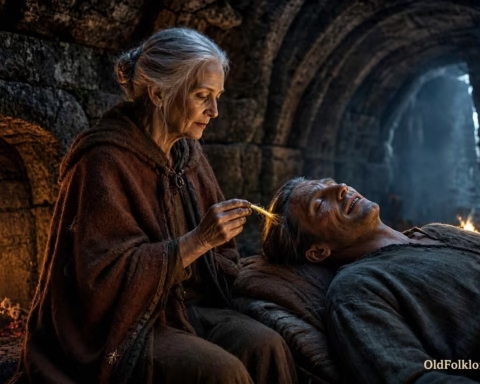
The king travelled to the tree early the next morning and rubbed the dew into his eyes. The remedy worked, and his sight became clear again. He was overjoyed and became deeply attached to True, who had helped him solve two serious problems.
The king now wanted True to remain close to him. He took him along wherever he went, both inside and outside the palace.
One day, they walked together through the royal orchard. The king looked at the trees and complained that, despite spending so much money on the garden, he could not make even one tree produce fruit.
True told him that he could solve the problem. He explained that a heavy gold chain lay buried in three turns around the orchard. If the king allowed him to have whatever was found and provided men to dig it up, the trees would begin to bear fruit.
The king agreed immediately.
True organised the workers and directed them as they dug through the orchard. Eventually, they uncovered the great gold chain. True received it and became a very wealthy man. The king was also pleased because the trees soon produced abundant fruit. Their branches bent under the weight of sweet apples and pears, and the orchard became more fruitful than any other in the kingdom.
There was still one problem troubling the king. His daughter remained unable to speak or hear, and he was saddened whenever he saw her.
One day, as the king and True were walking together, the princess passed them. The king looked at her with sorrow and wished that she could speak and hear like other people.
True told him that he knew how to cure her.
The king was filled with hope. He promised True that, if he could restore his daughter’s health, he would give him the princess in marriage and half his kingdom.
True gathered a few men and went to the church. They dug up the floor beneath the altar rails, exactly where the wolf had said the toad was hiding.
There, they found the creature with the piece of communion bread still lodged in its throat. True carefully removed the bread and took it to the princess.
When she received it, her condition changed. She regained her speech and hearing and was able to communicate like other people again.
The king was overjoyed. He had feared that his daughter would never recover, but True had found the remedy. He honoured his promise and prepared for the marriage.
The wedding celebration was magnificent. People from across the kingdom heard about the occasion, and the palace was filled with guests, music, dancing and food. True, who had once been abandoned blind in a forest, was now a wealthy and respected man. He was to marry the king’s daughter and receive half the kingdom.
During the celebration, a poorly dressed beggar arrived at the palace and asked for something to eat. His clothes were ragged, and he looked miserable. Many of the guests crossed themselves when they saw him.
True, however, recognised him immediately.
The beggar was Untrue, the brother who had betrayed him and left him blind in the forest.
True approached him and asked whether he recognised him. Untrue looked at the wealthy man and insisted that he could never have met someone so important.
True reminded him of the day he had plucked out his eyes and abandoned him in the forest. He repeated the words he had spoken then: Untrue was dishonest by name and dishonest by nature.
Yet True did not refuse to help him. He explained that, despite everything Untrue had done, he was still his brother. He gave him food and told him that he could go to the lime-tree where True had once found shelter. Perhaps, he suggested, Untrue might hear something there that would improve his situation.
Untrue was eager to try. He reasoned that if his brother had become so wealthy after spending a night in the tree, he might gain even more by following the same path.
He hurried into the forest and climbed into the lime-tree.
Before long, the four animals arrived again to celebrate St John’s Eve. They ate, drank and enjoyed themselves beneath the branches. When the meal was over, the fox suggested that they should tell stories, as they had done the previous year.
But the bear was suspicious. He remembered that someone had repeated their secrets to the king and warned the others that they should remain silent.
The animals refused to reveal anything further. They wished one another good night and departed.
Untrue had listened eagerly, but he learned nothing. He remained in the tree as ignorant as before.
The same opportunity that had changed his brother’s life had brought him no benefit. His dishonesty had destroyed the trust that might have allowed him to profit from what the animals knew.
And so the tale ends with True enjoying his good fortune, while Untrue is left without the knowledge he had hoped to steal.
Explore our complete Historic Folklore & Fairy-Tale Collections archive.
Moral Lesson
The story teaches that honesty, kindness and generosity can bring lasting rewards, while selfishness and deceit can destroy relationships and opportunities. True treats his brother fairly even when Untrue takes advantage of him. Later, when he becomes wealthy, he still offers his brother food rather than seeking revenge.
Untrue, by contrast, allows greed and anger to guide his actions. He betrays the person who trusts him and later tries to benefit from the same opportunity without earning anyone’s confidence. His failure shows that dishonesty may bring temporary advantages, but it cannot build the trust needed for lasting success.
Knowledge Check
1. Why did True and Untrue leave their mother’s home?
Their widowed mother was too poor to support them, so she sent them away to earn their living.
2. How did Untrue betray his brother during their journey?
He ate most of True’s food, refused to share his own when True’s supply ran out, and then blinded him before abandoning him in the forest.
3. Which four animals gathered beneath the lime-tree on St John’s Eve?
Bruin the bear, Greylegs the wolf, Slyboots the fox and Longears the hare.
4. What remedies did the animals reveal for the king’s problems?
The bear described dew that could restore eyesight; the wolf explained how to cure the princess’s deafness and inability to speak; the fox revealed a hidden spring beneath a stone; and the hare identified a buried gold chain preventing the orchard from bearing fruit.
5. How did True gain wealth and the king’s favour?
He used the animals’ information to provide clear water, restore the king’s eyesight, make the orchard fruitful and cure the princess. The king rewarded him with marriage to his daughter and half the kingdom.
6. Why did Untrue fail when he returned to the lime-tree?
The animals realised that someone had revealed their secrets, so they refused to tell their stories again. Untrue’s earlier dishonesty had also destroyed the trust that might have helped him.
Source
Peter Christen Asbjørnsen and Jørgen Engebretsen Moe, “True and Untrue,” in Popular Tales from the Norse, translated by Sir George Webbe Dasent. The tale appears as the first story in the collection, under the heading “I. True and Untrue”.
Explore More Asbjørnsen & Moe’s Norwegian Folk Tales