In The Story of the Year, Hans Christian Andersen presents the changing seasons as a succession of characters who rule the natural world. Through the eyes of sparrows, readers witness the arrival of Spring, the abundance of Summer, the golden beauty of Autumn and the return of Winter. Each season has its own character, appearance and purpose.
The tale begins during a bitter January snowfall, when the sparrows question why people celebrate the beginning of a new year while the weather grows colder. Their observations lead them to discover that the natural world follows a rhythm different from the dates printed in human calendars. As the seasons pass, Andersen explores renewal, ageing, change and the importance of accepting the natural course of life.
The Story of the Year
It was January, and a terrible snowstorm had covered the town. Snow swept through the streets and narrow lanes, clinging to the windows and falling in heavy masses from the rooftops. People hurried through the streets, struggling against the wind and trying to find shelter. Carriages and horses moved slowly through the deep snow, while foot passengers stayed close to the vehicles for protection.
When the storm finally weakened, people cleared a narrow path beside the houses. Whenever two strangers met, neither wished to step aside first and sink into the deep snow. They stood facing each other until, almost by silent agreement, one person moved aside and allowed the other to pass.
Towards evening, the storm ended. The sky became clear, and the stars shone brightly above the town. The frost was so severe that the snow creaked beneath anyone who walked upon it. The upper layer had hardened, and the ground looked as though it would remain frozen for a long time.
A few sparrows hopped along the cleared paths, searching for food. They found very little and shivered in the bitter cold.
One sparrow complained to another that people called this the beginning of a new year, yet the weather was worse than before. It wondered why anyone celebrated the departure of the old year when the new one had brought even colder days.
Another sparrow remembered the celebrations. People had fired guns, beaten pots and pans against doors and made a great noise to welcome the new year. The bird had also expected warmer weather, but instead the frost had become more severe. It concluded that people must have made a mistake when they calculated the beginning of the year.
An older sparrow, whose head was already white, explained that people followed something called a calendar. They had invented it themselves and arranged their lives according to its dates. But the old bird did not believe that the calendar understood nature. To it, the year truly began when Spring arrived.
Explore more stories from our Hans Christian Andersen Tales collection
The younger sparrows asked when that would happen.
The older bird answered that Spring would come when the stork returned. The storks had travelled away, and their return would bring a sign that the cold season was nearing its end. Since the countryside offered a better chance of seeing the returning birds, some sparrows decided to leave the town and wait there.
Not all of them agreed. One sparrow had built a comfortable home with its mate in a flowerpot fixed against the wall of a courtyard. The people who lived there had arranged the pots so that birds could enter through small openings. They also scattered bread crumbs for the sparrows.
The bird admitted that it was dissatisfied with the cold, but it did not want to abandon the shelter and food it had found. It decided to remain in town with its family.
The others flew towards the countryside.
There, the weather was even colder. Sharp winds swept across the snow-covered fields, and a farmer travelled through the frozen landscape in his sledge. His horses ran through the snow while he beat his arms against his chest to keep warm.
The sparrows hopped about in the tracks left by the sledge. They continued asking when Spring would arrive, but the hills and fields offered no answer.
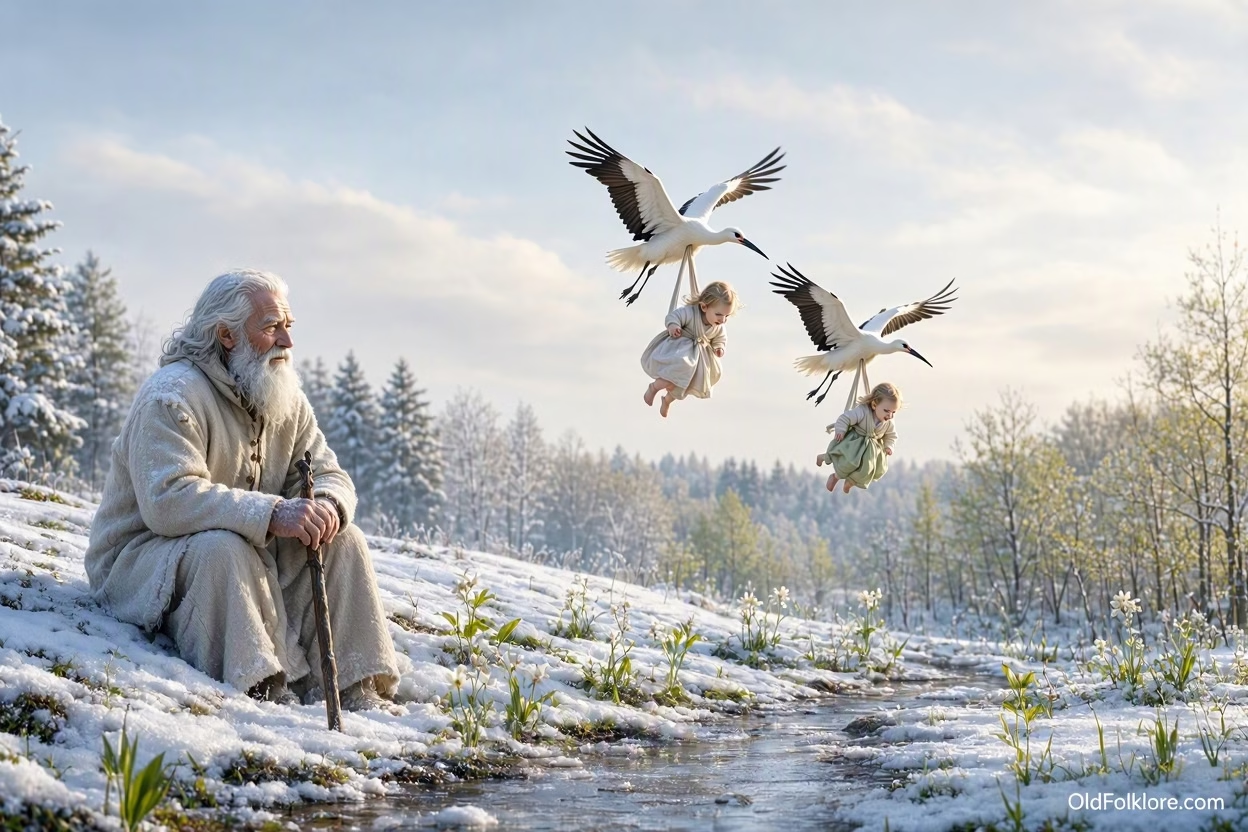
On a distant hill stood a strange old man. He wore a coarse white coat and had long white hair. His face was pale, and his eyes were large and blue. He sat upon a heap of snow, exposed to the wind and freezing weather.
The sparrows wondered who he was.
An old raven sitting on a fence recognised him. The raven explained that the man was Winter, the ruler of the season that had not yet ended. Although the calendar suggested that the previous year was gone, Winter had not disappeared. He remained in power and guarded the young Prince Spring, who was still waiting to arrive.
The sparrows were unhappy with Winter’s rule. They complained that the cold had lasted too long and insisted that Spring should take his place.
Weeks passed. The lakes remained frozen, and thick mists settled over the land. Black crows flew silently above the fields, while the snow-covered countryside seemed to be sleeping.
Then a beam of sunlight passed over the frozen lake. The snow began to lose its brightness, and small patches of green appeared in the fields. Sparrows gathered around these patches, delighted to find signs of life beneath the fading snow.
They called out to one another, wondering whether Spring had finally come.
Their question was answered when two storks appeared in the sky, flying northwards from the south. Each bird carried a beautiful child on its back. One child was a boy and the other was a girl. They descended towards the earth, greeted the ground with kisses and stepped upon the snow.
Wherever their feet touched, white flowers appeared.
The two children then approached Winter. They embraced the old man and clung to his breast. A thick, damp mist surrounded them, hiding the figures and the countryside from view.
The wind rose and swept through the mist. As it cleared, the warm sunlight returned. Winter had disappeared, and the children of Spring sat upon the throne of the year.
The sparrows rejoiced. They believed that their long suffering was finally over and that the new rulers would bring the warmth and abundance they had been waiting for.
Spring transformed the countryside. Green buds appeared on trees and bushes, while fresh grass pushed through the soil. The fields became green, and flowers spread across the land.
The young girl carried an apron filled with blossoms. Wherever she went, she scattered flowers over the earth. She decorated apple trees and peach trees until their branches were covered in beautiful blooms. The boy joined her in delight, and birds appeared from every direction, filling the air with songs announcing the arrival of Spring.
People who had grown tired of the long winter came outside to enjoy the sunshine. Even elderly women stepped into the open air and looked happily at the yellow flowers scattered across the fields. The familiar sights reminded them of their younger days, and for a moment the world seemed young again.
The forest was still covered in the brown and green colours of early growth, but fresh herbs and flowers had appeared beneath the trees. Violets, anemones and primroses brightened the ground. Streams flowed clearly among the rushes, and every blade of grass seemed filled with new strength.
The young pair sat together on the green earth. They held hands, sang and smiled as they grew older. A gentle rain fell around them, but they scarcely noticed it. The drops mingled with their tears of happiness.
They kissed and became betrothed, promising to marry. At that moment, the woods grew greener, and the forest opened into its full beauty beneath the rising sun.
Days passed, followed by weeks. Spring gradually gave way to warmer weather. The air became hot, and the sun shone strongly over the fields. The corn grew taller and more golden, while the water lilies spread their broad leaves across the lakes.
Summer had arrived.
The young woman who had been the child of Spring now appeared as the beautiful wife of Summer. She sat near a farmhouse, surrounded by blooming roses and cherry trees heavy with fruit. Yet her attention was fixed on the dark clouds gathering in the distance.
The clouds rose like great mountains and spread across the sky. Their shadows covered the forest, and the air became still. Birds stopped singing, and the countryside seemed to hold its breath.
People travelling along the roads hurried towards shelter. Then lightning flashed across the sky, followed by a tremendous crash of thunder. Rain poured down, and the storm continued with alternating darkness and brilliant flashes of light.
The wind bent the reeds on the moor, while rain covered the branches of the trees. Grass and corn were beaten down by the storm, and the fields looked as though they might never recover.
But the storm eventually weakened. The rain became gentle, and the sun appeared through the clouds. Water droplets glittered on leaves, birds began singing again, and fish leapt from the lakes.
Summer himself sat upon a rock beside the sea. He was a strong man with sturdy limbs and long, dripping hair. The cool water had refreshed him, and he sat in the warm sunshine with renewed strength.
The countryside recovered from the storm. The plants stood fresh and beautiful, and the fields were filled with life. Summer had brought warmth, growth and abundance.
The flowers released their fragrance across the clover fields. Bees gathered around the blossoms and flew towards an old ruined meeting place covered in brambles. There, the queen bee and her swarm prepared wax and honey.
The evening sky shone with golden light, and the summer nights were bright and beautiful. The season seemed full of blessings.
As time passed, the harvest approached. Reapers worked in the fields with shining scythes, while apple trees bent beneath the weight of their fruit. Hops hung in large clusters, and hazelnuts grew beneath the bushes.
Summer and his wife rested together under the hazel trees. The Queen of the Year looked around at the abundance and beauty of the land. She recognised the blessings everywhere, yet she felt a growing desire for peace and rest.
She remembered how she and her husband had first arrived in the northern land as children, bringing flowers, sunshine and greenery. The wind and changing seasons had gradually altered the landscape. The plants had grown darker and the trees had taken on the colours of the changing year.
Her husband noticed her thoughts and asked whether she wished to see the golden fruit of the season. When she agreed, he raised his arm. The leaves of the forest turned red and gold, and the woodland became more beautiful than before.
Rose bushes carried scarlet hips, elder branches hung with dark berries, and wild chestnuts fell from their husks. Even in the depths of the forest, violets appeared once more.
The beauty of Autumn had arrived.
Yet the Queen of the Year grew quieter and paler. The air had become colder, and damp mists gathered at night. She longed to return to the land of her childhood.
She watched the storks gather and prepare to leave. Their nests stood empty, and some had become places where flowers and other plants grew. Sparrows began flying into the abandoned nests, taking advantage of the shelter left behind.
The Queen stretched out her hands towards the departing birds, but they continued their journey.
The leaves turned increasingly yellow and fell from the trees. Stormy winds swept through the forest, and the Queen of the Year rested among the fallen leaves. She looked towards a bright star while her husband stood beside her.
A gust of wind swept across the ground, lifting the leaves into the air. When they settled again, the Queen had disappeared. Only the last butterfly of the season remained, flying through the cold air.
Autumn had ended, and Winter was approaching.
Wet fogs covered the land, and icy winds brought long, dark nights. The Ruler of the Year stood alone with hair as white as snow. He did not realise how old he had become. He thought the white appearance of his hair came from the falling snowflakes.
A thin layer of snow gradually covered the fields.
Soon, church bells began ringing to announce Christmas. The Ruler of the Year listened and understood that another change was coming. He said that the bells welcomed the newborn, and that a new king and queen of the year would soon appear. Like his wife, he expected to rest beneath the shining star.
In a green fir wood covered with snow, the Angel of Christmas stood among the young trees. The angel blessed the trees that would decorate the Christmas celebration.
The Ruler of the Year wished happiness for every home and for the people gathered beneath the green branches. He had grown very old, and he believed that his time of rest was near. He prepared to hand his crown and sceptre to the young rulers of the coming year.
The Angel of Christmas reminded him that although his time for rest was approaching, his power had not yet ended. Winter still had an important duty. The snow protected the young seeds beneath the ground, allowing them to remain safe until Spring returned.
The angel also told him that he must learn to accept being forgotten while he was still alive. Another ruler would receive attention and honour while Winter continued to hold power. His release would come when Spring appeared.
Winter asked when that would happen.
The angel answered that Spring would come when the stork returned.
The old ruler sat upon a snowy hill, looking towards the south. His hair and beard were white, and his body appeared cold and bent with age. Yet he remained strong, like the winter storm and the solid ice.
The lakes froze, and skaters moved across their smooth surfaces. Ravens and crows stood out against the white landscape, while the leafless trees displayed the delicate shapes of their branches.
The sparrows returned from the town and saw the old man sitting on the hill. They asked the raven whether he knew who the stranger was.
The raven explained that he was Winter, the old man from the previous year. He had not died, as the calendar seemed to suggest. Instead, he was still guarding the Spring that would soon arrive.
The sparrows complained once more about his rule. They longed for the warmer days and believed that the next season would treat them better.
Winter listened quietly. During the long winter sleep, he dreamed of his youth and the years when he had been strong and full of life. Frost covered the branches of the forest, and the sun scattered its sparkling crystals as morning approached.
Then the weather began to change. The sun shone more warmly, the snow melted and birds started singing. The sparrows recognised the signs and called out that Spring was coming.
Their words echoed across the snowy hills.
High above them, the first stork appeared, followed by another. Each carried a beautiful child on its back. The birds descended into the field, where the children kissed the earth and then greeted the old silent man.
A mist rose around Winter, and he disappeared from view.
The story of the year was complete.
Yet the sparrows were not entirely satisfied. They admitted that the events had been beautiful, but they complained that the order of the seasons did not follow the almanac. To them, the calendar remained the proper authority, even though nature had shown them a different way of measuring time.
Explore our complete Historic Folklore & Fairy-Tale Collections archive.
Moral Lesson
The Story of the Year reminds readers that change is a natural part of life. Every season has its purpose, and each stage makes way for another. Spring brings renewal, Summer brings growth, Autumn brings harvest and Winter provides a period of rest before life begins again. The tale also encourages readers to look beyond dates and human expectations to appreciate the natural rhythms that govern the world.
Knowledge Check
1. Why did the sparrows question the beginning of the new year?
They expected warmer weather after the celebrations, but January brought even colder conditions and heavy snow.
2. According to the older sparrow, when did the year truly begin?
It began when Spring arrived, which the sparrow associated with the return of the stork.
3. Who was the old man sitting on the snowy hill?
He was Winter, the old ruler who guarded the coming Spring.
4. How did the children of Spring transform the countryside?
They brought flowers, green buds, fresh grass, blooming trees and birdsong wherever they went.
5. What happened when Summer’s storm passed?
The rain weakened, the sun returned, and the countryside became fresh, strong and beautiful again.
6. What sign did the Angel of Christmas give Winter as the signal for Spring’s return?
The angel said that Spring would come when the stork returned.
Source
Hans Christian Andersen, “The Story of the Year,” in What the Moon Saw: and Other Tales, translated by H. W. Dulcken (London: George Routledge and Sons, 1866), p. 40.
Explore More Hans Christian Andersen Tales
- The Snowman: A Danish Folktale by Andersen
- The Farmer Who Traded His Horse for Rotten Apples
- The Beetle Who Wanted Golden Shoes
- The Goblin and the Huckster: Hans Christian Andersen