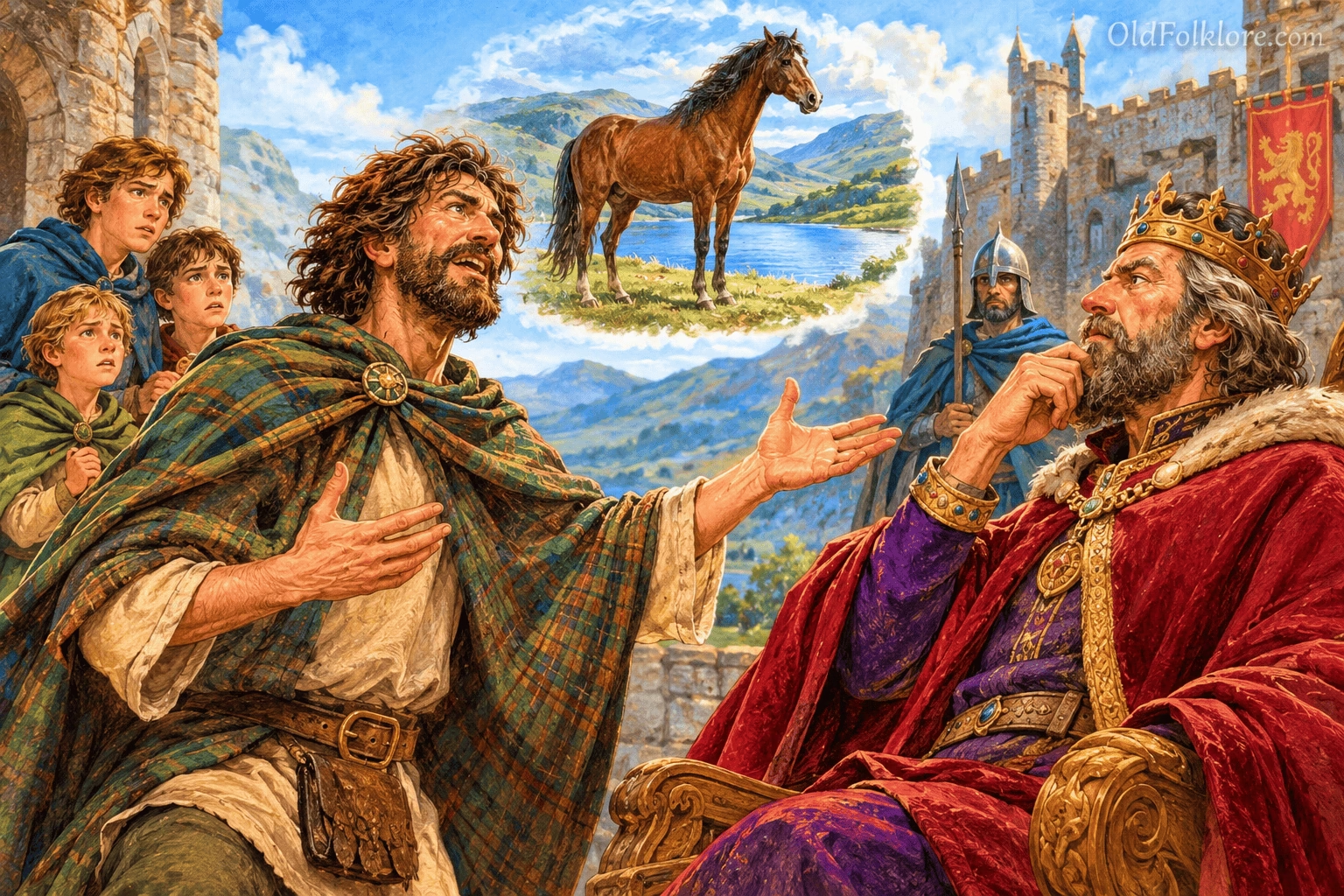
Long ago, in Erin, a land divided into five kingdoms, there lived a prosperous tenant farmer named Conall Yellowclaw. He had three sons, and his family was well known in the kingdom ruled by their neighbouring king.
One day, a quarrel broke out between Conall’s sons and the sons of the king. The disagreement turned violent, and Conall’s sons emerged victorious. However, during the fighting, they killed the king’s eldest son.
The king was furious. He summoned Conall and demanded an explanation.
“What made your sons attack mine?” he asked. “They have killed my eldest boy, and I ought to take revenge. Yet I fear that punishing you will bring me little satisfaction. I will offer you another way to save your sons. If you and your three boys can bring me the brown horse belonging to the King of Lochlann, I will spare their lives.”
Explore more stories from our Joseph Jacobs’ Celtic Fairy Tales collection.
Conall understood the danger of the assignment. The King of Lochlann was unlikely to surrender such a prized animal willingly.
Nevertheless, he accepted.
“Why should I refuse to do what my king asks?” he replied. “Even if my sons were not in danger, I would still do my best to please him. The task is difficult, but I am prepared to risk my life and the lives of my sons rather than fail.”
When Conall returned home, however, the weight of the undertaking troubled him. That evening, he told his wife what had happened.
She was heartbroken.
“Why did you not allow the king to do as he pleased with our sons?” she asked. “Now you are leaving, and I do not know whether I shall ever see you again.”
Conall had no comforting answer. He could only hope that his courage and determination would bring them all safely home.
The following morning, he gathered his three sons, and they set out for Lochlann. Their journey carried them across the sea until they reached the foreign kingdom.
They had no idea how to approach the task, so Conall suggested that they first visit the king’s miller.
The Brown Horse in the Royal Stable
The miller welcomed the travellers and invited them to spend the night. As they talked, Conall explained the trouble that had brought him to Lochlann.
He told the miller about the fight between their families, the death of the king’s eldest son, and the bargain that required him to bring back the brown horse.
The miller shook his head.
“You have chosen a difficult undertaking,” he said. “The King of Lochlann treasures that horse so much that he will never give it away. You will have to steal it. If you can devise a plan, however, I will keep your secret.”
Conall immediately began thinking.
“Since you work for the king, perhaps you and your assistants could hide us inside five sacks of bran. The royal servants collect bran from here and carry it to the stables. If they take us along with the sacks, we shall find ourselves inside the stable without having to enter through the guarded doors.”
The miller considered the suggestion and agreed that it might work.
He instructed his assistants to prepare the sacks, and Conall and his sons climbed inside. Soon afterwards, the king’s servants arrived to collect the bran. They loaded the five sacks and carried them to the royal stables, where they emptied their contents before the horses.
Once the servants had left and locked the doors, Conall and his sons emerged from their hiding places.
Before approaching the brown horse, however, Conall advised everyone to prepare a hiding place. If the king’s servants discovered their presence, they would need somewhere to conceal themselves.
They made hiding holes and then approached the horse.
Unfortunately, the animal was not accustomed to being handled by strangers. As soon as they tried to take hold of him, he began making an enormous noise throughout the stable.
The king heard the disturbance and ordered his servants to investigate.
Conall and his sons quickly disappeared into their hiding places. The servants searched the stable but found nothing unusual. Satisfied with their inspection, they returned to the king and reported that everything was in order.
The moment they had gone, Conall and his sons tried again.
This time, the horse made even more noise than before.
The king sent his servants back to investigate, but once again they discovered nothing. They searched carefully, then returned to their master.
The king was puzzled.
“If nothing is wrong with the horse, why does he keep making such a disturbance? Go and rest. If I hear him again, I shall come and investigate myself.”
As soon as the servants disappeared, Conall and his sons made another attempt. One of them finally caught hold of the horse, but the animal’s noise became louder than ever.
The king could no longer ignore the disturbance. He rang his bell, summoned his attendants and ordered the stable servants to accompany him.
Conall and his sons hurried into their hiding holes.
The King of Lochlann was more observant than his servants. He noticed signs that someone had been moving around the stable and began following the tracks. Eventually, he discovered the hiding places and brought the intruders out.
To his surprise, he recognised Conall.
“Is that you, Conall Yellowclaw?” he exclaimed.
“It is indeed, Your Majesty,” Conall replied. “Necessity has brought me here. I ask for your mercy and protection.”
He explained the entire situation, including the bargain with the King of Erin. His sons would be executed unless he returned with the brown horse.
“I knew you would never give him to me if I asked,” Conall admitted. “That is why I intended to take him secretly.”
The King of Lochlann listened. Rather than immediately punish his visitors, he invited Conall inside. He ordered his servants to provide food and instructed his guards to keep a close watch over the three sons.
Their fate would be decided the following day.
The First Story: The Cats in the Shepherd’s Bothy
That night, the King of Lochlann spoke to Conall.
“Tomorrow, your sons may all be hanged. Yet you have placed yourself under my mercy and insist that necessity brought you here. I will consider sparing them. Tell me, however, whether you have ever experienced anything more terrible than seeing your sons facing death. If you can tell me of such an experience, I will spare your youngest son.”
Conall agreed.
He began by recalling an adventure from his childhood.
When he was a young boy, his father had owned extensive farmland and herds of cattle. One day, his father instructed him to bring home a cow that had recently given birth.
Conall found the animal and started leading her home with her calf. Before they could complete the journey, a heavy snowfall began. Seeking shelter, he took the cow and calf into a shepherd’s bothy.
They had barely settled when a strange company arrived.
It was a gathering of cats, led by a large, one-eyed, fox-coloured creature who appeared to be their chief bard.
The leader ordered the others to sing a cronan, a traditional kind of chant or song, in honour of Conall Yellowclaw.
Conall was astonished that these mysterious animals knew his name.
When their song ended, the leader demanded a reward.
Conall had nothing to offer them, so he jokingly suggested that they could take the calf.
The cats immediately attacked the young animal and devoured it.
Afterwards, the leader demanded another song and another reward. This time, Conall offered them the cow.
Once again, the cats sang before killing and eating the animal.
By now, Conall understood that he was dealing with dangerous creatures. When they demanded another reward, he refused.
The cats began quarrelling among themselves, and Conall seized the opportunity to escape through a small opening at the back of the bothy.
He ran into the nearby wood and climbed a tall tree, hoping the animals would lose his trail.
The cats searched everywhere but could not find him. Eventually, they considered giving up.
Their one-eyed leader, however, had noticed something the others had missed.
Although he possessed only one eye, he spotted Conall hiding among the branches.
One of the cats climbed the tree, but Conall drew his weapon and killed it before it could reach him.
The furious leader then ordered the remaining cats to dig around the roots of the tree until it fell.
As they cut through the roots, Conall began shouting for help.
Nearby, a priest was working in the wood with ten men. Hearing the first cry, he wanted to investigate, but one of his companions advised him to wait until they heard it again.
The cats continued digging.
When another root broke, Conall shouted a second time. The priest realised that someone was in serious danger and prepared to go to the rescue.
Then the cats cut through a third root, and the tree began to fall.
Conall gave a final desperate cry.
The priest and his men rushed towards the noise. When they discovered the cats attacking the tree, they turned on the creatures with their spades.
A fierce struggle followed, but the men eventually drove the cats away.
Conall remained in the tree until he was certain that the last of the creatures had fled. Only then did he climb down and return home.
Having finished his story, he looked at the King of Lochlann.
“That was the hardest experience of my life. I would rather face hanging tomorrow than be hunted through the woods by those terrible cats.”
The king was amused by Conall’s extraordinary tale.
“You certainly have a gift for telling stories,” he said. “You have convinced me that your adventure was worse than the danger facing your youngest son. His life is spared.”
The Second Story: The One-Eyed Giant and the Magic Ring
The king was not yet satisfied.
“If you can tell me of another experience more terrible than the one you have just described, I will spare your second-youngest son as well.”
Conall accepted the challenge and recalled another adventure from his youth.
One day, while hunting near his father’s land, he wandered along a rugged stretch of coastline. The area was filled with rocks, caves and deep openings in the ground.
He noticed what appeared to be smoke rising between two rocks. Curious about its source, he approached to investigate.
Unfortunately, he lost his footing and tumbled into a deep hollow. A thick covering of heather softened his fall, so he escaped without breaking any bones.
But he could not climb out.
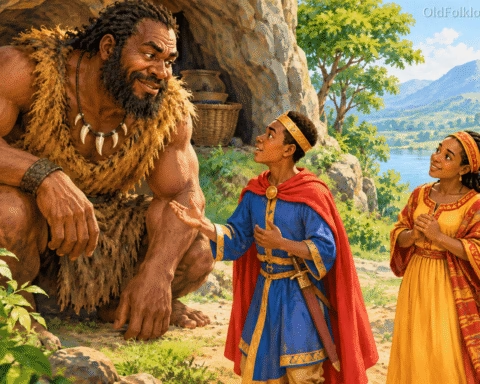
As he wondered how he would escape, he heard a tremendous noise approaching. Soon, a gigantic one-eyed creature appeared, accompanied by two dozen goats and a leading buck.
The giant tied up the animals before noticing Conall.
“At last!” he exclaimed. “My knife has been waiting a long time for your flesh.”
Conall realised that he was in terrible danger. Yet he quickly noticed that the giant had only one eye.
Thinking fast, he pretended to be a skilled healer.
“You are mistaken if you think killing me will benefit you greatly,” he said. “I would make only one meal. But I can do something much better for you. I can restore the sight of your other eye.”
The giant was delighted.
He brought out a large cauldron and prepared to heat water so that Conall could perform the supposed treatment.
Conall gathered some heather and made a rough implement with which to work. He persuaded the giant to sit in the hot water and began examining his good eye.
Pretending to treat the damaged one, Conall deliberately ruined the sight of the eye that still worked.
Soon, the giant could see nothing at all.
Realising he had been tricked, the furious creature leapt out of the cauldron and stationed himself at the entrance of the cave. He intended to catch Conall if he attempted to escape.
Conall spent the night hiding quietly.
When morning came, the giant ordered him to release the goats.
Conall first killed the buck. When the giant heard the noise, he questioned him, but Conall pretended that the ropes were difficult to untie.
He then began releasing the goats one by one.
As he worked, he skinned the dead buck, carefully separating its hide so that it could be used as a disguise.
When the last goats were nearly released, Conall climbed inside the buck’s skin. He arranged his own limbs to resemble the animal’s legs, placed the horns above his head and made himself look like the buck.
Then he walked towards the entrance.
The blind giant reached out and touched him.
“There you are, my fine buck,” he said. “You can see me, but I cannot see you.”
Conall continued until he was safely outside. Once he had escaped, he threw off the animal’s skin and shouted that he had outwitted the giant.
The giant was impressed by his cleverness. He even offered Conall a magical ring as a reward for escaping.
Conall refused to take it directly.
“Throw it to me,” he said, “and I shall pick it up.”
The giant threw the ring, and Conall placed it on his finger.
But the gift concealed another danger.
The giant asked whether the ring fitted him. When Conall answered yes, the creature demanded to know where the ring was.
To Conall’s horror, the ring answered aloud.
The giant could follow its voice, even though he could not see.
Realising that the magical object would betray him, Conall drew his knife, cut off the finger carrying the ring and hurled it into the deepest part of the nearby loch.
The giant called out again.
“Where are you, ring?”
From beneath the water came the answer:
“I am here.”
Believing that the ring was at the bottom of the loch, the giant leapt into the water after it. He drowned in its depths.
Conall was finally free.
He returned to the cave, gathered the giant’s treasures of gold and silver, and made his way home. His family rejoiced at his safe return.
As proof of the adventure, he showed the king the missing finger.
The King of Lochlann examined it and agreed that Conall had endured a terrible ordeal.
“You have saved another of your sons,” he declared. “But I will spare your eldest only if you can tell me of something even worse than watching him face execution tomorrow.”
The Third Story: The Child in the Giant’s Cave
Conall agreed to tell one final story.
He recalled that after his father had arranged his marriage, he once went hunting near the sea. During his journey, he noticed an island in the middle of a loch.
A boat lay nearby, secured with ropes at both ends. It contained valuable possessions, and Conall approached it hoping to take some of the treasures.
He placed one foot inside while keeping the other on the shore. But when he raised his head, he discovered that the boat had mysteriously moved into the middle of the loch.
It continued until it reached the island.
When Conall stepped out, the boat returned to its original position, leaving him stranded.
The island appeared deserted. There was no food, clothing or visible shelter.
He climbed a hill and eventually descended into a valley. There, at the bottom of a hollow, he discovered a woman holding a naked baby.
She had a knife in her hand and appeared to be preparing to kill the child. Yet when she brought the blade towards the baby’s throat, the little one laughed at her.
The woman began to cry and threw the knife away.
Conall approached her and asked what she was doing.
She asked him the same question in return. After he explained how he had arrived on the island, she told him that she too had been brought there against her will.
She then invited him into her dwelling.
Conall soon discovered the reason for her distress. A terrible giant lived there, and he had demanded that the woman’s baby be cooked for his meal. If she refused, he threatened to destroy her entire world.
Before they could discuss an escape, they heard the giant approaching.
The woman panicked.
“What shall I do? What shall I do?” she cried.
Conall looked around and noticed a large cauldron. Fortunately, it had not yet been heated.
He climbed inside just as the giant entered.
The creature immediately demanded to know whether the child was ready to eat.
“Not yet,” the woman replied.
From inside the cauldron, Conall suddenly called out:
“Mother! Mother! I am boiling!”
The giant burst into laughter. Delighted by what he believed was happening, he piled more wood beneath the cauldron to increase the heat.
Conall feared that he would be cooked alive before he could escape.
Fortunately, the giant eventually fell asleep beside the fire.
When the woman was certain that he was sleeping, she quietly approached the cauldron and whispered through a hole in its lid, asking whether Conall was still alive.
He answered that he was.
The opening was large enough for him to push his head through, but escaping was not easy. As he struggled to pull himself out, the skin around his hips was badly torn.
Nevertheless, he managed to escape.
Once outside, he asked the woman how they could defeat the giant.
She told him that the only weapon capable of killing the creature was his own spear.
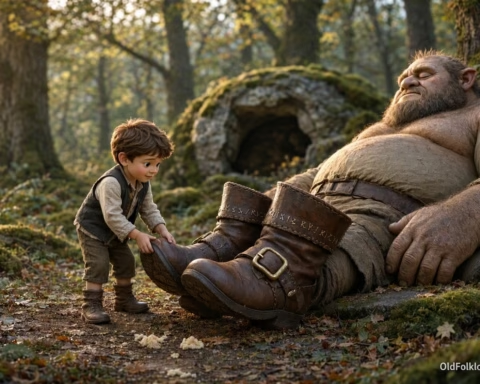
Conall approached the sleeping giant and began pulling at the weapon. But every time the creature breathed in, Conall felt himself being drawn towards its mouth. When it breathed out, he was pushed backwards.
After considerable effort, he finally managed to loosen the spear.
It was enormous and difficult for him to control. He struggled beneath its weight, but he knew that he had no other choice.
Gathering all his strength, he aimed the weapon at the giant’s single eye and thrust it forward.
The giant jerked his head violently, driving the other end of the spear against the roof of the cave. The weapon pierced through his head, killing him instantly.
Conall and the woman hurried outside.
They spent the night in safety, and the following morning Conall returned to the boat. It had not lost any of its precious cargo. He helped the woman and her child aboard and carried them safely to dry land.
Then he returned home.
When Conall finished recounting this adventure, an elderly woman who had been listening nearby suddenly spoke.
She was the mother of the King of Lochlann.
“Was it really you who went through all that?” she asked.
“It was,” Conall replied.
The old woman was overwhelmed with emotion.
“Then I am the woman you rescued! The child whose life you saved is now the King of Lochlann himself. He owes his life to you.”
The king was astonished.
He now understood that the stranger who had attempted to steal his horse was the very man who had saved him when he was a helpless baby.
His attitude towards Conall changed completely.
“You have suffered greatly, Conall, and you saved my life before I was old enough to know you. You shall have the brown horse. Not only that, but I will give you a sack filled with the finest treasures in my treasury.”
Conall’s Return to Erin
The following morning, Conall and his sons prepared to leave Lochlann.
The king’s household had already made arrangements for their departure. Conall received the magnificent brown horse, together with a sack filled with gold, silver and precious stones.
His three sons were safe, and he had gained a fortune beyond anything he had expected.
The family travelled back across the sea to Erin, where Conall was welcomed with great happiness.
He placed the treasures in his home and took the brown horse to the king who had sent him on the dangerous mission.
The two kings’ kingdoms were now connected by a remarkable act of courage and gratitude, and Conall and his own king remained good friends ever afterwards.
At last, Conall returned to his wife, who had spent so long worrying whether she would ever see him again.
They arranged a great feast to celebrate the return of her husband and sons.
It was a joyful gathering, and the family had every reason to celebrate. Conall had fulfilled the king’s demand, rescued his sons from death and returned home with a treasure that rewarded his courage and cleverness.
And so ended the extraordinary adventures of Conall Yellowclaw.
Explore our complete Historic Folklore & Fairy-Tale Collections archive.
Moral
Courage is not always about physical strength. Intelligence, patience, quick thinking and determination can help overcome even the most frightening challenges. The story also teaches that kindness is never wasted, for a good deed performed long ago may return in unexpected ways. Above all, it celebrates the importance of protecting one’s family and remembering those who have helped us.
Knowledge Check
1. Why did Conall and his sons have to obtain the brown horse of Lochlann?
Their sons had killed the eldest son of their own king during a fight. The king offered to spare their lives if Conall brought him the brown horse.
2. How did Conall and his sons enter the royal stable?
The king’s miller helped them hide inside five sacks of bran, which his servants carried into the stable.
3. How did Conall escape the cats in his first adventure?
He climbed a tree, called for help as the cats cut through its roots, and was rescued by a priest and his ten workers.
4. How did Conall defeat the one-eyed giant in his second adventure?
He destroyed the giant’s remaining eyesight, escaped disguised in the skin of a buck and eventually tricked the giant into drowning while pursuing a magical ring.
5. Why was the woman on the island preparing to kill her baby?
The giant who controlled the island had demanded that the child be cooked for his meal and threatened to destroy her world if she refused.
6. Why did the King of Lochlann eventually give Conall the horse?
He discovered that Conall had rescued him as a baby by killing the giant who intended to eat him.
7. What is the significance of the three stories Conall tells?
Each story demonstrates his ability to survive seemingly impossible situations. More importantly, each successful account persuades the king to spare another of his sons.
Source
Joseph Jacobs (ed.), Celtic Fairy Tales (London: David Nutt, 1892), Tale V, “Conall Yellowclaw,” pp. 34–46. Based on John Francis Campbell, Popular Tales of the West Highlands, Vol. I, No. V, “Conall Cra Bhuidhe,” pp. 105–108.
Explore More Joseph Jacobs’ Celtic Fairy Tales