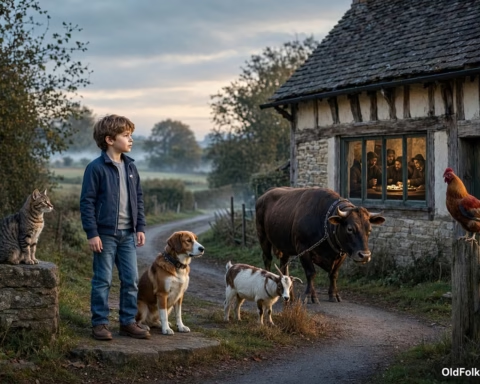
Felicia grows up believing she is the daughter of a poor labourer. After her father’s death, her brother Bruno treats her cruelly and leaves her with little more than a silver ring and a pot of pink flowers. Despite her difficult circumstances, Felicia remains gentle and takes great care of the small possessions her father left her.
One evening, while fetching water for her flowers, she meets a mysterious queen who recognises her kindness and offers her friendship. However, Bruno’s jealousy leads him to steal the flowers, setting off a series of strange events. With the help of a talking cabbage, a hen and a magical queen, Felicia gradually discovers the truth about her birth and the extraordinary destiny awaiting her.
The Story of Felicia and the Pot of Pinks
Once upon a time, there lived a poor labourer who had a son and a daughter. He loved both children dearly, but as he grew older and felt that his life was drawing to a close, he became concerned about their future.
He owned very little. His household possessions included two stools, a straw bed, a hen, a pot of pink flowers and a silver ring. The ring and the flowers had been given to him by a noble lady who had once stayed in his cottage.
Before leaving, the lady had instructed him to look after the gifts carefully. She had also made a remarkable promise concerning his daughter. The girl, she said, would grow into a beauty unlike any other. The labourer was to call her Felicia and, when she was old enough, give her the silver ring and the pot of flowers. These possessions would comfort her when she faced the difficulties of poverty.
When the labourer realised that he would not live much longer, he called his children to his bedside. He explained how their mother had brought the two stools and the straw bed as her dowry. He then divided the remaining possessions according to the noble lady’s instructions.
Felicia received the hen, the silver ring and the pot of pinks, while her brother, Bruno, received the other household belongings.
The children appeared satisfied with the arrangement. When their father died, they mourned him and divided the possessions as he had requested.
Felicia believed that her brother loved her and expected them to continue living peacefully together. Unfortunately, Bruno soon revealed his true character.
One day, Felicia sat down on one of the stools. Bruno immediately became angry and ordered her to leave his belongings alone. He told her that she could keep her flowers and silver ring but must not touch anything else in the house.
Felicia did not argue. She quietly stood up and returned to her little room, where she found comfort in the sweet fragrance of her flowers.
She approached the pot and spoke affectionately to the pinks. They were the only beautiful things she possessed, and she promised to water them regularly and protect them from anyone who might damage them.
Explore more stories from our Andrew Lang’s Colour Fairy Books collection.
When she examined the flowers more closely, she noticed that the soil was very dry. She picked up her pitcher and went outside to fetch water from a fountain some distance away.
The moon was shining brightly, and the countryside was quiet. Felicia walked towards the fountain, intending to return quickly before the night grew colder.
When she arrived, she sat beside the water to rest. Before long, she noticed a magnificent procession approaching.
At its centre was a stately lady surrounded by numerous attendants. Six young women carried the long train of her dress, while another supported her as she walked.
The attendants prepared a beautiful resting place beneath a canopy. They arranged a sofa covered in cloth of gold and placed an elegant supper on a table decorated with gold and crystal dishes. The gentle wind and the sound of the falling water seemed to provide music for the gathering.
Felicia watched from the shadows, astonished by the splendid scene.
The lady soon noticed her and asked that the young shepherdess be brought forward.
Felicia approached timidly and greeted her. Although she wore simple clothes and possessed very little, she carried herself with such natural grace that the attendants were impressed.
The lady asked what she was doing beside the fountain so late at night. She also wondered whether Felicia was not afraid of robbers.
Felicia replied that a poor shepherdess who owned almost nothing had little reason to fear thieves.
The lady smiled and asked whether she was very poor.
Felicia explained that she had only two possessions of value: a pot of pink flowers and a silver ring.
The lady then asked what Felicia would do if someone tried to steal her heart.
Felicia admitted that she did not know what it meant to lose one’s heart. She had always understood that a person could not live without one and that a broken heart brought great sorrow. Despite her poverty, she did not wish to lose the ability to live and feel happiness.
The lady admired her answer and observed that Felicia had something more valuable than wealth: a kind heart.
She asked whether the young shepherdess had eaten supper.
Felicia explained that she had not. Her brother had eaten all the food available in the cottage.
The lady immediately ordered that Felicia should be given a place at the table. She personally filled the young woman’s plate with delicious food, but Felicia was so surprised by the kindness that she could hardly eat.
After a while, the lady asked why she had come to the fountain.
Felicia explained that she had brought her pitcher to collect water for her flowers. She picked it up to show the lady, but was astonished to discover that it had changed.
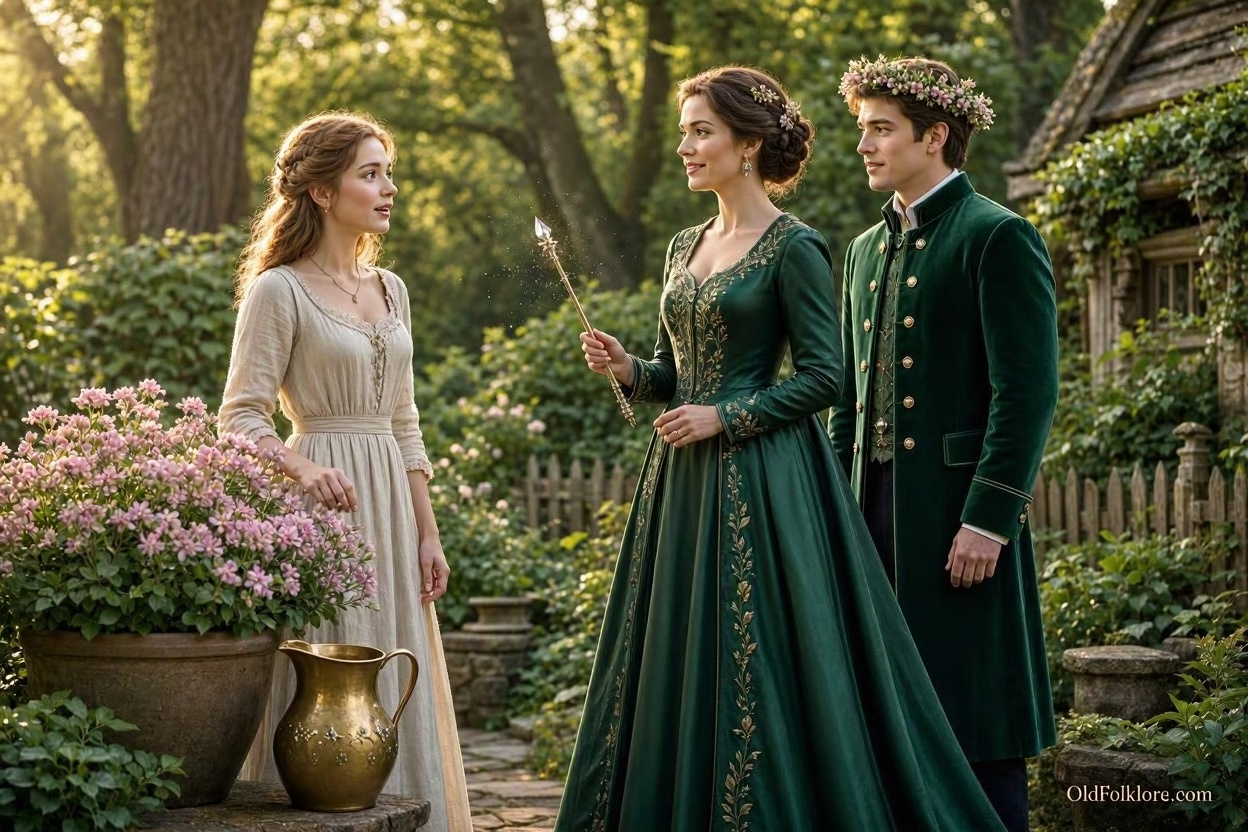
The ordinary pitcher had become a beautiful golden vessel decorated with large diamonds. The water inside it had also acquired a wonderful fragrance, sweeter than roses.
Felicia was afraid to accept such a valuable object. The lady reassured her and explained that the pitcher was a gift. She introduced herself as the Queen of the Woods and told Felicia to use the fragrant water for her flowers. She promised that the gift would remind the young shepherdess of her friendship.
Felicia was overwhelmed with gratitude. She bowed before the queen and wished she could offer her something in return.
She suggested bringing her pot of pinks because she believed the flowers would be in good hands with someone so generous.
The Queen of the Woods agreed to wait while Felicia fetched them.
Felicia hurried back to the cottage, carrying her golden pitcher. However, Bruno had been watching her movements. While she was away, he entered her room, stole the pot of pinks and hid it in his own bed.
To make the theft less obvious, he placed a large cabbage where the flowerpot had stood.
When Felicia returned, she was heartbroken. Her beloved flowers had disappeared, and she had no idea what to tell the queen.
She returned to the fountain carrying only her silver ring. Kneeling before the Queen of the Woods, she explained that Bruno had stolen the flowers. She offered the ring instead as a small expression of gratitude.
The queen hesitated. She reminded Felicia that the ring was almost everything she owned and asked what she would do if she gave it away.
Felicia replied that having the queen’s friendship would be enough for her.
The Queen of the Woods accepted the ring and placed it on her finger. She then climbed into a magnificent chariot made of coral and decorated with emeralds. Six white horses pulled it along the forest path.
Felicia watched until the procession disappeared from sight.
When she returned to the cottage, she remained troubled by the loss of her flowers. She entered her room and noticed the cabbage that Bruno had left in place of the pot.
Annoyed by the sight of it, she picked it up and threw it through the window.
To her astonishment, a small voice cried out in pain.
Felicia could hardly believe what she had heard. She looked around, wondering where the voice had come from, because she had never known a cabbage to speak.
The following morning, she went outside to search for her missing flowers. She soon discovered the cabbage and approached it angrily.
She asked why it had taken the place of her precious pinks.
The cabbage replied that it had not chosen to be carried into her room. It then offered to tell her where the flowers were hidden if she would return it to the ground beside the other cabbages.
Felicia was frightened by the talking vegetable but agreed to help. She replanted it carefully.
As she finished, she noticed Bruno’s hen nearby. Still upset by her brother’s behaviour, she caught hold of the bird and threatened to punish it for all the trouble Bruno had caused her.
The hen begged her not to harm it. It explained that it was fond of gossip and knew something that would astonish Felicia.
The bird then revealed a secret about her birth.
Felicia was not the labourer’s daughter. Her real mother had been a queen who already had six daughters. The king had become furious because he wanted a son to inherit his kingdom. He had threatened to have his wife’s head cut off if she failed to give birth to a boy.
When the queen gave birth to another daughter, she became terrified of her husband’s reaction. She therefore agreed to exchange the baby with the son of her fairy sister.
The arrangement was meant to protect the newborn princess, but events did not happen as planned.
The queen had been confined to a great tower by the king’s orders. When she heard nothing further from her sister, she escaped through a window using a rope ladder. She carried her baby with her and travelled through the countryside until she reached the labourer’s cottage.
The hen explained that it had once been the labourer’s wife and had cared for the infant. The queen told her the whole story of her suffering before dying from exhaustion and hardship.
The nurse had been unable to keep the secret. She eventually told the story to her neighbours, and one day a beautiful lady visited the cottage and heard it too.
The lady was a fairy. When she learned that the nurse had revealed the secret, she touched her with a wand and transformed her into a hen.
The labourer, who had been away when this happened, never discovered the truth. He searched for his wife but eventually believed that she had been drowned or killed by wild animals.
The fairy later returned to the cottage. She instructed the labourer to call the child Felicia and left the silver ring and the pot of pinks for her.
The hen also explained that the fairy had once protected Felicia from twenty-five royal guards who had arrived at the cottage searching for her. The fairy transformed the guards into cabbages, one of which was the vegetable Bruno had placed in Felicia’s room.
Felicia was astonished by everything she heard. She now understood that her life had been shaped by secrets and enchantments long before she could remember.
She felt sorry for the hen, who had once been her nurse, and wished that she could restore her to human form. However, the princess was more concerned about finding her flowers.
Bruno had gone into the forest, leaving the cottage unattended. Felicia thought she might be able to retrieve her property without facing another argument.
She entered his room and approached the straw bed. However, a terrifying army of rats surrounded it. The creatures guarded the bed fiercely and rushed towards her, biting and scratching whenever she tried to get closer.
Felicia retreated in fear. She could see that her flowers were near the bed, but she had no way of reaching them.
Then she remembered the golden pitcher and the fragrant water given to her by the Queen of the Woods.
Perhaps it possessed some magical power.
She hurried to fetch it and returned to the room. Carefully, she sprinkled a few drops over the rats.
The effect was immediate. Every rat fled towards its hole, leaving the bed unguarded.
Felicia approached the straw bed and recovered her pot of pinks. The flowers were almost dying because they had been left without water.
She quickly poured the remaining fragrant water over them.
As she bent towards the flowers, a gentle voice seemed to rise from among the leaves. It praised her beauty and told her that the flowers loved her.
Felicia was overwhelmed. She had already heard a cabbage and a hen speak, and now even her flowers seemed able to communicate with her.
The strange events became too much for her. She grew pale and fainted.
At that moment, Bruno returned from the forest. Seeing that Felicia had recovered her flowers, he became furious. He dragged her out of the cottage and shut the door behind her.
The fresh air soon revived her. When she opened her eyes, she found herself before the Queen of the Woods.
The queen had witnessed Bruno’s cruelty and asked Felicia whether she wished him to be punished.
Felicia refused to seek revenge. Although her brother had treated her badly, she still believed him to be her family and did not want anything terrible to happen to him.
The queen then asked what Felicia would think if Bruno were not her brother after all.
Felicia was confused. She explained that she had heard the hen’s story but found it difficult to believe without proof.
The Queen of the Woods assured her that her own words and conduct showed that she was indeed a princess. She promised that Felicia would no longer have to endure the cruelty she had experienced in the cottage.
Before the conversation could continue, a handsome young man appeared. He wore a green velvet coat fastened with emerald clasps, and a crown of pink flowers rested upon his head.
He knelt before the Queen of the Woods and kissed her hand.
The queen welcomed him warmly and expressed her happiness at seeing him restored to his natural form. She then explained his connection to Felicia.
The young man was her son, Prince Pink.
The zephyrs had once been instructed to carry him to the tower where Felicia’s mother was waiting. However, they left him in a garden of flowers and flew away to report their mistake.
A fairy who was an enemy of the Queen of the Woods discovered what had happened and transformed the prince into a pink flower. The queen could not reverse the enchantment, so she arranged for the prince to be brought to the cottage where Felicia would grow up.
She hoped that, when the children became adults, the princess would care for the flower and help restore the prince to his proper form.
The queen explained that the pot of pinks and the silver ring were part of the enchantment. Felicia’s willingness to give the ring away had brought the charm close to its end, while her courage in facing the rats had defeated the final attempt to frighten her.
Prince Pink had now returned to his human form through her care.
The queen asked Felicia whether she would consider marrying her son.
Felicia was grateful for the offer but hesitated. She had never before experienced the happiness of being loved, and she wanted to know whether the prince truly cared for her.
Prince Pink immediately assured her that he loved her. He explained that the enchantment had prevented him from expressing his feelings until that moment.
Felicia was delighted.
The Queen of the Woods then touched her with her wand. Her simple cotton dress changed into a magnificent silver robe embroidered with precious stones, and a crown of diamonds appeared in her dark hair.
Prince Pink was amazed by her beauty and begged her to accept his proposal.
Felicia finally agreed, and the queen was pleased that her plan had succeeded.
Just then, Bruno came out of the cottage on his way to work. He was astonished by the transformation before him. The poor young woman he had mistreated now stood dressed as a princess beside a handsome prince and a powerful queen.
Felicia noticed her brother’s shock and asked the Queen of the Woods to forgive him.
The queen was surprised that Felicia still wished to help someone who had treated her so cruelly. But Felicia explained that she was so happy that she wanted everyone around her to experience happiness too.
The Queen of the Woods agreed to grant her request.
With a wave of her wand, she transformed the poor cottage into a splendid palace filled with treasures. She deliberately left the two stools and the straw bed unchanged so that Bruno would remember the poverty from which he had come.
She also touched Bruno with her wand. His cruel and selfish nature changed, and he became gentle, polite and grateful.
He thanked the queen and Felicia for their kindness.
Finally, the Queen of the Woods restored the hen and the cabbages to their original forms.
The nurse regained her human shape, and the transformed guards were released from their enchantment. Everyone was delighted by the changes.
Prince Pink and Felicia were married soon afterwards in a magnificent celebration. The princess had recovered her true identity, the prince had regained his human form, and Bruno had learned to treat others with kindness.
They all lived happily ever after.
Explore our complete Historic Folklore & Fairy-Tale Collections archive.
Moral Lesson
The story teaches that kindness, generosity and forgiveness are valuable qualities. Felicia remains gentle despite her brother’s cruelty and continues to show compassion even after discovering the truth about her family.
Her willingness to share what little she owns, care for her flowers and forgive Bruno helps bring about the happy ending. The tale also shows that appearances can be misleading and that a person’s true worth is not determined by wealth or social position.
Knowledge Check
1. What possessions did Felicia receive from her father?
She received a hen, a silver ring and a pot of pink flowers.
2. How did the Queen of the Woods reward Felicia for her kindness?
She gave Felicia a magical golden pitcher filled with fragrant water and promised her friendship.
3. What did Bruno do while Felicia was visiting the Queen of the Woods?
He stole her pot of pinks and replaced it with a cabbage.
4. What secret did the talking hen reveal about Felicia’s birth?
It revealed that Felicia was the daughter of a queen who had exchanged her with a fairy’s son to protect her from the king’s anger.
5. How did Felicia recover her pot of pinks?
She sprinkled the magical water from the golden pitcher over the rats guarding Bruno’s bed, causing them to flee.
6. Who was Prince Pink, and how was he restored to human form?
He was the son of the Queen of the Woods. An enemy fairy had transformed him into a flower, and Felicia’s care helped bring the enchantment to an end.
Source
“Felicia and the Pot of Pinks,” in The Blue Fairy Book, edited by Andrew Lang (London: Longmans, Green, and Co., 1889), beginning on page 148.
Explore More Andrew Lang’s Colour Fairy Books
- Prince Hyacinth and the Dear Little Princess
- The Bronze Ring: A Classic Fairy Tale
- Why the Sea Is Salt: The Blue Fairy Book
- The Death of Koschei the Deathless: The Red Fairy Book
- The Story of Pretty Goldilocks: The Blue Fairy Book
- The Norka: A Russian Fairy Tale
- Toads and Diamonds: A Classic Fairy Tale
- Drakestail: A Classic Fairy Tale