A father’s love for his child can endure even when distance and uncertainty separate them. In this tale, an elderly Shaykh recounts how his family was torn apart by jealousy and magic. After nearly thirty years of marriage without a child, he took another woman as his concubine, and she gave birth to a son whom he cherished deeply. His first wife, however, harboured a secret resentment. When the Shaykh travelled away on business, she used the magic she had learned in childhood to transform the boy and his mother into animals. What followed tested the father’s judgement, compassion and determination to recover his lost son.
The Shaykh and His First Wife
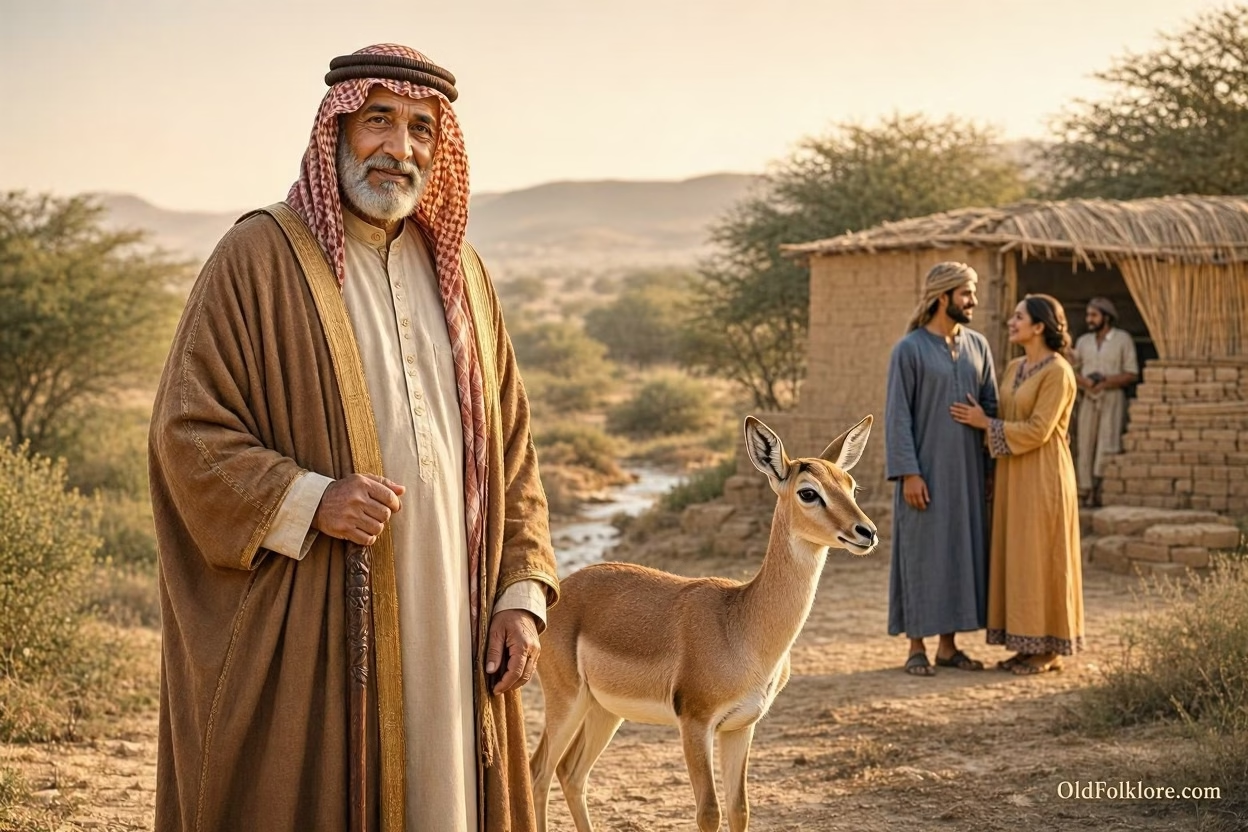
The Shaykh began his account by explaining to the Jinni that the gazelle standing beside him was once his wife. She was his paternal uncle’s daughter, and he had married her when she was still a young woman.
They lived together for nearly thirty years. Although their marriage lasted a long time, they had no children. The Shaykh wanted a son, and eventually he took a concubine who gave birth to a beautiful boy.
The child became the centre of his father’s affection. He had bright eyes, finely shaped eyebrows and well-formed limbs. As the years passed, he grew into a handsome young man. His father watched him mature and took great pride in him.
The boy reached the age of fifteen, and the Shaykh continued to care for him. He had no reason to suspect that his household concealed a danger that would soon separate him from his only son.
His first wife had learned magic and enchantment during her childhood. She possessed knowledge that she kept hidden from her husband, and her resentment towards the concubine and her son eventually drove her to use it against them.
The Wife’s Terrible Enchantment
One day, the Shaykh needed to travel to several cities to attend to his business. He carried a considerable amount of merchandise and expected to be away for some time.
His departure gave his wife the opportunity she had been waiting for. She used her magical knowledge to transform the fifteen-year-old boy into a calf. She also transformed his mother into a heifer.
After changing their forms, she handed both animals over to the care of the herdsman. The boy and his mother could no longer appear before the household as human beings, and the Shaykh remained unaware of what had happened.
Explore more stories from our The Arabian Nights collection.
When he eventually returned from his journey, he asked his wife about his son and the boy’s mother.
She gave him a false account. She claimed that the concubine had died and that the boy had run away. She also said that she did not know where he had gone.
The news devastated the Shaykh. He had loved his son deeply, and the thought that the boy had disappeared without explanation filled him with grief. He mourned for an entire year, with tears and sorrow occupying his days.
His wife watched him suffer while keeping the truth hidden.
The Heifer at the Festival
When the time came for the Great Festival of Allah, the Shaykh sent for his herdsman. He instructed the man to select a fat heifer for the occasion.
The herdsman brought an animal that was, unknown to the Shaykh, his former concubine. The magical transformation had changed her into a heifer, but it had not erased her identity.
The Shaykh prepared to sacrifice the animal. He took up a knife and approached her, intending to carry out the religious observance.
As he came closer, the heifer began to low. Tears ran from her eyes, and her cries moved him. He was surprised by the animal’s distress and felt pity for it.
He stopped and asked the herdsman to bring him another animal.
His cousin, however, urged him to proceed. She insisted that the heifer was the fattest and fairest among the animals and should not be spared.
The Shaykh listened to her and approached the animal again. But the heifer cried and wept once more. Her distress troubled him, and although he could not understand why she reacted so strangely, he decided not to kill her himself.
He instructed the herdsman to slaughter and skin the animal instead.
The herdsman carried out the order, but when he examined the carcass, he found almost no flesh or fat. The animal was little more than skin and bone.
The Shaykh regretted what had happened. He had ignored his pity and allowed the animal to be killed, only to discover that the sacrifice had yielded nothing.
He then asked the herdsman to bring him a fat calf.
The Calf That Recognised Its Father
The herdsman returned with a calf. This animal was the Shaykh’s own son, still trapped in the form imposed by his father’s wife.
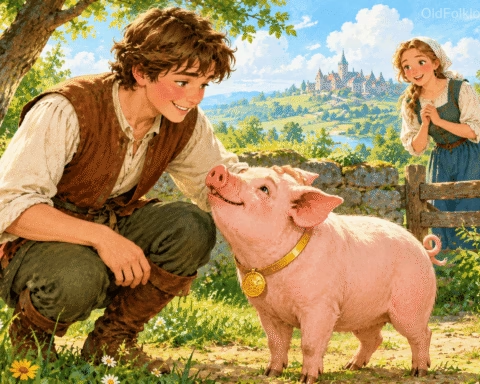
As soon as the calf saw the Shaykh, it broke free from its tether and ran towards him. It fawned upon him, cried and shed tears.
The sight touched the father’s heart. Although he did not recognise the calf as his son, he felt a strong sense of compassion towards it.
He could not bring himself to kill the animal. Remembering what had happened with the heifer, he decided to spare it and ordered the herdsman to bring another animal instead.
His cousin became furious. She insisted that he must sacrifice the calf because it was a holy day and the animal was the finest among the herd.
The Shaykh refused to obey her. He reminded her that the previous heifer had appeared fat and suitable for sacrifice, yet its body contained almost no flesh. He regretted having allowed that animal to be killed and would not repeat the same mistake.
His wife continued to pressure him. She even questioned his manhood and declared that she would no longer remain his wife if he refused to kill the calf.
The Shaykh did not understand the reason for her anger. He knew nothing about the enchantment or the identity of the animal standing before him.
Despite his reluctance, he approached the calf with a knife in his hand.
At this point, the night ended, and Shahrazad paused her narration until the following evening.
The Herdsman’s Daughter Reveals the Truth
When Shahrazad continued the story on the second night, she explained that the Shaykh had decided not to kill the calf. He ordered the herdsman to take it away and keep it among his animals.
His cousin was displeased, but she could not persuade him to change his mind.
The following day, the herdsman came to the Shaykh with news that would bring him great happiness. He explained that he had a daughter who had learned magic as a child from an old woman who lived with their family.
The previous day, when the herdsman had brought the calf home, his daughter had seen it and reacted strangely. She covered her face, then began to laugh and weep.
Her father asked what had caused such unusual behaviour.
The young woman explained that the calf was not an ordinary animal. It was the Shaykh’s son, whom his stepmother had transformed through magic. She also revealed that the boy’s mother had suffered the same enchantment.
The young woman had laughed because she recognised the calf’s true identity. She had wept because she understood that the calf was grieving for its mother, whom the Shaykh had unknowingly ordered to be killed.
The herdsman was astonished by his daughter’s revelation. Once he understood what she had discovered, he hurried to inform his master.
The Shaykh could hardly contain his excitement. He accompanied the herdsman to his home, eager to learn whether the news was true.
When he arrived, the calf approached him just as it had done before. It fawned upon him, showing the same affection that had first moved him to spare its life.
The Shaykh asked the herdsman’s daughter whether the animal was truly his son.
She confirmed that it was. The father was overwhelmed with joy and asked her to release the boy from the enchantment.
The Conditions for Breaking the Spell
The Shaykh offered the young woman all the cattle and property under her father’s care if she could restore his son to human form.
She declined the offer of wealth. Instead, she explained that she had two conditions.
First, the Shaykh must agree to marry her to his son. Second, she must be allowed to use her magic against the woman who had enchanted the boy. She wanted to ensure that the wicked stepmother could no longer harm them.
The Shaykh accepted both conditions. He promised the young woman the cattle and household property as well, and he agreed that she could deal with his cousin as she considered necessary.
The herdsman’s daughter then prepared a cup of water. She recited an enchantment over it and sprinkled the water upon the calf.
She called upon the power of Allah, declaring that if the animal had been created as a calf, it should remain in that form. But if magic had changed it, it should return to its original human shape by the command of Allah.
As soon as the water touched the calf, its body trembled and changed. The animal gradually regained its human form.
The Shaykh’s son stood before him once again.
His father embraced him and asked him to explain everything that had happened. The young man then revealed how his stepmother had transformed him and his mother while his father was away.
The Shaykh finally understood the truth behind the disappearance of his son and the strange behaviour of the heifer he had ordered to be slaughtered. His beloved concubine had been the animal whose tears had moved him, but he had failed to recognise her before her death.
His joy at recovering his son was therefore accompanied by sorrow for the woman he had unknowingly sacrificed.
The Stepmother Becomes a Gazelle
The herdsman’s daughter fulfilled the second condition she had made before breaking the enchantment.
She used her magic against the Shaykh’s first wife and transformed her into a gazelle. The animal was the same gazelle that the Shaykh now led beside him as he told his story to the Jinni.
The Shaykh then arranged for his son to marry the herdsman’s daughter. He honoured the agreement he had made with her and gave her the cattle and household property under her father’s care.
The young woman had restored the boy’s human form and protected him from the woman who had used magic against him. Her actions brought the father and son together again, although the boy’s mother could not be restored because she had already been killed.
The herdsman’s daughter remained with the family. She and the young man lived together until she eventually died.
After her death, the Shaykh’s son travelled to the cities of Hind. His father did not see him again for some time.
The Shaykh, meanwhile, continued to keep the gazelle with him. He travelled from one place to another, seeking news of his son. His journey eventually brought him to the place where he encountered the merchant and the Jinni.
There, he offered to tell the Jinni the story of his life with the gazelle. If the Jinni found the account sufficiently extraordinary, he would grant the merchant a third of his life as a reprieve.
The Jinni agreed to hear him.
The Shaykh completed his account, explaining how his wife had transformed his son and the boy’s mother, how he had unknowingly sacrificed the latter, and how the herdsman’s daughter had restored his son and turned his cousin into a gazelle.
The Jinni found the tale remarkable and granted the Shaykh’s request. He promised him a third of the merchant’s blood, allowing the merchant to escape part of the punishment he faced.
Thus, the Shaykh’s family tragedy became part of the larger story of the merchant and the Jinni.
Explore our complete Historic Folklore & Fairy-Tale Collections archive.
Moral Lesson
The story explores the destructive effects of jealousy, deception and the misuse of power. The Shaykh’s first wife allowed resentment to control her actions and used magic to separate a father from his child. Her actions caused suffering and eventually brought about her own transformation.
The tale also highlights the importance of compassion. The Shaykh’s decision to spare the calf, despite his wife’s pressure, allowed his son to survive. It further shows that knowledge and courage can help overcome harmful actions, as demonstrated by the herdsman’s daughter.
Knowledge Check
1. Who was the gazelle before she was transformed?
She was the Shaykh’s first wife, who was also his paternal uncle’s daughter.
2. Why did the Shaykh take a concubine?
He had been married to his first wife for nearly thirty years without having a child, and the concubine later gave birth to his son.
3. What did the Shaykh’s first wife do while he was away?
She used magic to transform his son into a calf and the boy’s mother into a heifer.
4. Why did the Shaykh spare the calf during the festival?
The calf cried, fawned upon him and moved him to pity. He also regretted having allowed the previous heifer to be slaughtered.
5. How did the herdsman’s daughter discover the calf’s identity?
She recognised through her knowledge of magic that the calf was the Shaykh’s enchanted son and that the heifer had been his mother.
6. What conditions did the herdsman’s daughter make before restoring the boy?
She asked the Shaykh to marry her to his son and allow her to use magic against the woman who had enchanted him.
Source
Adapted from “The First Shaykh’s Story,” an embedded frame-tale in “The Tale of the Trader and the Jinni,” in The Book of the Thousand Nights and a Night, Volume I, translated and annotated by Sir Richard Francis Burton. The Burton Club published the volume in 1885.
Explore More On The Arabian Nights