Long ago, in Niigata, Japan, there lived a young man named Nagao Chōsei. His father was a physician, and Nagao was being trained to follow the same profession.
Since childhood, he had been promised in marriage to O-Tei, the daughter of one of his father’s friends. Their families had agreed that the wedding would take place once Nagao completed his education. Both young people had grown up expecting to share their lives together.
But fate had other plans.
O-Tei was delicate and frequently ill. Before she reached her sixteenth year, she developed a serious illness that gradually weakened her body. The doctors could do little for her, and before long she understood that her life was coming to an end.
Explore more stories from our Lafcadio Hearn’s Kwaidan collection.
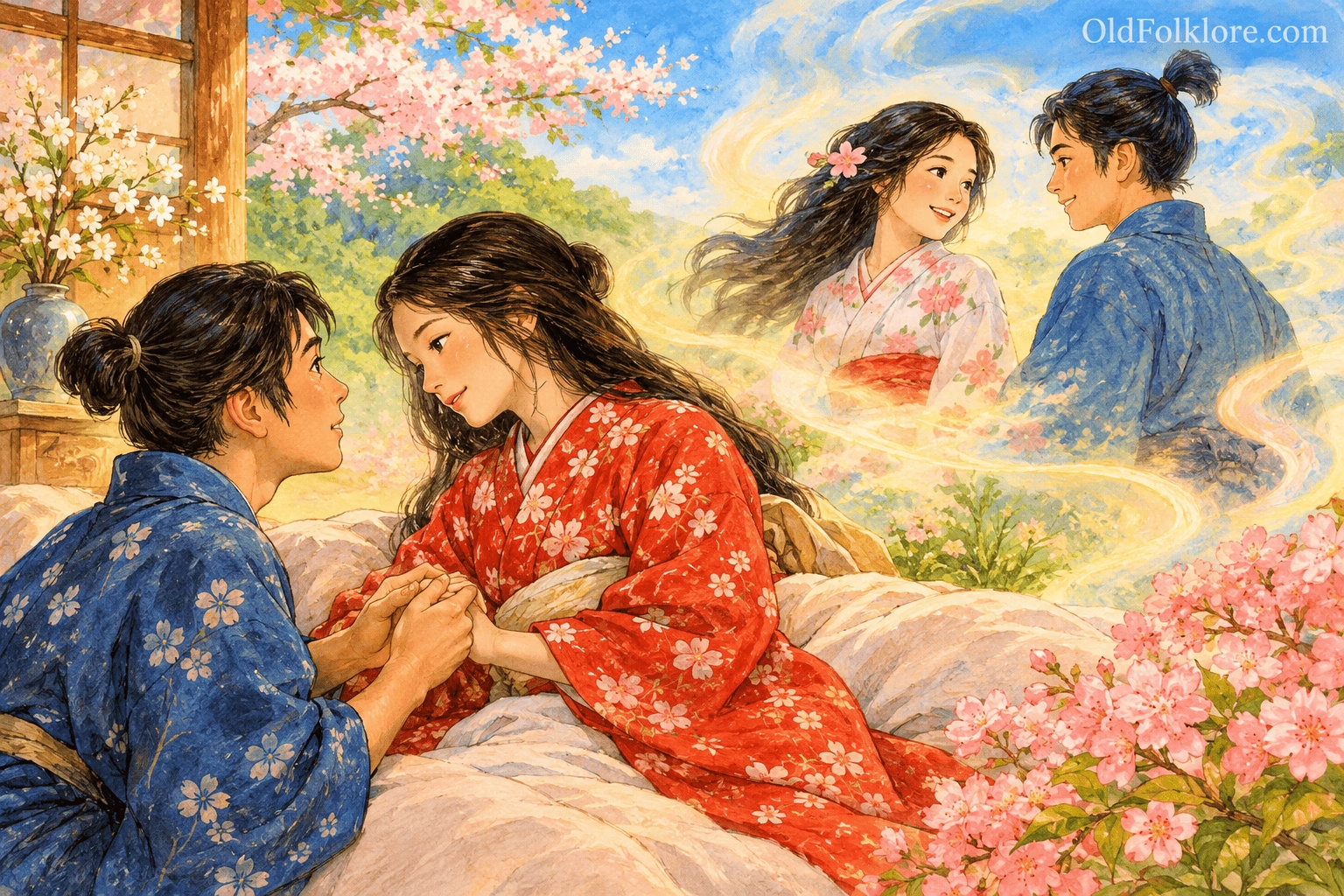
Knowing that she might never see Nagao again, she asked for him to be brought to her bedside.
When he arrived, he knelt beside her, struggling to hide his sorrow.
She looked at him with affection and spoke gently.
They had been promised to each other since childhood, she reminded him, and their wedding had been so close. Yet she could not escape the illness that was taking her life. She believed it would be selfish to wish to remain alive merely because she wanted to become his wife. Her frail condition would only bring him further suffering, and she had accepted that death was approaching.
She asked him not to grieve too deeply.
Then she told him something that surprised him.
She believed they would meet again.
Nagao immediately thought she was speaking about the Pure Land, the Buddhist realm beyond the suffering of earthly existence. He assured her that they would surely be reunited there, where separation and sorrow would no longer trouble them.
But O-Tei shook her head.
That was not what she meant.
She believed they would meet again in this very world, during his present lifetime. She would have to die, be born again as a girl and grow into a woman. The reunion might take fifteen or sixteen years, but she was certain it could happen.
Nagao was nineteen, still young enough to wait.
He promised that waiting for her would be both a joy and a duty. Their bond, he believed, was one that would endure through seven existences.
However, another thought troubled him. If O-Tei returned in a different body, with another name and an unfamiliar face, how would he recognise her?
He asked whether she could give him a sign by which he would know her.
O-Tei admitted that she could not. Only the gods and Buddhas knew where or how their paths would cross again. Nevertheless, she remained certain that she would find her way back, provided he was willing to receive her.
She asked him to remember her words.
Then her eyes closed, and she died.
A Promise Beside the Altar
Nagao was heartbroken.
He had genuinely loved O-Tei, and her death left a deep emptiness in his life. He arranged for a mortuary tablet to be made in her name and placed it inside the household Buddhist altar, known as a butsudan.
Every day, he presented offerings before it, remembering the young woman who had been promised to him.
Her final words continued to occupy his thoughts. Was it truly possible that she would return? Could two people who had loved each other in one lifetime find one another again in another?
Unable to dismiss her conviction, Nagao decided to make a promise of his own.
He wrote a solemn declaration that if O-Tei ever returned to the world in the body of a woman, he would marry her. He pressed his personal seal upon the document and placed it inside the butsudan, beside her mortuary tablet.
It was his way of keeping faith with the woman he had lost.
Nevertheless, Nagao was his parents’ only son, and his family expected him to marry. Eventually, he yielded to their wishes and accepted a bride chosen by his father.
He continued making offerings to O-Tei and remembered her with affection, even after beginning his new married life. But as time passed, the details of his former betrothed gradually faded from his memory.
Her face became less distinct, like an old dream whose details disappear upon waking.
Years went by, and tragedy continued to visit Nagao.
First, he lost his parents. Then his wife died, followed by his only child. One misfortune after another stripped away the people who had once given his life meaning.
Eventually, he found himself entirely alone.
Unable to bear the memories surrounding his former home, he abandoned it and began travelling, hoping that a change of scenery might bring some relief from his sorrow.
The Stranger at the Mountain Inn
One day, his travels brought him to Ikao, a mountain village celebrated for its hot springs and beautiful surroundings.
He found accommodation at a local inn, where a young woman was assigned to attend to his needs.
The moment she entered his room, Nagao was struck by an extraordinary feeling.
Her face reminded him of someone he had known long ago. He looked at her more closely, almost unable to believe what he was seeing.
As she moved about the room, bringing food, preparing the fire and arranging his belongings, the resemblance became increasingly difficult to ignore.
It was not simply her appearance. Her movements, manner and gentle presence seemed to awaken memories he had almost forgotten.
Even her voice carried a sweetness that stirred something deep within him.
Nagao could no longer contain his curiosity.
He politely asked the young woman where she came from and what her name was. He explained that she bore an astonishing resemblance to someone he had known many years earlier.
The moment he finished speaking, she answered.
Her words came in the familiar voice of someone he had believed lost forever.
She told him that her name was O-Tei.
She recognised him as Nagao Chōsei of Echigo, the man to whom she had been promised in marriage.
Then she began recounting events from seventeen years earlier.
She described how she had died in Niigata while still a young girl. She remembered their final conversation, his promise to wait for her and the written declaration he had sealed with his personal mark.
She knew exactly where he had placed the document: inside the butsudan, beside the mortuary tablet bearing her name.
She had returned, she explained, because he had made that promise.
Nagao listened in complete astonishment.
The woman before him was not merely someone who resembled his former betrothed. She knew things that no stranger could reasonably have known.
But just as she finished speaking, she suddenly collapsed and lost consciousness.
The Reunion
When the young woman recovered, Nagao married her.
Their marriage proved to be a happy one, and the two began a new life together.
Yet something remarkable remained unresolved.
Although O-Tei had recognised Nagao at the inn and recalled the circumstances of her former death, she never remembered that experience again.
She could not recall their childhood engagement, her death in Niigata, the promise made at her bedside or the written declaration Nagao had placed beside her mortuary tablet.
Even the extraordinary words she had spoken at Ikao disappeared from her memory.
It was as though the recollection of her former existence had briefly awakened at the precise moment she encountered the man she had once loved, only to sink back into obscurity.
Nagao, however, had found the woman he thought he had lost forever.
And the promise made beside a dying girl’s bed had finally been fulfilled.
Explore our complete Historic Folklore & Fairy-Tale Collections archive.
Moral
True affection is not always dependent on physical appearance, familiarity or the memories shared between two people. The story suggests that love, loyalty and promises may possess a significance that extends beyond what ordinary human understanding can explain.
Knowledge Check
1. Who were Nagao Chōsei and O-Tei?
Nagao was the son of a physician, while O-Tei was the daughter of his father’s friend. They had been promised to each other in marriage since childhood.
2. What did O-Tei predict before her death?
She believed she would be reborn as a girl and eventually meet Nagao again in the same world.
3. How did Nagao preserve his promise?
He wrote a declaration promising to marry O-Tei if she returned in another woman’s body, sealed it and placed it beside her mortuary tablet in the household Buddhist altar.
4. How did Nagao recognise O-Tei’s return?
He encountered a young woman at an inn in Ikao whose appearance, movements and voice reminded him of his former betrothed. She then identified herself and recalled the details of their previous relationship.
5. Why is the ending particularly mysterious?
O-Tei remembered her former life and recognised Nagao during their meeting, but afterwards lost all recollection of that existence.
6. Which religious and cultural ideas shape the story?
The narrative draws upon Japanese Buddhist vocabulary and beliefs concerning rebirth, the Pure Land, mortuary tablets and household Buddhist altars.
Source
Lafcadio Hearn, Kwaidan: Stories and Studies of Strange Things (Boston and New York: Houghton, Mifflin and Company, 1904), “The Story of O-Tei.”
Explore More On Lafcadio Hearn’s Kwaidan