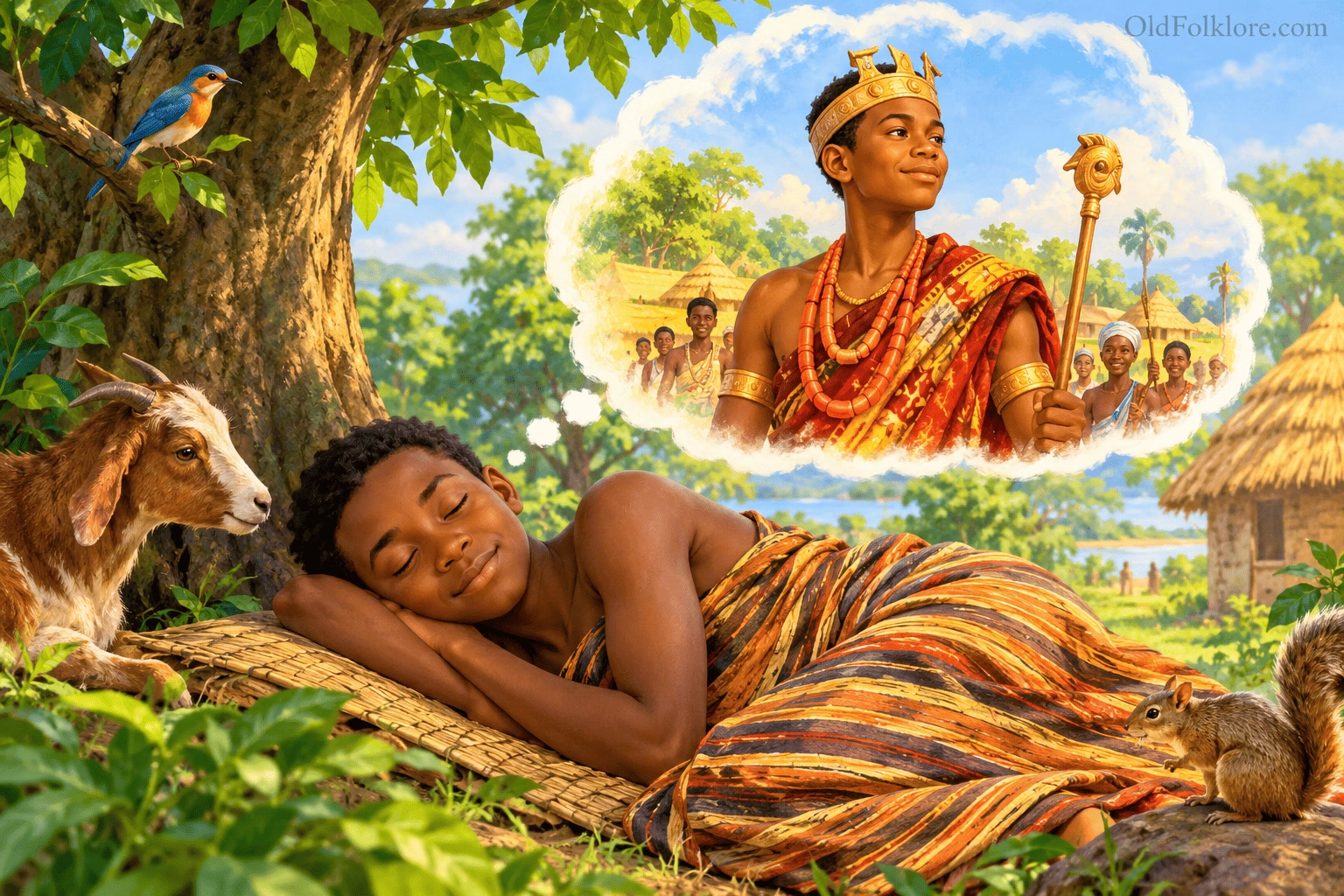
In the district of Toïchi in Yamato Province, Japan, there lived a gōshi named Miyata Akinosuké. In his garden stood a great, ancient cedar tree, beneath which he often rested when the afternoon grew hot.
One warm day, Akinosuké sat beneath the tree with two friends of the same rank. They chatted and drank wine together until a heavy drowsiness overcame him. Apologising for his inability to remain awake, he lay down at the foot of the cedar and soon fell asleep.
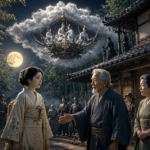
As he dreamed, he saw a magnificent procession approaching from a nearby hill. It was more splendid than any procession he had ever witnessed. Young men in rich clothing walked at its head, pulling an elaborate carriage decorated with brilliant blue silk.
Explore more stories from our Lafcadio Hearn’s Kwaidan collection.
When the procession stopped near his house, a richly dressed official stepped forward and bowed deeply.
“Honoured sir,” the man announced, “I am a servant of the King of Tokoyo. My master commands me to greet you and requests your presence at his palace. He has sent this carriage to convey you there.”
Akinosuké was too astonished to reply. Almost as though his own will had disappeared, he obeyed the official and entered the carriage.
The procession turned southward, carrying him away from his garden and into a world he had never known.
A Marriage to the King’s Daughter
Before long, the carriage stopped before an enormous two-storeyed gateway. The official left to announce Akinosuké’s arrival, and two noblemen soon appeared to escort him inside.
They led him through a vast garden to a palace of extraordinary size and splendour. Servants brought refreshments, and Akinosuké was seated in a place of honour.
After he had eaten, the two attendants explained the reason for his summons.
“The King wishes you to become the husband of his only daughter. Your marriage is to take place today.”
They dressed Akinosuké in magnificent ceremonial robes and a regal headdress, then escorted him into the royal audience chamber. There, the King of Tokoyo sat in state, surrounded by dignitaries dressed in splendid garments.
The King welcomed Akinosuké and confirmed that he had chosen him as the adopted husband of his only daughter.
Music filled the palace as a procession of court ladies led the bridegroom to the wedding chamber. The King’s daughter appeared radiant in beautiful robes, and the assembled guests bowed as Akinosuké took his place before her.
Their marriage was celebrated with great joy. Afterwards, the newlyweds were escorted to their private apartments, where noble guests presented them with congratulations and countless wedding gifts.
Akinosuké had entered the palace as an ordinary man. Now he was the King’s son-in-law, surrounded by wealth, honour, and the promise of a remarkable future.
Governor of the Island of Raishū
Several days after the wedding, the King summoned Akinosuké once more.
This time, he entrusted his new son-in-law with an important responsibility. In the southwestern part of the kingdom lay an island called Raishū, whose people were described as loyal and obedient. The King appointed Akinosuké its governor, charging him with improving the island’s laws and customs and ruling its inhabitants with kindness and wisdom.
Everything was prepared for the journey. Akinosuké and his bride departed the palace accompanied by nobles and officials, then boarded a royal ship that carried them across the sea.
When they arrived at Raishū, the islanders gathered along the shore to welcome their new governor and his wife.
Akinosuké soon settled into his duties. During his first three years, he worked on establishing laws and regulating the affairs of the island. Wise advisers assisted him, and the work brought him little difficulty.
Once these arrangements were completed, his responsibilities became lighter. He mainly attended the ceremonies required by ancient custom.
Raishū proved to be an exceptionally peaceful place. The land was fertile, the climate healthy, and its people lived without the sickness, poverty, and lawlessness that might trouble other communities.
Akinosuké’s life there was filled with happiness. He governed the island for twenty-three years, enjoying a peaceful marriage and raising seven children with his wife: five sons and two daughters.
For all those years, sorrow seemed to have no place in his world.
The Death of the Princess
In the twenty-fourth year of his governorship, disaster struck.
Akinosuké’s beloved wife fell ill and died. Her burial was conducted with great ceremony on the summit of a beautiful hill in the district of Hanryōkō. A magnificent monument was erected over her grave.
But no monument could ease Akinosuké’s grief. Having lost the woman he loved, he no longer felt any desire to continue living.
When the official mourning period ended, a royal messenger arrived from the palace of Tokoyo. He brought words of condolence from the King and a message that Akinosuké was to return to his own country.
The King also assured him that his seven children, who were royal grandchildren, would receive proper care.
Akinosuké accepted the command. After settling his affairs and bidding farewell to his counsellors and trusted officials, he was escorted to the harbour with great honour.
He boarded the royal ship, and it sailed into the open sea beneath a clear blue sky.
As the vessel carried him away, the island of Raishū gradually faded from sight. First it became blue, then grey, until it disappeared altogether.
At that very moment, Akinosuké awoke.
He was lying beneath the ancient cedar tree in his own garden.
The Butterfly and the Ants
For a moment, Akinosuké could hardly understand what had happened. His two friends were still sitting beneath the cedar, chatting and drinking as though nothing unusual had occurred.
“How strange!” he exclaimed.
His companions laughed and asked him what he had seen. Akinosuké then described the royal procession, his marriage to the King’s daughter, his appointment as governor of Raishū, and the twenty-three years he had spent on the island. His friends listened in astonishment. He had been asleep for only a few minutes.
One of them then told him something equally curious. While Akinosuké had been sleeping, they had watched a little yellow butterfly flutter around his face. It had eventually settled on the ground near the cedar, where a large ant emerged from a hole and dragged it underground.
Just before Akinosuké awoke, the same butterfly had emerged from the hole, fluttered around his face once more, and vanished.
“Perhaps that butterfly was Akinosuké’s soul,” suggested one friend. He thought he had even seen it fly into Akinosuké’s mouth, though he could not explain how this might account for the extraordinary dream.
The other friend wondered whether the ants might hold the answer. Perhaps, he suggested, they were not ordinary creatures at all. There was certainly a large ant colony beneath the cedar tree.
Moved by this possibility, Akinosuké fetched a spade, and the three men examined the ground beneath the tree.
What they discovered amazed them. An enormous colony of ants had excavated the earth and constructed a network of tiny dwellings from straw, clay, and plant stems. These little structures resembled miniature towns.
At the centre stood a construction much larger than the others. Countless small ants swarmed around the body of a particularly large ant with yellowish wings and a long black head.
Akinosuké stared in disbelief.
“There is the King of my dream!” he cried. “And there is the palace of Tokoyo!”
He began identifying other parts of the colony with the places he had visited in his dream. He believed that the island of Raishū must lie somewhere to the southwest of a large root. Searching further, he became convinced that he could locate the hill of Hanryōkō and the princess’s grave.
He searched among the ruined passages and broken structures until he finally found a tiny mound. A water-worn pebble, shaped like a Buddhist monument, rested on top of it.
Beneath the mound, embedded in the clay, lay the dead body of a female ant.
The discovery left Akinosuké with a mystery he could not explain. He had dreamed of a kingdom, a marriage, children, years of peaceful rule, and the death of his wife. Now, beneath the tree where he had taken a brief nap, he had found an ant colony whose tiny inhabitants seemed to mirror the world he had visited in his sleep.
The dream was over, but its strange details remained.
Explore our complete Historic Folklore & Fairy-Tale Collections archive.
Moral
The story suggests that human experience is more mysterious than it first appears. Happiness, grief, time, and the boundaries between dreams and waking life may not always be as straightforward as we assume. It also reminds us that even an apparently complete lifetime can vanish in a moment, leaving behind questions that have no easy answers.
Knowledge Check
1. Who is Akinosuké?
Akinosuké is a gōshi, a member of the privileged warrior-farmer class in feudal Japan.
2. How does Akinosuké enter the kingdom of Tokoyo?
He falls asleep beneath a cedar tree and dreams that a royal procession arrives to escort him to the King’s palace.
3. What happens during his life on Raishū?
He becomes governor, marries the King’s daughter, raises seven children, and enjoys twenty-three years of peaceful life before his wife dies.
4. How long is Akinosuké actually asleep?
Only a few minutes, despite experiencing what seems to be more than two decades of life.
5. What do Akinosuké and his friends discover beneath the cedar tree?
They find an enormous ant colony containing miniature structures that resemble the places in his dream, including a mound beneath which lies a dead female ant.
Source
Lafcadio Hearn, Kwaidan: Stories and Studies of Strange Things. Boston and New York: Houghton Mifflin Company, first published in April 1904.
Explore More Lafcadio Hearn’s Kwaidan Tales