In a village in Musashi Province, two woodcutters named Mosaku and Minokichi travelled together to a nearby forest each day. Mosaku was an old man, while Minokichi, his apprentice, was only eighteen years old.
One winter evening, they were returning home when a fierce snowstorm overtook them. They reached the river crossing but discovered that the ferryman had gone away, leaving his boat on the opposite bank. With the storm growing stronger, the two men took shelter in the ferryman’s small hut.
The shelter offered little protection. It had a single door, no window and no place to light a fire. Mosaku and Minokichi fastened the door and lay down beneath their straw raincoats, hoping the storm would soon pass.
Mosaku quickly fell asleep. Minokichi remained awake for some time, listening to the howling wind and the snow striking the door. The river roared nearby, and the hut shook beneath the force of the storm. Eventually, the exhausted young man also fell asleep.
The Woman in White
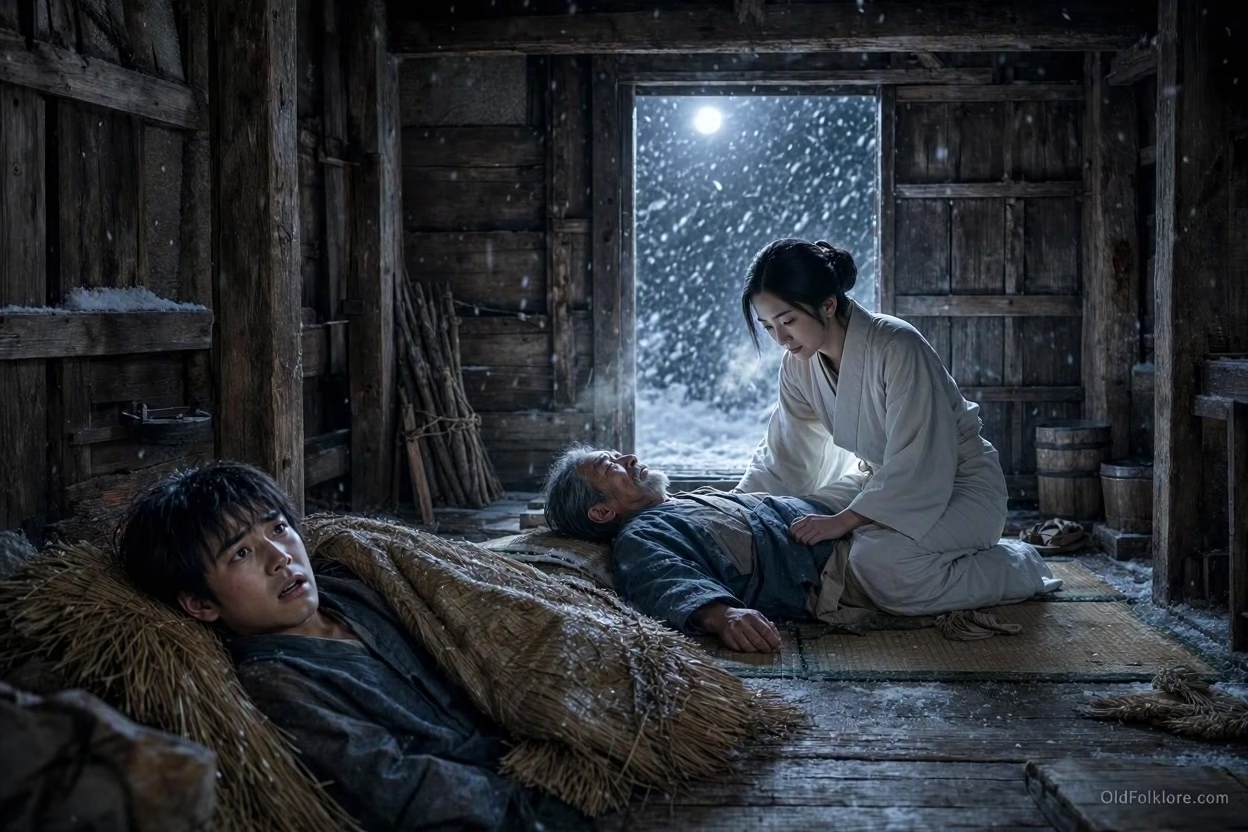
Minokichi awoke when snow blew into his face. The door had been forced open, and a strange woman stood inside the hut. She was dressed entirely in white.
The woman bent over Mosaku and blew her breath upon him. It resembled a stream of bright white smoke. She then turned towards Minokichi and leaned over him.
Although she was beautiful, her eyes filled him with fear. He tried to cry out but discovered that he could not make a sound.
The woman watched him for a moment before speaking. She explained that she had intended to treat him as she had treated the older woodcutter. However, she felt pity for Minokichi because he was so young. She would spare his life, but only on one condition.
He must never tell anyone what he had witnessed that night, not even his own mother. If he revealed the secret, she warned, she would find out and kill him.
After delivering her threat, the woman passed through the doorway and disappeared into the storm.
Minokichi found that he could move again. He hurried to secure the door, then reached out to awaken Mosaku. When he touched the old man’s face, he discovered that it was as cold as ice.
Mosaku was dead.
At dawn, the storm finally subsided. The ferryman returned and found Minokichi unconscious beside the frozen body. The young woodcutter was taken care of and eventually recovered, although the experience left him ill for a long time.
Explore more stories from our Lafcadio Hearn’s Kwaidan collection.
He never told anyone about the woman in white. Whether she had truly appeared before him or whether he had experienced a terrible vision remained a question he kept to himself.
The Arrival of O-Yuki
When Minokichi recovered, he returned to his work. He went alone to the forest each morning and carried his bundles of wood home at night, where his mother helped him sell them.
During the winter of the following year, he met a young woman on the road. She was tall, slender and remarkably beautiful. Her voice was pleasant, and the two began walking together as they talked.
The woman introduced herself as O-Yuki. She explained that she had recently lost both parents and was travelling to Yedo, where she hoped to find work with the help of distant relatives.
Minokichi was charmed by her. He asked whether she was engaged to be married, and she replied that she was free. When she asked him the same question, he explained that he was unmarried and still lived with his widowed mother.
As they continued their journey, the young couple grew increasingly fond of each other. By the time they reached the village, Minokichi was reluctant to part from her. He invited O-Yuki to rest at his home.
His mother welcomed the visitor and prepared a warm meal. O-Yuki behaved so graciously that the older woman immediately took a liking to her. She persuaded the young woman to delay her journey to Yedo.
O-Yuki never resumed that journey. Instead, she remained in the household and became Minokichi’s wife.
A Happy Family
O-Yuki proved to be a devoted wife and a good daughter-in-law. She cared for Minokichi’s mother, who continued to speak of her with affection until her death about five years later.
The couple had ten children, all described as handsome and fair-skinned. The villagers admired O-Yuki because she seemed different from the other women in their community. Even after giving birth to ten children, she retained the youthful appearance she had possessed when she first arrived.
Years passed, and the dreadful night in the ferryman’s hut became a distant memory for Minokichi. He had kept his promise and never spoken of the strange woman who had spared his life.
One night, however, he watched O-Yuki sewing beside a paper lamp. The light falling across her face reminded him of the woman he had encountered during the snowstorm many years earlier.
He began telling his wife about the frightening experience he had endured as an eighteen-year-old apprentice. He described the storm, the woman dressed in white, her strange breath and Mosaku’s frozen body.
Minokichi admitted that he had never been certain whether the encounter had been a dream or a meeting with the mysterious Woman of the Snow.
As he spoke, O-Yuki stopped sewing.
The Broken Promise
O-Yuki suddenly rose and confronted her husband. She revealed that she was the very woman he had seen in the ferryman’s hut.
She reminded him that she had warned him never to tell anyone about that night. His words had broken the promise that had allowed him to live.
Furious, she declared that she would kill him immediately if their sleeping children were not present. She then warned him to care for the children properly, threatening that she would punish him if they ever had reason to complain about him.
As she spoke, her voice grew thin and strange, like the sound of the wind. Before Minokichi could respond, O-Yuki began to dissolve into a bright white mist. The mist rose towards the roof beams and disappeared through the smoke-hole.
O-Yuki was never seen again.
Minokichi was left with the memory of the woman who had spared him in his youth, shared his home for years and finally vanished after he revealed the secret she had forbidden him to tell.
The Meaning of Yuki-Onna
Yuki-Onna is a haunting tale in which an ordinary winter journey leads to an encounter with a supernatural being. The story moves from the terror of the snowstorm to the apparent happiness of Minokichi’s marriage before returning to the mystery that has shaped his life.
Minokichi’s silence protects him for many years, but his decision to speak eventually brings the past into his home. The ending leaves the reader with the unsettling image of O-Yuki disappearing like mist, taking her secret with her.
The tale’s lasting power comes from the contrast between O-Yuki’s loving life as a wife and mother and the deadly presence Minokichi first encountered in the snow. Her final departure transforms an apparently ordinary family story into a chilling supernatural legend.
Explore our complete Historic Folklore & Fairy-Tale Collections archive.
Moral Lesson
Yuki-Onna reminds readers that promises can carry serious consequences and that some mysteries may be dangerous to reveal. It also shows how the past can remain hidden for years before a single conversation changes everything.
Knowledge Check
1. Who were the two woodcutters in the story?
Mosaku, an old woodcutter, and Minokichi, his eighteen-year-old apprentice.
2. Why did the woodcutters shelter in the ferryman’s hut?
A severe snowstorm prevented them from crossing the river because the ferryman’s boat was on the opposite bank.
3. Why did the woman in white spare Minokichi?
She felt pity for him because he was young.
4. What promise did Minokichi make to the woman?
He promised never to tell anyone, including his mother, about their encounter.
5. How did O-Yuki become part of Minokichi’s family?
She met him on the road the following winter, visited his home and stayed after his mother welcomed her.
6. What happened when Minokichi told O-Yuki about the woman in white?
O-Yuki revealed her supernatural identity, threatened him for breaking his promise and disappeared as a white mist.
Source
Source: “Yuki-Onna,” in Lafcadio Hearn’s Kwaidan: Stories and Studies of Strange Things (1904). Hearn explained that a farmer from Chōfu in Musashi Province had told him the tale as a legend associated with his native village.
Explore More Lafcadio Hearn’s Kwaidan Tales