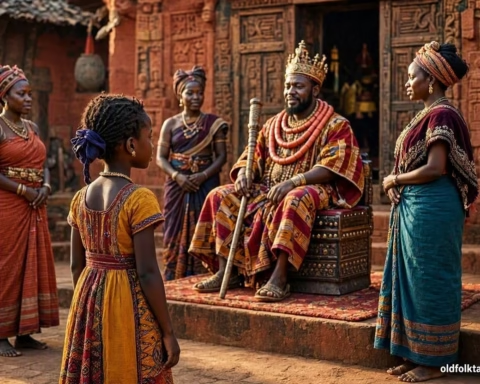
Long ago, when King Eyo III ruled over both humans and animals, he maintained a great palaver house where his subjects gathered from time to time. These gatherings were occasions for feasting, drinking tombo, and discussing matters concerning the kingdom.
After every feast, the guests were allowed to make speeches. It was an opportunity for different creatures to boast about their abilities, defend their reputations, and sometimes challenge one another.
On one such occasion, the head of the driver ants rose to address the gathering. He spoke proudly of his people, declaring that they were stronger than every other creature in the kingdom. Not even the mighty elephant, he insisted, could withstand their strength.
Although his boast was considerable, there was reason to take it seriously. Driver ants were formidable creatures, moving in enormous numbers and overwhelming whatever stood in their path.
Explore more stories from our West African Folk-Tales collection.
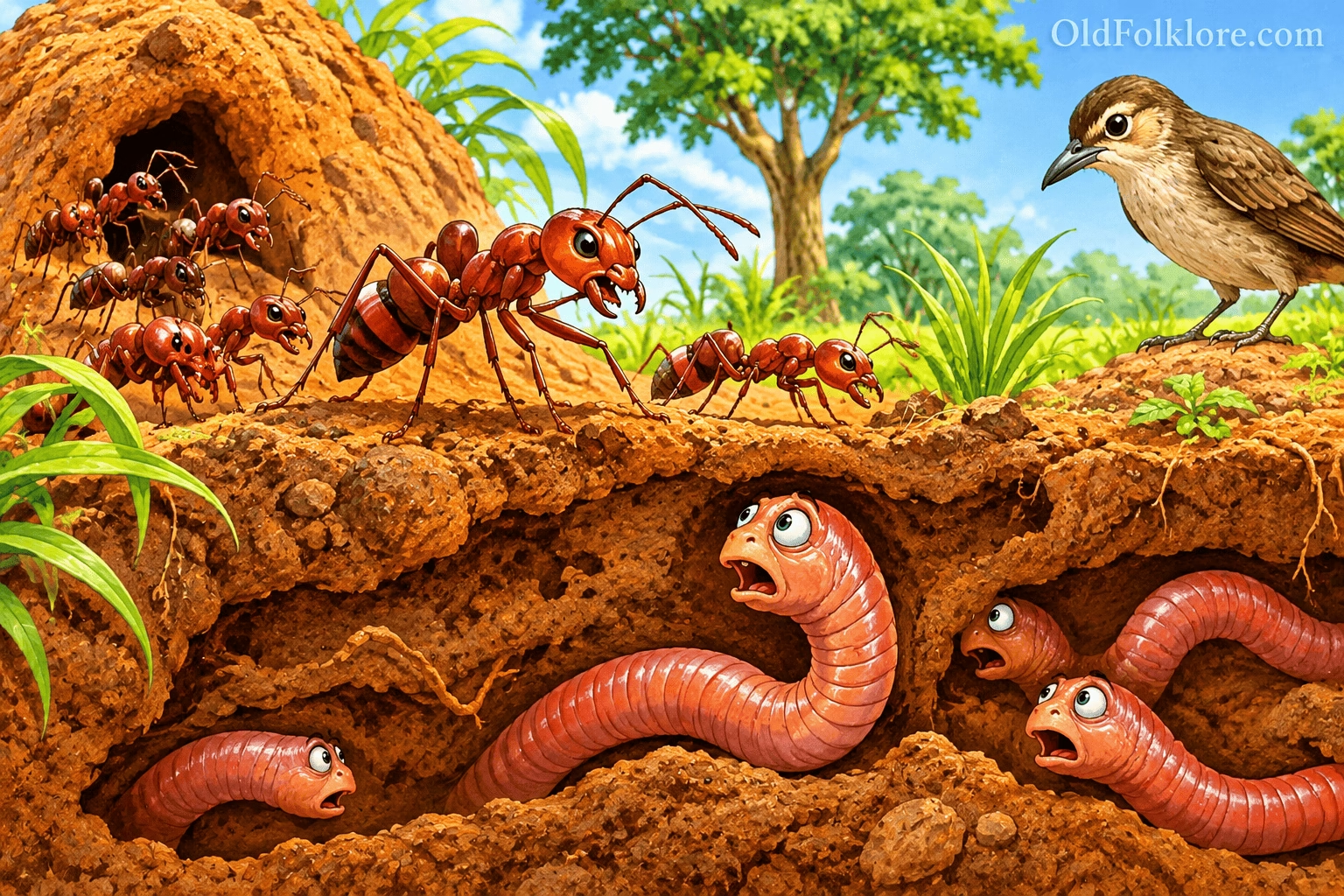
But the ant leader did not stop there. He turned his attention to the worms, whom he particularly disliked, and ridiculed them as weak, helpless creatures that could do nothing but wriggle about.
The worms were deeply offended. They protested against the insult and complained to the king, insisting that the ant leader should not be allowed to declare himself superior without being challenged.
King Eyo III listened to both sides. Rather than settle the disagreement through arguments, he proposed a contest. If the ants truly believed themselves stronger than the worms, they would have to prove it in battle.
The king ordered both sides to meet on the road and fight until the matter was decided. He appointed the third day after the feast for the contest, and word quickly spread throughout the kingdom. When the appointed day arrived, creatures gathered to witness the great encounter.
Early that morning, the driver ants emerged from their nest in their thousands and millions. They advanced in their familiar formation, marching closely together in a long, densely packed column about an inch wide. From a distance, their procession resembled a dark-brown band moving steadily across the land.
Their organisation was impressive. Scouts moved ahead to investigate the ground, while advance guards and flankers protected the approaching column. Behind them came the immense main body, advancing in countless numbers towards the appointed battlefield.
The worms were waiting.
As the ants approached, their narrow marching column spread out across the battlefield. More and more poured into the open ground until the entire area became a moving mass of ants and struggling worms.
The battle was fierce, but it did not last long. The driver ants attacked with their powerful, pincer-like jaws, biting the worms and tearing them apart. Against such overwhelming numbers and such formidable weapons, the worms stood little chance.
Within a few minutes, the contest was over. Most of the worms had been destroyed, while the few that survived escaped by wriggling away and burying themselves beneath the ground.
King Eyo III watched the outcome and declared the driver ants the clear winners. Their victory settled the dispute, and the worms had no strength left to challenge the judgement.
From that day onwards, the worms became creatures of the underground. Having suffered such a terrible defeat, they learned to remain beneath the earth, away from the dangerous ants and other creatures.
Even today, when rain brings worms up to the surface, they quickly disappear beneath the soil whenever something approaches. Their instinct is to hide, for they remember the danger that once overcame their ancestors.
And that, the story explains, is why worms live underneath the ground.
Explore our complete Historic Folklore & Fairy-Tale Collections archive.
Moral
Boasting about one’s strength and insulting others can lead to unnecessary conflict. The story also illustrates how overwhelming strength and numbers can determine the outcome of a contest, regardless of the opponent’s willingness to fight.
Knowledge Check
1. Who ruled over humans and animals in the story?
King Eyo III, who held gatherings and settled disputes among his subjects.
2. What caused the disagreement between the driver ants and the worms?
The head driver ant boasted about his people’s strength and insulted the worms, describing them as weak and insignificant.
3. How did King Eyo III decide to settle the dispute?
He ordered the driver ants and worms to meet on the road and fight, appointing the third day after the feast for the contest.
4. What made the driver ants so formidable?
They advanced in enormous numbers, organised into a dense column with scouts, an advance guard, and flankers. Their sharp jaws enabled them to overpower the worms.
5. What happened to the surviving worms?
They escaped by burying themselves beneath the ground.
6. What does the story explain?
It offers a traditional explanation for why worms live underground and quickly retreat beneath the soil when something approaches.
Source
Adapted from “Why the Worms live Underneath the Ground,” Tale XIII, in Folk Stories from Southern Nigeria, West Africa by Elphinstone Dayrell, with an introduction by Andrew Lang, published by Longmans, Green and Co. in 1910, pp. 56–57.
Explore More West African Folk-Tales
- Thunder and Anansi: A West African Folktale
- Tom Tit Tot: The Girl Who Outwitted a Terrifying Imp by Guessing His Name
- Why the Sun and the Moon Live in the Sky: A Southern Nigerian Folktale
- Igiri and the Mushroom Baby: An Ikom Folktale
- The Envier and the Envied: A Powerful Arabian Nights Tale
- The Old Man and the River Spirit
- The Enchanted Date Palm of the Oasis