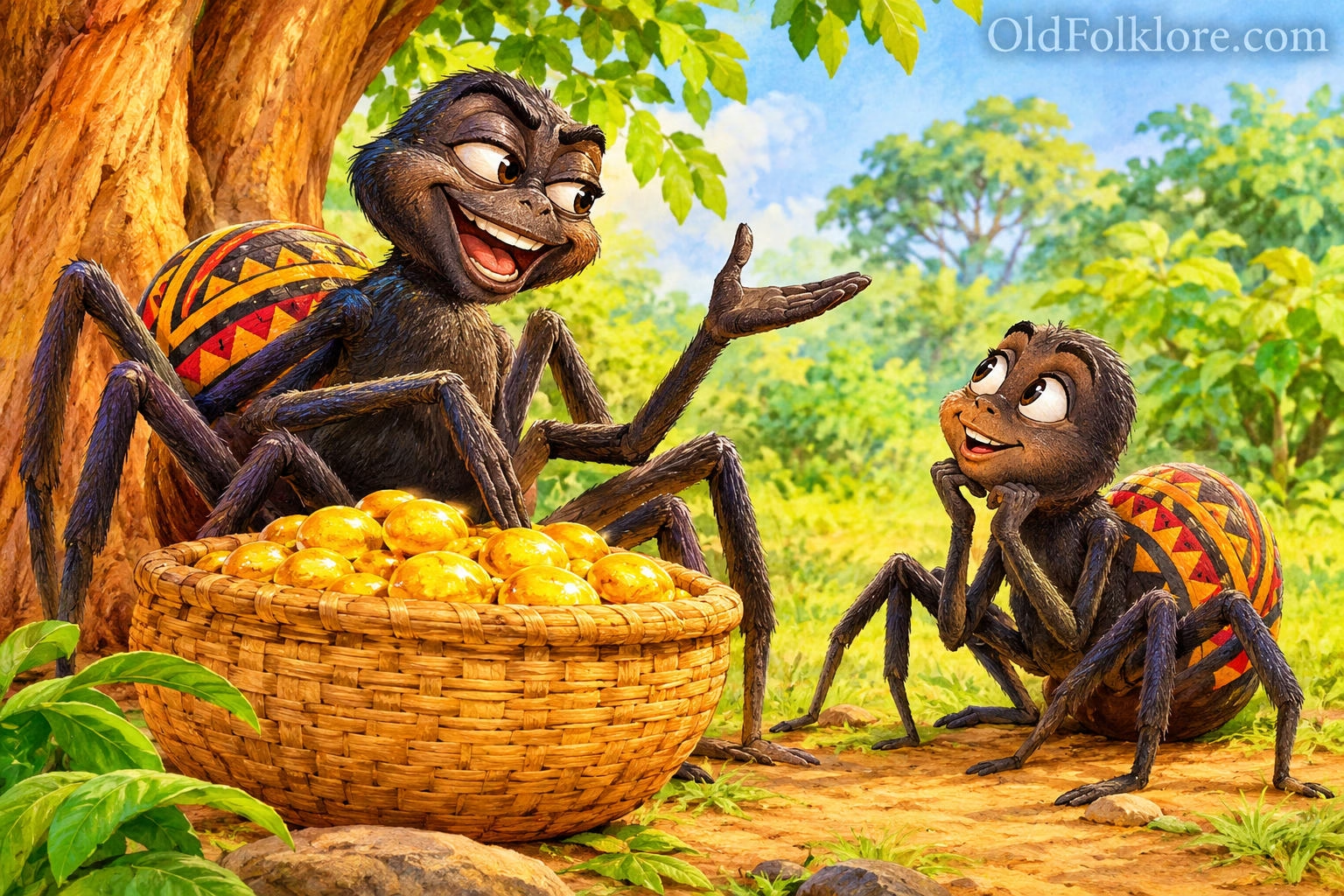
For many months, a terrible famine had troubled the land. Food was difficult to find, and meat had become so scarce that only wealthy chiefs could afford to buy it. Ordinary families struggled to feed themselves, and Anansi’s household was suffering badly.
Then, one fortunate day, Anansi’s eldest son, Kweku Tsin, discovered a part of the forest where animals were still plentiful. He began hunting there and bringing meat back to the village, where he sold it to hungry people for a good price.
But Kweku knew his father well. Anansi was a cunning and selfish man who would not hesitate to take advantage of another person’s good fortune. So the young man kept his discovery secret.
His father, however, soon noticed that Kweku was returning home with meat almost every day. Curious and suspicious, Anansi demanded to know where his son was finding so much game. Kweku refused to reveal his secret.
Explore more stories from our West African Folk-Tales collection.
Anansi was not prepared to accept defeat. If his son would not tell him willingly, he would find another way to discover the truth.
One night, while Kweku slept, Anansi crept into his room. He found the bag his son carried whenever he went hunting and secretly made a tiny hole in one corner. He then poured some ashes into it before returning the bag to its usual place.
The following morning, Kweku picked up his bag and headed into the forest, unaware of what his father had done. As he walked, the ashes trickled through the little hole, leaving a trail along the path.
Anansi waited for some time before setting out after him. Following the scattered ashes, he had no difficulty finding his son’s secret hunting ground.
When he arrived, Kweku was already there. But instead of asking his son to share the animals or allowing him to continue hunting, Anansi immediately claimed the place for himself. He declared that, according to the law of the land, the hunting ground belonged to him.
Kweku understood at once how his father had discovered the secret. Anansi had stolen his hunting ground through deception, and the young man was determined to recover what he had lost.
He returned home and set about preparing a plan.
First, he made a small image and attached little bells around its neck. Then he tied a long thread to its head and carried it back towards the forest.
About halfway along the path, he found a suitable tree branch. He hung the image from it and concealed himself among the nearby bushes, holding the other end of the thread.
Meanwhile, Anansi had been busy hunting. Determined to make as much money as possible, he killed numerous animals, skinned them and prepared their meat for sale in the neighbouring villages.
Having gathered his first load, he set off towards his own village.
As he walked along the forest path, he came upon the strange little image hanging from a tree. He stopped, uncertain about what he was seeing. It looked to him like an image of one of the gods.
Just then, the image began shaking its head vigorously.
Anansi immediately became uneasy. He suspected that the gods were displeased with him and decided that the safest thing would be to offer the image some of his meat.
“May I give you a little of this meat?” he asked.
The image shook its head.
Anansi tried again. “Would you like half of it?”
Once more, the head shook.
His patience began to wear thin. “Do you want the whole load, then?” he demanded.
At last, the image nodded.
Anansi was horrified. He had expected to make a generous profit from his hunting, not surrender everything he had gathered.
“I will not give you all my meat!” he shouted.
The little image immediately began shaking violently, its bells ringing as though it were terribly angry.
Anansi was overcome with fear. Convinced that he had offended a powerful spirit, he abandoned the entire load of meat and fled.
As he ran, he called back that the following day he would go to Ekubon, where the image would have no chance of taking his meat.
But Anansi did not realise that someone had been listening.
Hidden in the bushes, Kweku had heard every word.
The next day, he simply carried his little image to the path leading towards Ekubon and hung it from another tree. Then he concealed himself as before, waiting for his father.
Anansi arrived with another load of meat. When he encountered the image again, he was filled with dread. Once more, he tried offering it a little meat, then half his load. The image refused both offers and demanded everything.
Terrified, Anansi abandoned his meat and ran away.
The same trick continued day after day. Whenever Anansi announced that he intended to take his next load to another place, Kweku moved the image to the appropriate path. His father repeatedly encountered what he believed to be an angry divine figure and surrendered everything he had hunted.
Anansi never discovered that the mysterious image was merely part of his son’s revenge.
Eventually, every animal in the forest had been killed. Kweku Tsin had become a wealthy man through his successful hunting and trading, while Anansi remained as poor as ever.
Indeed, the tables had turned so completely that Anansi now depended on his son for food. He had to visit Kweku’s house every day to receive something to eat.
When the famine finally ended, Kweku decided to celebrate his good fortune. He organised a great feast and invited the entire village.
With everyone gathered together, he revealed how his father had discovered his hunting ground by secretly putting ashes into his bag. He then explained how he had used the little image and its bells to make Anansi abandon every load of meat he collected.
The villagers burst into laughter at the story. Anansi, who had once been so pleased with his own cleverness, was now thoroughly embarrassed. His son’s trick had exposed his greed and made him the laughing-stock of the community.
Ashamed by what had happened, Anansi promised that he would give up his wicked tricks and stop deceiving others.
But Anansi was Anansi. Although he made the promise, he did not keep it for long.
And so, even after being outwitted by his own son, the old trickster soon returned to his familiar ways.
Explore our complete Historic Folklore & Fairy-Tale Collections archive.
Moral
Those who use cunning and deception to take advantage of others may eventually fall victim to the same tricks, for dishonesty often returns to its source.
Knowledge Check
1. Why did Kweku Tsin keep his hunting ground secret from Anansi?
Because he knew his father’s selfish and deceitful nature and feared that Anansi would take the discovery for himself.
2. How did Anansi discover the location of the hunting ground?
He secretly made a hole in Kweku’s hunting bag, filled it with ashes and followed the trail they left behind.
3. How did Kweku trick his father?
He made a small image with bells around its neck, attached a thread to it and manipulated it from his hiding place to make Anansi believe it was a displeased god demanding his meat.
4. What happened to Anansi’s hunting profits?
He repeatedly abandoned his loads of meat out of fear of the mysterious image, while Kweku became wealthy.
5. What happened after the famine ended?
Kweku organised a feast, exposed his father’s deception before the villagers and embarrassed Anansi into promising to abandon his wicked tricks.
6. Did Anansi keep his promise?
No. The story ends by explaining that he soon returned to his old tricks.
Source
West African Folk-Tales (1917), collected and arranged by W. H. Barker, B.Sc., and Cecilia Sinclair.
Explore More West African Folk-Tales
- Thunder and Anansi: A West African Folktale
- Tom Tit Tot: The Girl Who Outwitted a Terrifying Imp by Guessing His Name
- Why the Sun and the Moon Live in the Sky: A Southern Nigerian Folktale
- Igiri and the Mushroom Baby: An Ikom Folktale
- The Envier and the Envied: A Powerful Arabian Nights Tale
- The Old Man and the River Spirit
- The Enchanted Date Palm of the Oasis