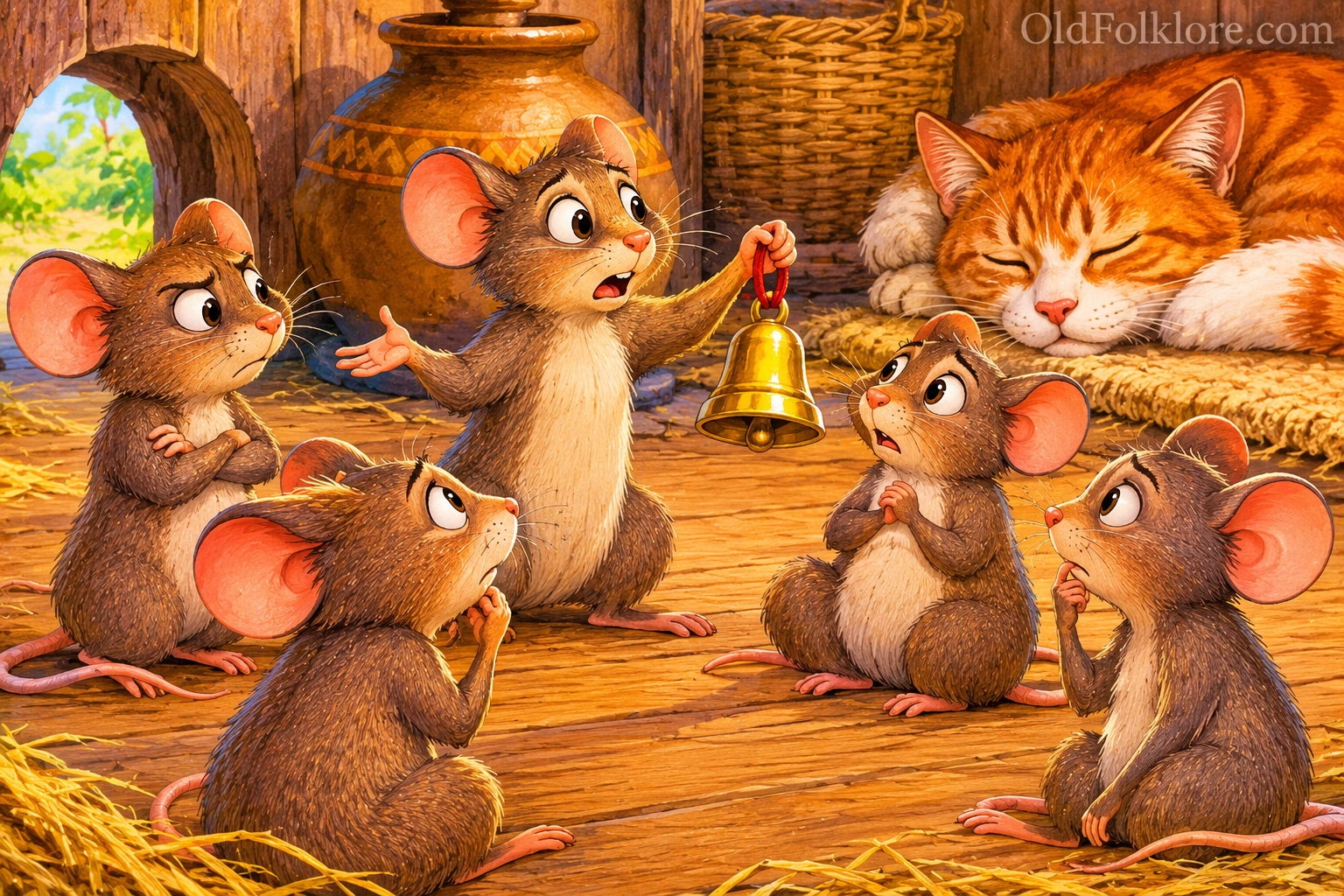
Long ago, a community of mice lived in constant fear of a cunning Cat. She was their greatest enemy, moving silently through their hiding places and catching them whenever they least expected it. No matter how carefully the mice watched their surroundings, they could never be certain when she would appear.
Tired of living under such constant danger, the mice decided to hold a general meeting. They gathered together to discuss how they could protect themselves and finally escape the threat posed by their enemy.
One mouse suggested that they should change their hiding places. Another proposed that they should become more watchful, while others offered different ideas. However, none of the suggestions seemed capable of solving their problem.
Explore more stories from our Aesop’s Fables collection.
Eventually, a young mouse stood up and asked the others to listen to his proposal.
“Our greatest danger,” he explained, “is that the Cat approaches us so quietly that we have no warning of her arrival. If we could somehow know when she was nearby, we would have enough time to escape before she could catch us.”
The mice listened with interest.
“I suggest that we find a small bell and attach it to the Cat’s neck with a ribbon. Whenever she moves, the bell will ring. We will hear the sound and know that she is approaching. That way, we can run to safety before she gets close enough to catch us.”
The idea immediately excited the gathering. The mice cheered, praised the young speaker and congratulated him on his cleverness. At last, they believed they had discovered a solution to their greatest problem.
But while the others celebrated, an old mouse slowly rose to his feet.
He had listened carefully to the proposal, and although he recognised its cleverness, he had one important question.
“Your suggestion is certainly a good one,” he said. “But there is something we have not considered.”
The mice became quiet.
“Who among us,” the old mouse asked, “will be brave enough to put the bell around the Cat’s neck?”
Suddenly, the excitement disappeared.
The mice looked at one another, waiting for someone to volunteer. Nobody moved. Nobody offered to take the responsibility. The young mouse’s clever proposal had sounded wonderful while they were discussing it, but carrying it out meant approaching the very enemy they feared most.
One by one, the mice fell silent.
The old mouse looked around the gathering and delivered his final observation:
“It is easy to propose impossible remedies.”
And with that, the meeting came to an end. The mice had discovered a clever solution in theory, but none of them was prepared to put it into practice.
Explore our complete Historic Folklore & Fairy-Tale Collections archive.
Moral
It is easier to suggest solutions to difficult problems than to take the risks and responsibility required to carry them out. A good plan must be practical, achievable and supported by people willing to act.
Knowledge Check
1. Why did the mice organise a meeting?
They wanted to find a way to protect themselves from the Cat, their common enemy.
2. What solution did the young mouse propose?
He suggested attaching a bell to the Cat’s neck so that its sound would warn the mice whenever she approached.
3. Why did the mice initially celebrate the proposal?
They believed the bell would give them enough warning to escape whenever the Cat came near.
4. What question did the old mouse ask?
He asked who would be brave enough to approach the Cat and attach the bell to her neck.
5. What is the central lesson of the fable?
A clever idea is not enough. A solution must also be practical and capable of being carried out.
Source
“Belling the Cat,” in The Fables of Aesop, attributed to Aesop, selected and retold by Joseph Jacobs, with illustrations by Richard Heighway, published by Macmillan & Co., London and New York, 1894. The fable appears in the Project Gutenberg digital edition, eBook No. 28
Explore More Aesop’s Fables
- The Hare and the Tortoise: A Timeless Fable About Patience and Perseverance
- The Fox and the Crow: How Flattery Cost a Crow Her Cheese
- The Dog and the Shadow: An Aesop Fable
- The Wolf and the Crane: An Aesop Fable