In the little Danish town of Kjøge, where the land was flat and the countryside offered few remarkable sights, two children found happiness in the gardens beside a stream.
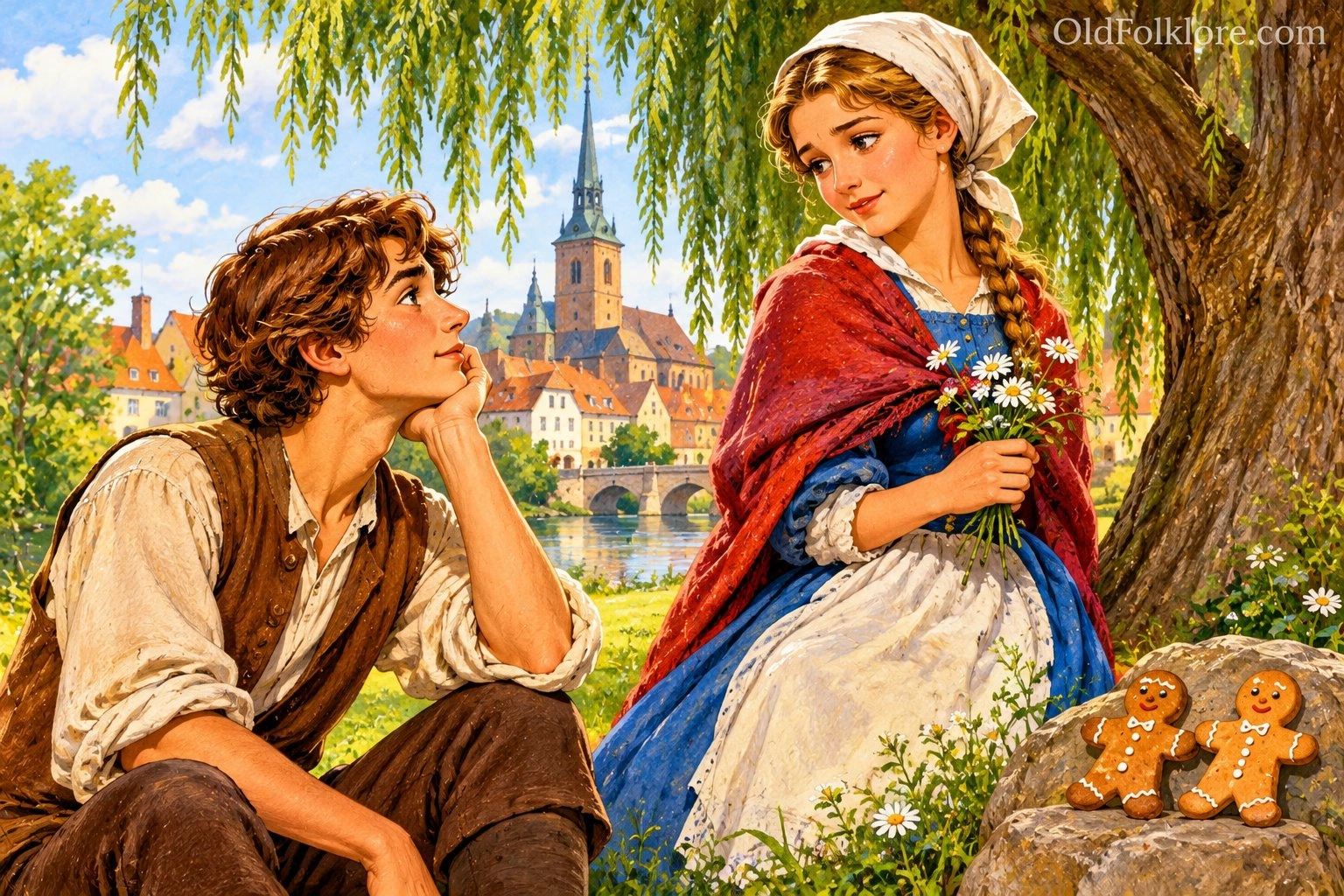
Knud and Joanna lived in neighbouring houses. Their families were poor, but the children had everything they needed in one another’s company. They played among the gooseberry bushes, wandered along the roads, and spent many happy hours beneath an old willow tree.
An elder tree stood in one garden and the willow in the other. The children affectionately regarded them almost as members of their families, giving them the names Elder-mother and Willow-father.
Knud was particularly afraid of water. While other children happily splashed about in the sea, he refused to join them and became the subject of their teasing. However, everything changed when Joanna told him about a dream in which she had been sailing in a boat and Knud had entered the water to reach her, eventually disappearing beneath its surface.
After hearing about the dream, Knud no longer wanted the other children to call him a coward. Although he never actually carried out what he had dreamed of doing, Joanna’s story gave him courage.
Explore more stories from our Hans Christian Andersen Tales collection.
Their parents often visited one another for tea, and the children continued to enjoy their friendship.
One year, during the town fair, a gingerbread seller came to lodge with Knud’s family. He brought the children occasional treats and, more importantly, entertained them with stories.
One evening, he told them about two gingerbread figures displayed in his shop: a little man wearing a hat and a maiden without a bonnet.
The man had a bitter almond embedded in his chest, while the maiden was made entirely of sweet honey-cake.
They had been placed beside one another for so long that they eventually fell in love. Unfortunately, neither spoke of their feelings.
The maiden believed that the man should declare his affection first because he was a man. The man, meanwhile, imagined that he was a poor boy who would buy the maiden with his four pennies and eat her.
Weeks passed, and the gingerbread figures gradually became hard and dry. The maiden’s feelings remained gentle, but eventually she could no longer endure her condition and broke in two.
The man regretted that she had never discovered his love.
The gingerbread seller gave the unbroken man to Knud and the broken maiden to Joanna. The children were so moved by the unfortunate romance that they could not bring themselves to eat either figure.
The following day, they carried the gingerbread lovers to the churchyard, placed them among the ivy growing along the church wall, and told their story to the other children.
Everyone agreed that it was a beautiful story about love.
But when they turned around, they discovered that a mischievous older boy had eaten the broken maiden. The children were heartbroken. Eventually, they ate the remaining gingerbread man too, believing that he should not be left alone.
They never forgot the story.
Separation and the promise of reunion
Knud and Joanna continued to spend their days together, and Joanna’s beautiful singing became well known throughout Kjøge. Even people who barely knew the children stopped to listen whenever she sang.
But their happy childhood could not last.
Joanna’s mother had died, and her father planned to remarry and move to Copenhagen, where he had been offered a better-paying position. The families prepared to separate, and the children wept at the thought of losing one another. Their parents promised to exchange letters at least once a year.
Knud was also growing older. His parents decided that it was time for him to learn a trade, so he became an apprentice to a shoemaker.
Although the children were now apart, Knud never stopped thinking about Joanna.
Near Christmas, a letter arrived from Copenhagen. Joanna’s father explained that the family was doing well and that Joanna’s singing had opened a promising future for her. She had secured a position at a theatre and was already earning money.
She had even sent Knud’s family a dollar for their Christmas celebrations, asking them to drink to her health. At the end of the letter, she had included a special greeting for Knud.
The message filled him with happiness. He realised that his feelings for Joanna had grown into something deeper than childhood friendship. He wanted her to become his wife.
The old gingerbread story returned to his thoughts. He remembered how the two figures had loved one another but never spoken. He was determined not to make the same mistake. Once he had established himself as a shoemaker, he would tell Joanna exactly how he felt.
Knud’s journey to Copenhagen
At last, Knud completed his apprenticeship and became a journeyman shoemaker. He packed his belongings and prepared to travel to Copenhagen, where he had secured employment with a master craftsman.
He was nineteen, and Joanna was seventeen.
Before leaving Kjøge, he had considered buying her a gold ring, but decided that he would find a better one in the capital.
After arriving in Copenhagen, Knud settled into his new workplace and waited eagerly for Sunday, when he could visit Joanna and her family.
When he finally reached their home, he was welcomed warmly by her father and introduced to his stepmother. The house was comfortable, and Joanna now had a beautiful room of her own.
But Knud hardly noticed the expensive furnishings. His attention was fixed entirely on the girl he had travelled so far to see.
Joanna had grown into a beautiful young woman. For a moment, she seemed almost like a stranger, but her surprise quickly turned into delight. She rushed towards him, nearly embracing him, and began asking questions about his parents, their old neighbourhood, and the trees beneath which they had played.
She even remembered their childhood names for the elder and willow trees. Then she brought up the gingerbread figures and their unfortunate love story, laughing as she recalled how the maiden had broken apart.
Knud blushed. To him, the story had become much more than a childhood amusement.
Joanna treated him kindly throughout the evening. She served tea, read aloud, and sang for the family. Her voice was as beautiful as ever, and Knud was so overwhelmed that tears ran down his cheeks.
When he finally prepared to leave, Joanna held his hand and told him that he had a good heart and should always remain the same.
Knud could hardly sleep that night. He was convinced that Joanna’s warmth and affection meant she might return his feelings.
During the following days, he developed a habit of walking past her house after work. Sometimes he could see the light in her window, and on one occasion he recognised the shadow of her face against the curtain.
He looked forward to seeing her again and rehearsed what he would say.
He would explain that he loved her, that he was willing to work hard, and that although he was only a poor shoemaker, he hoped one day to provide a good home for her.
The next Sunday, however, Joanna’s family had an engagement elsewhere. She suggested that he attend the theatre on Wednesday, when she would be performing, and promised to send him a ticket.
Knud accepted eagerly.
On Wednesday evening, he entered a theatre for the first time in his life. There, on the stage, was Joanna, dressed beautifully and performing before a large audience.
In the play, she appeared to be married to another man. Knud understood that it was only acting, and he watched with pride and excitement. The audience applauded enthusiastically, and even the king appeared delighted by her performance.
Knud felt small beside the important people surrounding him, but his admiration for Joanna only grew stronger.
He continued to believe that she loved him. After all, he reasoned, she would never have invited him to watch her perform if she knew it would cause him such pain.
The truth about Joanna’s feelings
The following Sunday, Knud visited Joanna again. This time, she was alone and seemed pleased that he had come.
She had something important to tell him.
She was leaving for France on Friday. If she wished to improve her abilities and become a truly accomplished singer, she explained, she needed to travel there.
Knud was devastated. It felt as though the room had begun to spin around him.
Seeing his distress, Joanna called him an honest and faithful soul. Her words finally gave him the courage to speak.
He confessed that he had loved her for years and wanted her to become his wife.
But Joanna’s expression changed. She became pale and gently released his hand.
She told him that he must not make either of them unhappy. She cared for him deeply, but only as a brother and a trusted friend. She could never become his wife.
Trying to comfort him, she reminded him that Heaven gave people strength to endure many things if they made a sincere effort to do their best.
When her stepmother entered, Joanna quickly explained that Knud was upset because she was leaving. She encouraged him to be brave and reasonable, just as he had been during their childhood beneath the willow tree.
Although her kindness continued, Knud understood that his hopes had been misplaced.
Before they parted, Joanna insisted that he shake hands with his sister. With tears in her eyes, she repeated that he would always be her brother.
Knud left with a broken heart.
Joanna departed for France, while he remained in Copenhagen, struggling to accept what had happened.
A journey through Europe
Knud’s fellow workers noticed his sadness and encouraged him to join them at the dancing halls. He went along, hoping that entertainment might help him forget Joanna.
But even among the cheerful crowds and beautiful young women, he could think of nobody else.
He remembered Joanna’s words about finding strength through goodness and perseverance. When the music began and the dancers moved around him, he suddenly felt uncomfortable, as though he had brought Joanna into a place where she did not belong.
He left the gathering and wandered through the streets until he reached her former home. Her room was dark, and the house seemed empty.
Winter arrived, and the streams froze. When spring returned, Knud felt an overwhelming desire to leave Copenhagen. He wanted to travel far away, somewhere that would not constantly remind him of his lost love.
He packed his belongings and journeyed through Germany.
Eventually, he reached the old city of Nuremberg, whose unusual houses, towers, narrow streets, and decorated rooftops fascinated him. He found work with a good master and began learning German.
For a while, he enjoyed a quieter existence. But the elder bushes growing near his master’s house reminded him of the garden in Kjøge. When spring arrived and their blossoms filled the air with fragrance, memories of Joanna became unbearable.
He changed masters and moved to another part of the city.
His new workplace stood near an old stone bridge and a rushing watermill. Opposite it grew a magnificent willow tree.
The tree reminded him of Willow-father, the old willow beneath which he and Joanna had spent their childhood.
Once again, he found himself surrounded by reminders of home. Eventually, he could no longer remain in Nuremberg.
He continued his journey, carrying his sorrow silently.
The gingerbread figures often returned to his thoughts. He now understood the bitter almond in the man’s chest: it represented the bitterness he himself carried. Joanna, with her gentle nature, was like the sweet honey-cake maiden.
As he travelled farther, he began to see the world differently. The mountains, forests, rivers, and lakes opened before him, and gradually his longing for home became less painful.
He crossed the Alps, travelled through beautiful landscapes, and eventually arrived in Milan.
There, he found employment with an elderly German couple who treated him kindly. He worked diligently, lived quietly, and gradually found some peace.
He particularly enjoyed visiting the magnificent marble cathedral, whose white pinnacles and statues reminded him of snow-covered mountains. From its heights, he could look across the city and the vast Lombard plains.
He had now been away from home for three years.
Joanna appears again
One day, Knud’s elderly master took him to the opera.
The building was magnificent. Its many levels were decorated with beautiful curtains, and elegantly dressed spectators filled the auditorium. The music was grander than anything Knud had experienced in Copenhagen.
Then the curtain rose.
A singer appeared on the stage, dressed in silk and gold, wearing a crown.
It was Joanna.
Knud could hardly believe his eyes. Her voice was more beautiful than ever, and the audience was captivated. She moved towards the front of the stage and smiled, looking in his direction.
He seized his master’s hand and called her name.
His master checked the printed programme and confirmed that the singer was indeed Joanna.
The audience applauded wildly. Flowers and wreaths were thrown towards her, and whenever she left the stage, the spectators demanded that she return.
After the performance, a crowd gathered around her carriage and accompanied it triumphantly through the streets.
Knud joined them, shouting with excitement. He was overjoyed to see her again, even though he was only one face among the many people celebrating her success.
When the carriage reached her home, Joanna stepped out into the light. She smiled and acknowledged the crowd.
Knud stood close enough to look directly into her face. She looked at him too, but she did not recognise him.
A distinguished gentleman wearing a glittering decoration offered her his arm. People whispered that the two were engaged.
In that single moment, Knud understood how completely their lives had separated.
Joanna had become a celebrated woman, admired by important people and surrounded by opportunities. He was still the quiet shoemaker who had loved her since childhood.
He returned home, packed his knapsack, and decided to go back to Kjøge.
He wanted to see the old garden, the elder tree, and Willow-father once more.
The final journey home
The elderly couple who employed Knud begged him not to leave. Winter was approaching, and snow had already begun falling in the mountains.
But he would not change his mind.
He set out towards the north, determined to reach home even if the journey became difficult.
The mountains were cold, and the roads were dangerous. His strength gradually weakened, but he continued walking.
One night, exhausted and ill, he noticed what appeared to be a cluster of stars shining in a valley below him. As he drew closer, he realised that they were the lights of a small town.
He managed to reach a modest inn, where he rested for the night and the following day.
Early on the second morning, a travelling organ player arrived and began playing a familiar tune. The music reminded Knud of home, and he could no longer remain where he was.
He resumed his journey.
For many days, he travelled north with growing urgency. He feared that if he delayed, everyone he had left behind might be gone before he returned.
He spoke to nobody about the sorrow driving him onward. He was a stranger among strangers, carrying a grief that he believed no one could understand.
Eventually, the landscape began to resemble the countryside around Kjøge. The land became flatter, with fields and meadows stretching along the road.
As evening approached, the cold intensified.
Beside the road stood a large willow tree.
Knud recognised something familiar in its branches. Exhausted, he sat beneath it, and soon his head began to droop.
As sleep overcame him, the tree seemed to transform into a great, powerful old man. In his imagination, Willow-father had come searching for his lost son and was carrying him back to the garden of his childhood.
He dreamed that he was once again in Kjøge.
The old willow stood beside the stream, and Joanna was there, looking as beautiful as he remembered her. She wore a golden crown and welcomed him warmly.
Then two familiar figures appeared.
They were the gingerbread man and maiden, but they no longer looked like the fragile cakes of his childhood. They had become almost human.
They thanked Knud for teaching them that love must be spoken aloud. His childhood lesson, they explained, had helped them overcome their silence. They had finally declared their feelings and were now engaged.
Hand in hand, the gingerbread lovers led the way towards the church.
Knud and Joanna followed them, also holding hands.
The church doors opened, and the organ began to play. The gingerbread couple graciously stepped aside, allowing Knud and Joanna to approach the altar first.
Knud knelt before Joanna.
She bent over him, and tears fell from her eyes. They were icy tears, but the ice around her heart seemed to be melting beneath the warmth of his love.
The tears touched his burning cheeks.
Suddenly, Knud awoke.
He was still beneath the willow tree, far from Kjøge. The evening was bitterly cold, and icy hail was falling upon his face.
He realised that the beautiful reunion had been nothing but a dream.
Yet he declared that it had been the happiest hour of his life. He wished he could dream it again, so he closed his eyes and drifted back into sleep.
During the night, heavy snow began to fall. The wind covered him with drifting snow, but Knud did not wake.
The following morning, villagers were making their way to church when they discovered a journeyman sitting beside the road beneath the willow tree.
He was dead.
The cold had taken his life, and the young shoemaker who had spent so many years longing for home would never return to Kjøge.
Explore our complete Historic Folklore & Fairy-Tale Collections archive.
Moral
Love should be expressed honestly rather than hidden behind silence, but genuine affection must also recognise that love cannot be demanded or forced. Sometimes, even the deepest feelings are not returned, and holding on to an impossible dream can bring lasting sorrow.
Knowledge Check
1. Where did Knud and Joanna spend much of their childhood?
They played in neighbouring gardens, particularly beneath an old willow tree beside a stream in Kjøge, Denmark.
2. What was the story of the two gingerbread figures?
A gingerbread man and maiden fell in love but never expressed their feelings. They eventually became hard and dry, and the maiden broke apart before either could fulfil their love.
3. Why did Knud travel to Copenhagen?
He travelled there to work as a journeyman shoemaker and hoped to reunite with Joanna, whom he intended to marry.
4. Why did Joanna reject Knud’s proposal?
She cared for him as a childhood friend and brother but did not share his romantic feelings.
5. What happened when Knud saw Joanna performing in Milan?
He discovered that she had become a celebrated singer. Although he recognised her immediately, she no longer recognised him.
6. What did Knud dream about beneath the willow tree?
He dreamed that he had returned to Kjøge, reunited with Joanna, and married her in the church, while the two gingerbread figures celebrated their own engagement.
7. How does the story end?
Knud falls asleep beneath a willow tree during his journey home and dies from the freezing cold and falling snow.
Source
The retelling is based on Hans Christian Andersen’s Under the Willow Tree, translated into English by H. W. Dulcken, Ph.D. The tale appears in What the Moon Saw: and Other Tales, published in London by George Routledge and Sons in 1866.
Explore More Hans Christian Andersen Tales
- The Snowman: A Danish Folktale by Andersen
- The Farmer Who Traded His Horse for Rotten Apples
- The Beetle Who Wanted Golden Shoes
- The Goblin and the Huckster: Hans Christian Andersen