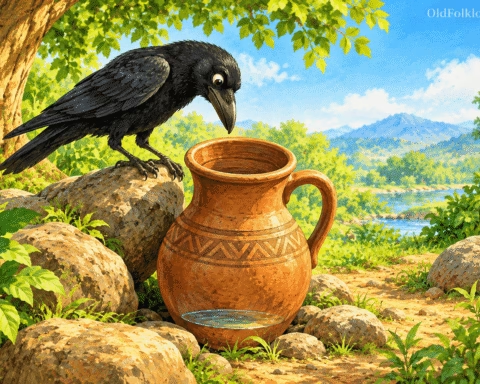
The emperor’s favourite horse wore golden shoes, one on each foot. The beautiful animal had earned this extraordinary reward through bravery. During battle, it had carried the emperor through smoke and flying bullets, fought off advancing enemies and leapt over fallen horses. Above all, it had helped save the emperor’s life and precious crown.
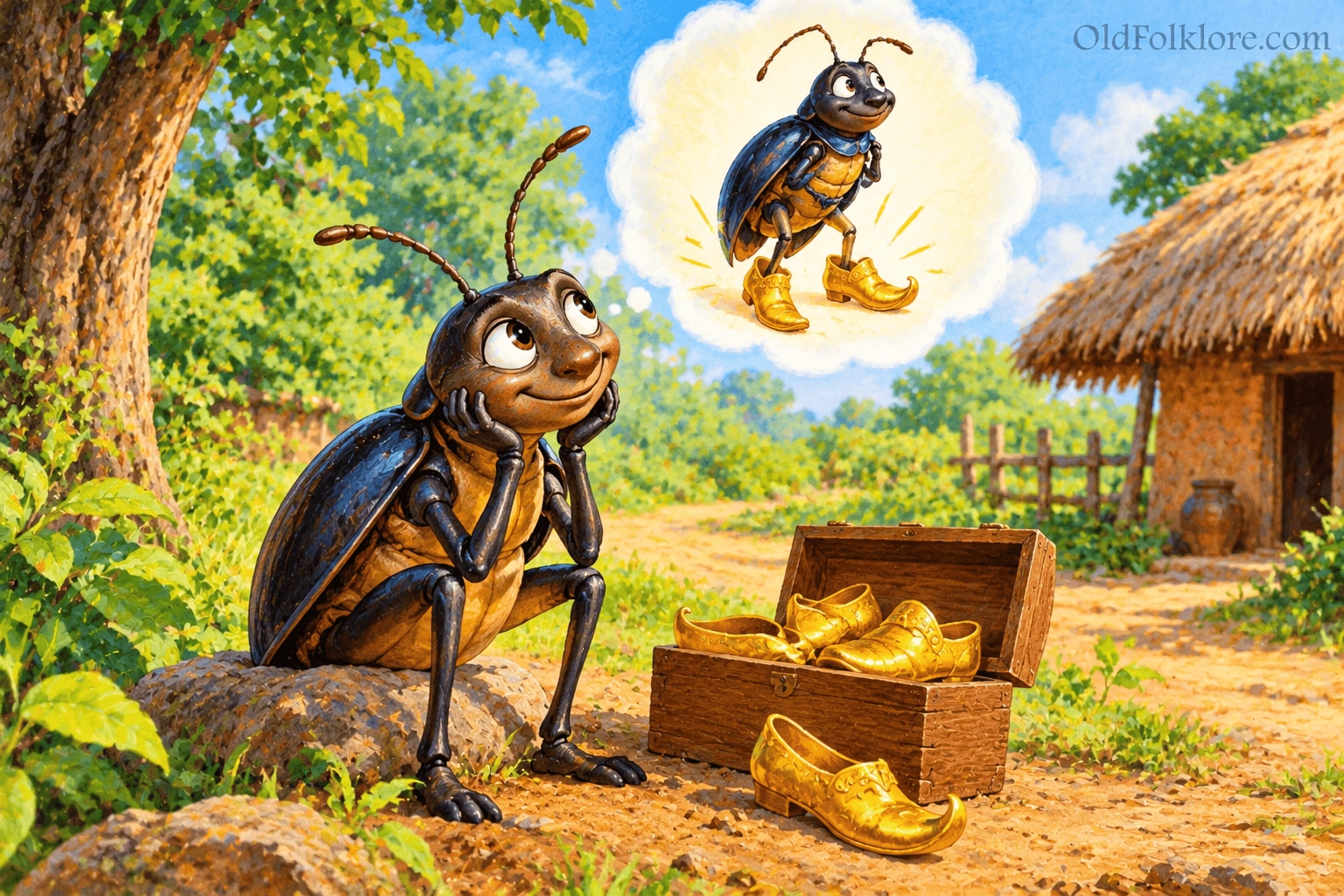
The horse’s golden shoes were a mark of honour, but a beetle living in the imperial stable saw them differently.
As the blacksmith finished his work, the beetle approached and stretched out his slender legs.
“Golden shoes for me, please,” he announced.
Explore more stories from our Hans Christian Andersen Tales collection.
The blacksmith stared at him in disbelief. Surely the beetle could not expect the same treatment as the emperor’s celebrated horse.
“Why shouldn’t I have them?” the beetle demanded. “I belong to the imperial stable, just as the horse does. He receives food, attention and a comfortable place to live. Am I not just as worthy?”
The blacksmith tried to explain that the horse had earned its reward by saving the emperor. The beetle refused to accept the explanation. He decided that the horse’s golden shoes were a personal insult, deliberately intended to humiliate him.
Angry at what he considered an injustice, he announced that he would leave the stable and seek his fortune elsewhere.
The blacksmith dismissed him, and the beetle departed in a huff, convinced that the world had failed to recognise his importance.
A Garden Full of Creatures
The beetle soon arrived in a beautiful garden filled with roses and lavender. Little ladybirds fluttered among the flowers, delighted by the fragrance and colour surrounding them.
“Isn’t this a lovely place?” one asked.
The beetle looked around with contempt. He was accustomed to the imperial stable and considered the garden beneath him. There was not even a dung heap where he might feel properly at home.
Moving on, he encountered a caterpillar basking in the warmth of the sun.
“How wonderful the world is!” the caterpillar exclaimed. “When my time comes, I shall sleep and awaken as a butterfly, with beautiful wings.”
The beetle found this confidence ridiculous. He boasted that he came from the emperor’s stable and even claimed that the emperor’s favourite horse wore golden shoes that had once belonged to him.
He reminded the caterpillar that beetles could already fly and spread his wings to demonstrate.
Then he flew away, irritated by the conversation and still convinced that others failed to appreciate his superior position.
His confidence did not last long.
A heavy rainstorm swept across the garden. The beetle was tossed about on the wet ground, unable to fly or find his way into the earth. Fearing for his life, he remained where he was until the downpour eased.
Eventually, he discovered a piece of linen spread out to bleach and crawled into one of its damp folds. It offered some shelter, although nothing like the warmth of his former home. He spent the day and night there, growing increasingly dissatisfied with the weather.
The following morning, he found two frogs sitting on the linen, thoroughly enjoying the rain.
“What refreshing weather!” one declared.
The other praised the dampness and wondered whether swallows travelling through distant lands ever found a climate as delightful.
The beetle could hardly believe what he was hearing. He told them about the comfortable atmosphere of the emperor’s stable and asked whether there was a suitable place nearby for a creature of his standing.
The frogs did not give him the answer he wanted. After asking his question repeatedly without receiving a satisfactory response, he left in annoyance.
Under the Broken Pottery
Further along, the beetle came upon a broken piece of pottery that sheltered several families of earwigs. The earwigs welcomed company and happily discussed their children.
One mother was delighted that her son had become engaged. She considered his ambition to crawl into a clergyman’s ear an endearing sign of promise. Another proudly described her lively son, who had begun exploring the world almost as soon as he emerged from his egg.
Other mothers joined the conversation, each convinced that her children were exceptionally beautiful and clever.
Their little ones crawled about, playfully pinching the beetle with the small appendages on their tails. Their mothers found the behaviour amusing, but the beetle soon grew bored.
He asked how far he would have to travel to find a greenhouse or hotbed, somewhere more suitable for him.
The earwigs explained that he would have to cross the ditch and venture into the wider world. One mother hoped none of her children would ever travel so far.
The beetle, however, was determined to continue. He left without a formal farewell and reached the ditch, where he encountered several other beetles living comfortably in the rich mud.
They invited him to join them.
The traveller accepted, claiming that his journey had been exhausting. He complained about the rain, the damp linen and the draught beneath the pottery, presenting ordinary discomforts as hardships unworthy of someone of his rank.
When one of the beetles asked whether he had come from a nearby dung heap, the traveller proudly corrected him.
He had come from the emperor’s stable, he declared, and had been born with golden shoes on his feet. He was also travelling on a secret mission, the details of which he could not possibly reveal.
The other beetles accepted his grand claims, and he settled among them.
There he met three young female beetles. Their mother warned him not to encourage her daughters unless he had serious intentions. The traveller assured her of his admiration, praising the young beetles as more beautiful than any creatures he had seen in the royal stable.
His compliments were enough. The beetles celebrated, and an engagement was immediately followed by a wedding.
For two days, the newly married beetle enjoyed himself. By the third day, however, he began thinking about the food he would need to provide for his wife and any future children.
He decided that he had been tricked into a responsibility he had never truly wanted. If others had managed to take advantage of him, he reasoned, he could do the same to them.
He slipped away and did not return.
His wife was left behind, while the other beetles condemned him for abandoning her. Her mother declared that the marriage should be considered over and that her daughter could return to the company of her sisters.
The beetle, meanwhile, continued his journey without looking back.
The Scholars and the Greenhouse
The beetle crossed the ditch on a cabbage leaf and continued his travels. One morning, two scholars discovered him. They picked him up, examined him carefully and discussed his nature. The younger scholar even quoted the Koran before translating the beetle’s name into Latin and explaining what he knew about the insect.
The older scholar suggested taking the beetle home as a specimen. The beetle considered this suggestion insulting. He suddenly spread his now-dry wings and flew away before either man could hold him again.
His flight carried him to a greenhouse, where a partly open window allowed him to enter. He burrowed into the warm earth and immediately felt at home.
When he awoke, he found himself surrounded by magnificent plants, tall palms and brilliant flowers. He admired the abundance, imagining how delicious the plants would become once they decayed. He also wondered whether some of his relatives might live there, though he doubted that many creatures would be worthy of his company.
His thoughts returned to a pleasant dream he had experienced while sleeping. In the dream, the emperor’s horse had died and left him its golden shoes, promising him two more besides. The beetle found the imagined inheritance deeply satisfying.
But his comfort did not last.
The gardener’s young son and a companion entered the greenhouse and spotted him. Eager for amusement, they caught him, wrapped him in a vine leaf and put him into a pocket. The beetle struggled, but the boy pressed him into silence.
The children then carried him to a lake at the end of the garden. There, they placed him inside an old, broken wooden shoe, fixed a little stick upright as a mast and tied the beetle to it with a woollen thread.
His new vessel was launched upon the water.
To the boys, the lake was merely a garden pond. To the beetle, it seemed like an enormous ocean. He was terrified as the little boat drifted farther from the shore, and his situation grew worse when the children were suddenly called away. They ran off, leaving the wooden shoe to float wherever the current carried it.
Bound to the mast, the beetle could not escape.
A fly landed nearby and remarked on the beautiful weather, suggesting that the beetle was enjoying a pleasant outing.
The beetle protested that he was a prisoner.
The fly replied that it was not a prisoner and flew away.
Left alone on the water, the beetle began to reflect bitterly on his experiences. He believed he was the only honest creature in a dishonest world. The blacksmith had refused him golden shoes, the rain had forced him to endure miserable conditions, the other beetles had burdened him with a wife, and now human children had tied him to a wooden shoe and abandoned him to the waves.
Throughout his complaints, one grievance remained greater than all the others: the emperor’s horse still possessed the golden shoes he believed should have been his.
He declared that the world did not deserve to hear his story. Had he received the reward he wanted, he would have remained an ornament of the imperial stable. Instead, he had gone out into the world, suffered countless indignities and lost his rightful place.
He was convinced that everything was over.
The Beetle Returns Home
Fortunately for the beetle, his adventure had not yet reached its end.
A boat carrying several young girls approached the floating wooden shoe. One girl noticed the tiny creature tied to its mast, and the girls brought the boat alongside to rescue him.
A girl took a small pair of scissors from her pocket and carefully cut the thread. Once they reached the shore, she placed the beetle on the grass and encouraged him to crawl or fly away.
Freedom had been restored to him.
The exhausted beetle gathered his strength, spread his wings and flew off. Before long, he found himself passing through an open window into a familiar building.
It was the emperor’s stable.
There stood the emperor’s favourite horse, still wearing its golden shoes. The beetle flew directly towards the animal and settled in its magnificent mane, where he rested after his long journey.
Suddenly, his spirits lifted.
He was sitting on the emperor’s favourite horse, almost as though he were riding it himself. Then he remembered the question the blacksmith had asked him at the beginning of his journey: why had the horse received golden shoes?
At last, the beetle believed he understood.
The horse had received the golden shoes because of him.
This explanation made perfect sense to the beetle. His pride was restored, and all his earlier bitterness disappeared. He declared that travelling broadened the mind and decided that the world was not so bad after all, provided one knew how to take things as they came.
The sunlight streamed into the stable, brightening the familiar surroundings.
The beetle had returned to the very place he had abandoned, but his opinion of himself had not changed. Rather than reconsidering his demands, he had found a new way to interpret his experiences so that he could remain satisfied with his own importance.
And there, beside the emperor’s horse, the beetle was happy once more.
Explore our complete Historic Folklore & Fairy-Tale Collections archive.
Moral
Pride can prevent us from recognising the difference between what we deserve and what we merely desire. True worth is not established by demanding the same rewards as others, and experience does not necessarily bring wisdom when we refuse to question our own assumptions.
The beetle’s journey also reminds us that people can explain away their disappointments rather than learn from them. Returning to a familiar place may restore comfort, but comfort alone does not mean that we have changed.
Knowledge Check
1. Why did the emperor’s horse receive golden shoes?
The horse had served the emperor bravely in battle and helped save his life and crown.
2. Why did the beetle leave the imperial stable?
He believed he deserved golden shoes too and interpreted the blacksmith’s refusal as a personal insult.
3. What happened when the beetle married another beetle?
After a few days, he abandoned his wife rather than accepting the responsibility of providing for her.
4. How was the beetle rescued from the lake?
A group of young girls found him tied to a wooden shoe, freed him by cutting the thread and placed him on the grass.
5. Did the beetle learn humility from his travels?
No. He returned to the stable convinced that the horse had received its golden shoes because of him. His experiences changed his circumstances but did not correct his vanity.
Source
The 1930 collection Hans Andersen Forty-Two Stories, translated from the Danish by M. R. James. Faded Page provides a digital transcription of “The Beetle,” based on the 1953 Faber and Faber edition.
Explore More Hans Christian Andersen Tales