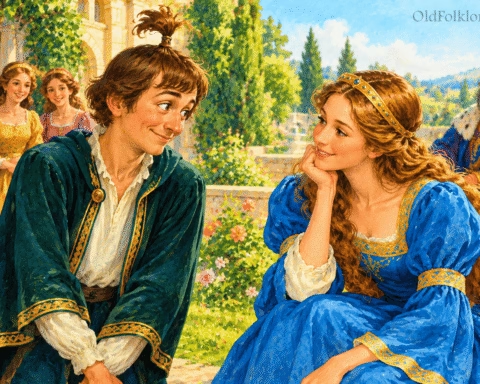
Jack the Dullard is a humorous tale about intelligence, confidence and the difference between being educated and knowing how to use one’s words. While two brothers spend their time preparing impressive speeches for a royal marriage contest, their younger brother appears to have little knowledge or ambition. His family considers him foolish, and even his father refuses to provide him with a proper horse for the journey.
However, Jack is not discouraged. He sets out on a billy-goat, carrying three unusual objects he has collected along the road: a dead crow, an old wooden shoe and some wet clay. His brothers laugh at him, but these strange possessions eventually become the foundation of his success.
The princess is looking for a husband who can arrange his words better than all the other suitors. Jack’s brothers believe their education and carefully prepared speeches will make them victorious. Yet when they stand before the princess, their confidence disappears. Jack, on the other hand, turns ordinary objects into unexpected answers and proves that cleverness can take many forms.
The Princess Announces a Marriage Contest
Far inside the country stood an old baronial hall where an elderly proprietor lived with his sons. Two of the young men considered themselves exceptionally clever. They believed they possessed the education and speaking ability required to win the hand of the King’s daughter.
The princess had made a public announcement that she would choose as her husband the young man who could arrange his words most successfully. This meant that every suitor would have to demonstrate his ability to speak intelligently and respond to her questions.
The two brothers immediately decided to compete. They spent a whole week preparing themselves for the occasion, which was the longest preparation time allowed.
The elder brother had memorised the entire Latin dictionary. He had also learned three years’ worth of the daily newspaper from a small town. His memory was so impressive that he could repeat the information forwards or backwards.
The other brother had studied corporation laws thoroughly. He believed that his knowledge of legal and public affairs would allow him to speak confidently about matters of government and take part in important discussions.
He also possessed a practical skill. He could embroider braces with roses, flowers and decorative patterns, something he considered another sign of his ability.
Explore more stories from our Hans Christian Andersen Tales collection
Both brothers were convinced that the princess would choose them. Their confidence was so great that neither considered the possibility of failure.
The Father Provides Horses
Their elderly father was pleased with their ambition and decided to provide each of them with a fine horse.
The brother who had memorised the dictionary and newspapers received a black horse. The one who knew the corporation laws was given a milk-white horse.
Before setting out, they rubbed the corners of their mouths with fish-oil. They believed this would make their speech smooth and their words more pleasant.
The servants gathered in the courtyard to watch the two young men mount their horses. Just then, their younger brother appeared.
Although the proprietor had three sons, the youngest was rarely regarded as an equal by his brothers. He was not as educated as they were and was generally known as Jack the Dullard.
Seeing his brothers dressed in their finest clothes and preparing to travel, Jack asked where they were going.
They explained that they were travelling to the King’s court to compete for the princess’s hand in marriage.
Jack was immediately interested.
He announced that he would join them, too. His brothers burst into laughter because they could not imagine the princess choosing someone like him.
Jack Chooses a Billy-Goat
Jack went to his father and asked for a horse.
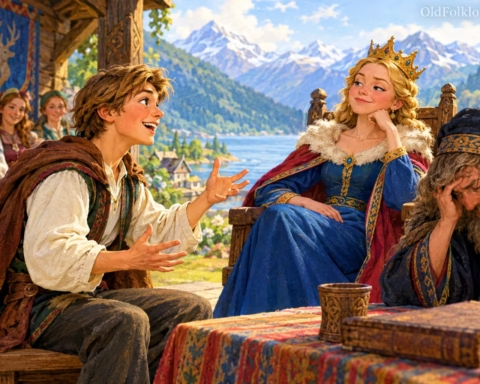
He explained that he felt strongly inclined to marry and intended to compete for the princess’s hand. He added confidently that if she accepted him, he would be happy, but if she refused, he would still find a way to make her his wife.
His father dismissed the idea as nonsense. He argued that Jack did not know how to speak properly or arrange his words. In his opinion, his two elder sons were much better prepared for the challenge.
The father refused to give him a horse.
Jack was not discouraged. He announced that he would use his own billy-goat instead, since it was capable of carrying him.
He mounted the animal, pressed his heels against its sides and rode down the high street at great speed.
He shouted and sang as he travelled, making his presence known to everyone around him.
His brothers were already riding ahead. Unlike Jack, they were not singing or making jokes. They were concentrating on the speeches they had prepared and thinking about how best to impress the princess.
Jack Collects Three Unusual Gifts
As Jack continued along the road, he called out to his brothers and showed them something he had found.
It was a dead crow.
His brothers were puzzled and asked what he intended to do with such an object.
Jack explained that he planned to give it to the princess.
The brothers laughed at him and continued riding.
A little farther along the road, Jack discovered another object. This time, it was an old wooden shoe with its upper part missing.
He called to his brothers again and proudly displayed his discovery.
They mocked him, asking whether he intended to present the broken shoe to the princess as well.
Jack confidently replied that he did.
The brothers rode farther ahead, convinced that their younger brother was making himself ridiculous.
However, Jack soon called to them for a third time. He had discovered something else that he considered valuable.
This time, it was ordinary clay taken from a ditch.
His brothers looked at it and laughed. They could not understand why he would collect something so common and carry it in his pocket.
Jack disagreed. He admired the wet clay and explained that it was of excellent quality because it ran easily through his fingers.
He filled his pocket with it and continued his journey.
The two elder brothers rode quickly towards the town, leaving Jack behind. They eventually arrived at the town gate about an hour before him.
The Suitors Gather at the Palace
At the town gate, each suitor received a number. They were arranged in rows, with six men standing in each row.
The arrangement was deliberately close, leaving them little room to move their arms. The organisers believed that this would prevent the suitors from fighting over their positions.
Large crowds gathered around the castle. People from the surrounding country wanted to watch the princess receive the men who hoped to marry her.
The suitors entered the hall one after another.
Although many had spent considerable time preparing their speeches, the sight of the princess and the royal surroundings made them nervous. Their confidence disappeared as soon as they stood before her.
The princess listened to each man and quickly decided whether his words were good enough. Whenever a suitor failed to impress her, she dismissed him from the hall.
The contest was proving more difficult than the young men had imagined.
The First Brother Loses His Words
At last, the turn came for the brother who had memorised the Latin dictionary and three years of newspapers.
He entered the hall expecting his education to make a strong impression.
However, the surroundings frightened him. The wooden boards seemed to echo beneath his feet, while the mirrored ceiling reflected his image upside down.
Near the window stood three clerks and a head clerk. They were writing down every word spoken by the suitors so that the conversations could be printed in the newspapers and sold to the public.
The room was also extremely hot because a large fire had been made in the stove.
The first brother became uncomfortable and remarked that the room was dreadfully hot.
The princess replied that her father was roasting young pullets that day.
The young man had not prepared for such an ordinary response. Instead of producing a clever remark, he could only repeat a foolish sound like a bleating lamb.
The princess immediately declared that he was of no use and ordered him out of the hall.
The brother who had memorised so much information had failed to find a suitable answer when he needed one.
The Second Brother Also Fails
The next suitor was Jack’s other elder brother.
He entered the hall believing that his knowledge of corporation laws and public affairs would help him succeed.
Like the first brother, he began by commenting on the heat in the room.
The princess gave him the same answer. She explained that they were roasting young pullets.
The young man attempted to respond, but his words became confused. He began stammering and could not complete his sentence.
The clerks recorded his unfinished words, making his failure even more embarrassing.
The princess dismissed him as well.
Both brothers who had spent the week preparing their speeches had failed to impress her. Their education had not helped them respond naturally to the situation.
Jack the Dullard Enters the Hall
At last, Jack’s turn arrived.
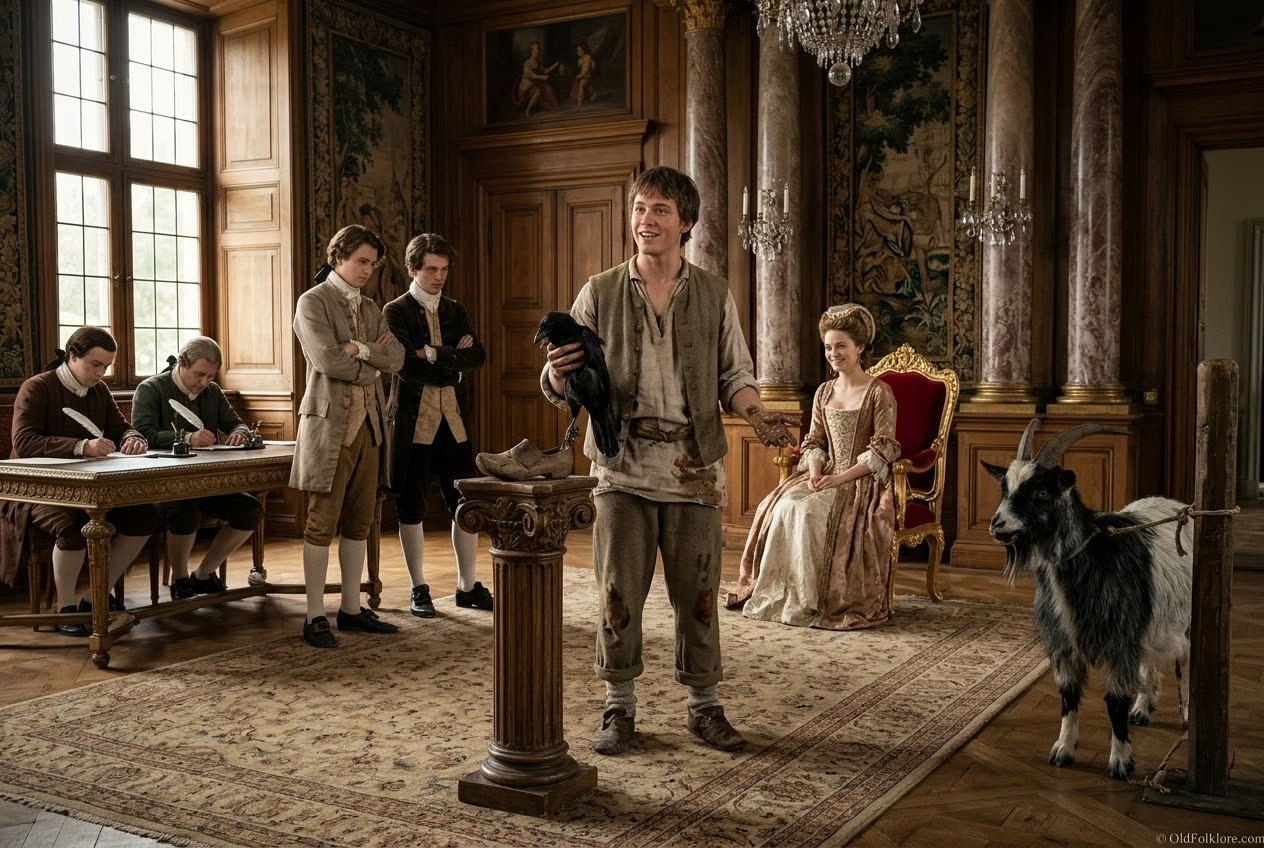
Unlike the other suitors, he did not enter the hall on a fine horse. He rode in on his billy-goat.
The unusual sight attracted attention, but Jack did not appear embarrassed.
He looked around the room and immediately remarked that it was unbearably hot.
The princess replied that the heat came from the fire because she was roasting young pullets.
Jack was delighted by her answer.
He explained that this was fortunate because he had brought a crow that she could roast at the same time.
The princess found his response amusing. She then asked whether he had anything in which to roast the crow, since she had neither a pot nor a pan available.
Jack confidently produced the old wooden shoe he had collected along the road.
He explained that it was a cooking utensil with a tin handle and placed the dead crow inside it.
The princess was entertained by his strange solution. She then asked what they would use for sauce.
Jack immediately reached into his pocket and brought out the wet clay.
He explained that he had plenty of it and could afford to throw some away.
The princess liked his answers. Unlike his brothers, Jack had responded to her questions with confidence and humour.
Jack Wins the Princess’s Hand
The princess declared that Jack had proved himself capable of answering questions and finding something to say for himself.
She announced that he would become her husband.
However, she pointed towards the clerks and explained that every word spoken in the hall was being recorded. The conversations would be published in the newspapers the following day.
She also drew attention to the head clerk, whom she described as the least capable of the group because he could not understand anything properly.
The princess intended this comment to frighten Jack.
Instead, he treated it as another opportunity to display his humour.
He announced that if those men were the clerks, he would give the best part of his collection to the head clerk.
He then emptied his pockets and threw the wet clay directly into the head clerk’s face.
The princess admired his action. She remarked that it had been cleverly done and admitted that she could not have thought of doing something similar herself, although she hoped to learn.
Jack had succeeded where his brothers had failed.
He was declared the winner of the contest, made a king, received a crown and married the princess.
The Corporation of Printers Gets the Last Word
The tale concludes with a humorous remark about the report of Jack’s success.
The account explains that the story came from the printing press of the head clerk and the corporation of printers.
However, the narrator adds that these printers are not to be trusted at all.
This final comment gives the story an additional comic touch. The very people who had been recording the contest and preparing to publish its details are treated as unreliable reporters.
Jack’s victory therefore ends not only with a marriage and a crown but also with a joke about those who claim to record events accurately.
Explore our complete Historic Folklore & Fairy-Tale Collections archive.
Moral Lessons
The story reminds readers that formal education and memorised information do not automatically make someone wise or successful. Jack’s brothers possessed impressive knowledge, but they struggled when they needed to respond naturally. Jack succeeded because he remained confident, observant and quick-thinking.
It also challenges the habit of judging people by their appearance, social position or reputation. Jack was dismissed as a dullard because he lacked the education of his brothers, yet he proved himself capable in a situation where their preparation failed. His story encourages readers to recognise that intelligence can appear in unexpected forms.
Knowledge Check
1. Why did the King’s daughter invite suitors to compete for her hand?
She had announced that she would marry the young man who could arrange his words best.
2. What made Jack’s two elder brothers confident about winning the contest?
One had memorised the Latin dictionary and three years of newspapers, while the other had studied corporation laws and possessed embroidery skills.
3. Why did Jack travel on a billy-goat instead of a horse?
His father refused to provide him with a horse because he believed Jack was not clever enough to compete for the princess.
4. What three objects did Jack collect on the road?
He collected a dead crow, an old wooden shoe and wet clay from a ditch.
5. How did Jack use the three objects to impress the princess?
He offered the crow for roasting, used the wooden shoe as a cooking utensil and presented the clay as sauce.
6. What happened to Jack at the end of the story?
The princess chose him as her husband. He was made a king, received a crown and married her.
Source
This retelling is based on “Jack the Dullard: An Old Story Told Anew,” by Hans Christian Andersen.
Explore More Hans Christian Andersen Tales
- The Snowman: A Danish Folktale by Andersen
- The Farmer Who Traded His Horse for Rotten Apples
- The Beetle Who Wanted Golden Shoes
- The Goblin and the Huckster: Hans Christian Andersen
- The Story of the Year: A Tale of the Four Seasons